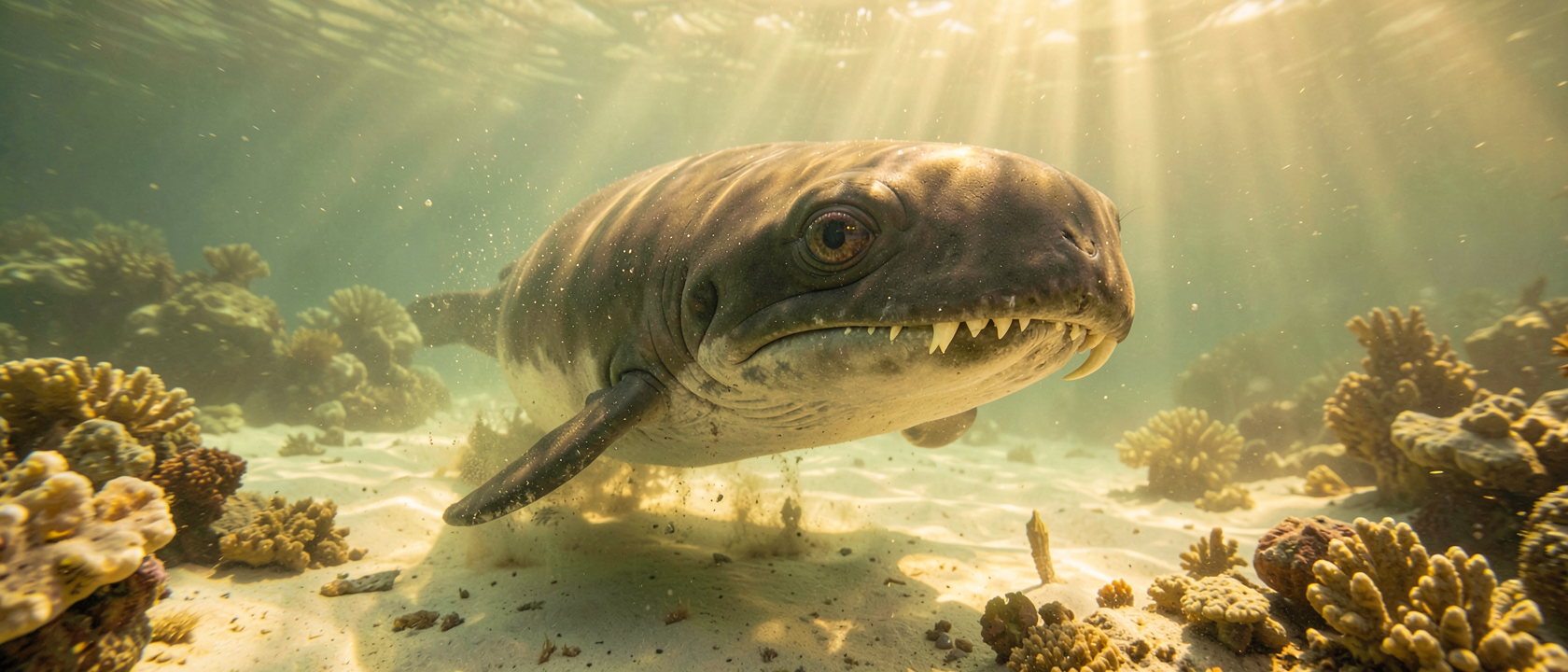
The Baleen Whale That Hunted Like a Shark
Twenty-six million years ago, off the coast of what is now southeastern Australia, a compact whale measuring approximately 7 feet (2.1 meters) long was hunting individual prey with sharp slicing teeth and large, forward-facing eyes. Its closest modern relatives are blue whales and humpbacks. That is not a contradiction in terms. That is what the baleen whale lineage actually looked like before it became the thing we now campaign to protect.
The species, Janjucetus dullardi, was described on August 12, 2025, in the Zoological Journal of the Linnean Society. Lead author Ruairidh Duncan, a paleontology doctoral student at Museums Victoria Research Institute and Monash University, and senior author Erich Fitzgerald, senior curator of vertebrate paleontology at Museums Victoria Research Institute, worked with four co-authors on the analysis. Their specimen, a single juvenile or subadult recovered from the Jan Juc Marl geological formation at Half Moon Bay near Melbourne, estimated to be between 24 and 28 million years old, is described, without hedging, as “a shark-like version of a baleen whale.” The teeth show virtually no wear: these are not vestigial structures on an aging animal but a juvenile’s sharp, functional set, exactly as designed.
What the Skull Actually Says
Duncan and Fitzgerald’s team analyzed the holotype skull, catalogued as NMV P256471 at Museums Victoria, using photography and microCT scanning, which uses X-ray beams to produce a detailed three-dimensional image of internal fossil structure without damaging the specimen. Three anatomical features converge on the same conclusion.
First, the eye orbits are proportionally enormous, forward-facing, built for close-range tracking, the geometry of a leopard seal rather than a bowhead whale. In living mysticetes (the formal group containing all baleen whales), the skull is architecturally committed to filter-feeding; Janjucetus dullardi has the kind of eye sockets associated with animals that lock visually onto individual prey. Second, the dentition is heterodont (teeth varying in shape along the jaw) and built for slicing and stabbing, with no baleen structure present. Third, the researchers interpret the compact body plan as speed-adapted, configured for pursuit predation.
The unworn teeth in a juvenile close off the usual escape route for a skeptic. In some earlier fossil mysticetes, worn or ambiguous dental structures were interpreted as transitional filtering tools. A young animal’s unworn teeth cannot carry that reading.
An Evolutionary Cradle on the Edge of the World
Janjucetus dullardi belongs to the family Mammalodontidae, small-bodied toothed ancient whales known only from the Chattian stage of the Late Oligocene (roughly 33.9 to 23 million years ago) in southeastern Australia and New Zealand. The Jan Juc Marl has now produced three distinct mammalodontid species, and Fitzgerald frames the region explicitly as an evolutionary “cradle” of unusual whale diversity, one data point in a genuine radiation, not a curiosity.
The early mysticete lineage, before it locked into the body plan we now associate with it, was actively diversifying in warm, shallow seas at the edge of what would become the Southern Ocean. Filter-feeding came later, a derived condition the lineage evolved toward under specific selection pressure. The predatory, visually driven, fast-bodied whale came first. The paper also identifies a pedomorphosis signal (retention of juvenile traits in adult form) when the two known Janjucetus holotypes are compared, suggesting some features previously considered defining for the genus were likely developmental artifacts rather than species-specific characters.
The Gentle Giant Was Not the Default
Janjucetus dullardi, together with its sister species Janjucetus hunderi (described by Fitzgerald in a 2006 paper in the Proceedings of the Royal Society B), kills the assumption that the baleen whale lineage was always peaceful and gentle. Mammalodontids are classified within Mysticeti on the basis of skull anatomy, they are, by the evidence of their bones, early baleen whales. They were also raptorial predators with no baleen at all. Filter-feeding is an evolutionary achievement of the lineage, not its point of origin. The gentle giant is the surprise ending of the story, not the premise.
Named for the Man Who Stopped to Look
In June 2019, Ross Dullard, a school principal with no professional background in paleontology, was walking along Half Moon Bay near Jan Juc, Victoria, when he noticed skull fragments eroding from a wave-cut rock face. He recognized their significance, prepared the specimen, and donated it to Museums Victoria, where it was catalogued as NMV P256471. Six years later, that fragment became the holotype of a new species bearing his name. Fitzgerald’s response: “world-changing fossils can be found in your own backyard.”
What the Fossil Cannot Tell Us Yet
The holotype is a juvenile or subadult; no adult specimen of Janjucetus dullardi is known, so the full-grown animal’s size and dental development remain unobserved. The paper notes that NMV P256471 is the first mammalodontid specimen to preserve both teeth and inner ear structures together, though what those structures reveal about hearing and navigation has not yet been published. Prey is inferred from skull morphology alone, no stomach contents or direct evidence exist, and the cause of mammalodontid extinction remains unknown.
Duncan and Fitzgerald’s team note that the Torquay Basin holds a large number of isolated cetacean teeth and ear bones that remain undescribed, and further mammalodontid species are explicitly anticipated. The Jan Juc Marl is still being read, one eroding cliff face at a time, by whoever happens to be walking past and paying attention.