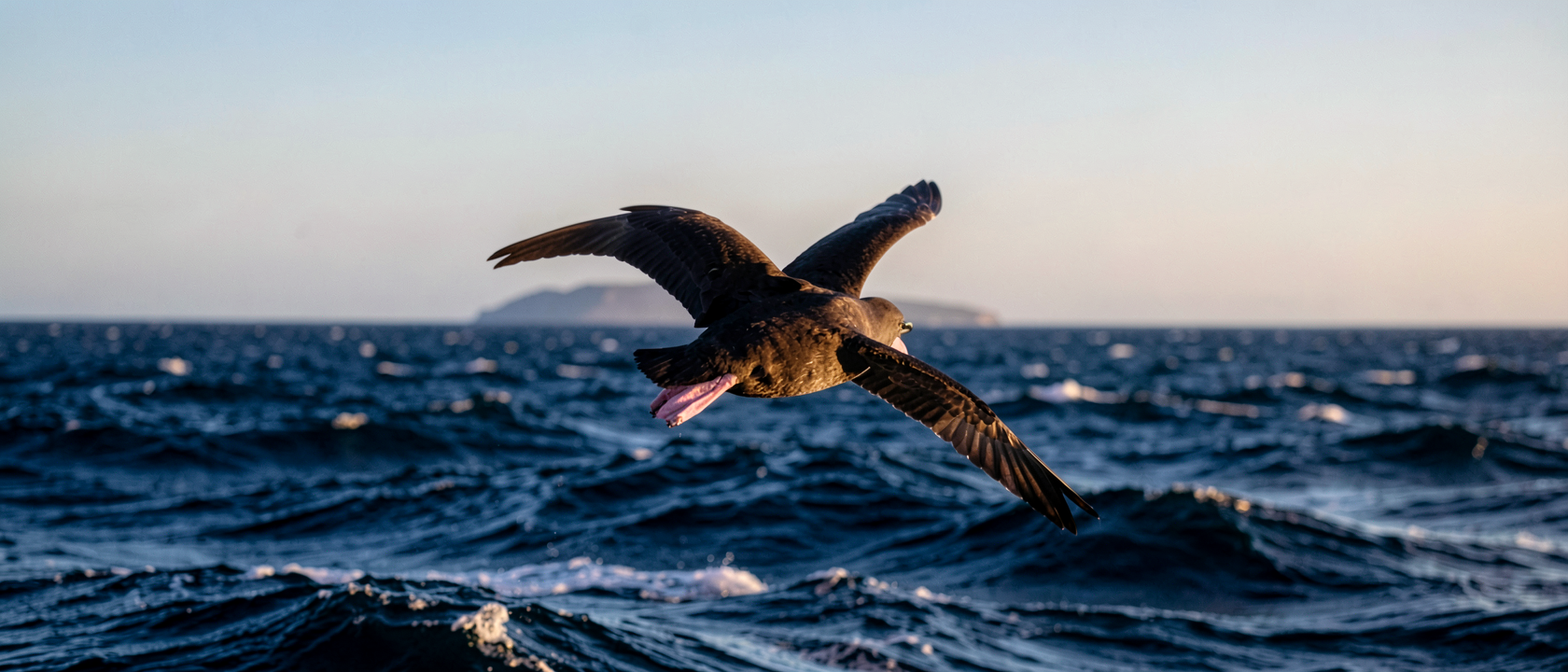
Half a gram. Gone.
A sable shearwater chick on Lord Howe Island, weighing roughly 1.4 lbs (620 g) at fledging, can have its entire reproductive future erased by half a gram of plastic. A 15-year study of the Ned’s Beach colony, published in the Proceedings of the National Academy of Sciences on August 17, 2026, by Jennifer L. Lavers, Hannah Worthington, and Alexander L. Bond of the Natural History Museum in London, found that ingesting just 0.5 grams of plastic as a chick reduces the probability of returning to Lord Howe Island to breed as an adult by 12%.
Between 10 and 20 percent of fledglings on Lord Howe Island carry more than 1 gram of ingested plastic in any given year. Across the full 15 years of the study, 10 percent of birds exceeded 3.6 grams. Chicks carrying more than 5 grams are, in the dataset, essentially absent from the colony’s future. The Lord Howe colony of around 22,000 breeding pairs is already in measurable decline. This is the first study to demonstrate, using longitudinal field data, that plastic pollution reshapes a wild animal population at the demographic level, not merely injuring or killing individual birds.
Parent brings home lunch. Lunch is a bottle cap.
Adult sable shearwaters hunt across the open Indo-Pacific and return to the nest to regurgitate food directly into their chick’s mouth. Floating plastic debris, seen from above on the water’s surface, is not reliably distinguishable from prey. Pellets, fragments, and packaging shards travel the same route as fish: into a chick still sitting in its burrow.
What accumulates there causes two documented forms of damage. The first is plasticosis, a fibrotic disease first formally described in 2023 by Charlton-Howard, Bond, Rivers-Auty, and Lavers in the Journal of Hazardous Materials, based on examination of 30 flesh-footed shearwater fledglings from Lord Howe Island. Plastic ingestion disrupts the tubular glands in the proventriculus, triggering overproduction of scar tissue, reducing digestive fluid output, and at high exposure levels eliminating the glands’ tissue structure entirely. The second form is neurological. A 2025 paper in Science Advances by de Jersey et al. found that plastic exposure in sable shearwater fledglings aged 80 to 90 days generated proteomic signals comparable to those associated with Alzheimer’s and Parkinson’s disease. The PNAS 2026 study additionally found that the birds’ complex song repertoire, used by adults to locate their own nesting burrows and chicks, is impaired in plastic-exposed individuals.
The chick fledges carrying all of this damage already done, then spends several years at sea before the moment it should return to breed and does not.
The colony looks fine. It isn’t.
Sable shearwaters are long-lived birds. Adults that bred successfully years ago continue to breed, and the colony headcount does not immediately reflect what is missing: younger cohorts that should be arriving for their first breeding season and are not. A cohort harmed in the nest by plastic would be expected to recruit into the breeding population years later. When it fails to appear, the absence is distributed across time and the open ocean, where no one is counting.
Lavers, Worthington, and Bond describe chicks carrying more than 2 grams of plastic as “the walking dead.” These birds fledge successfully and are alive when they leave the island. They are absent from the data when the colony is surveyed in subsequent years. The decline at Lord Howe is currently gradual precisely because long-lived adults keep the headcount stable while the recruitment pipeline empties behind them. The researchers warn that the curve could steepen sharply once multiple burdened cohorts fail to appear simultaneously, which is structurally where the colony is heading.
“It harms individuals, not populations.” Fifteen years of data disagree.
The assumption that plastic pollution causes harm at the level of individual animals but does not produce measurable population-level change has been widespread in both science and conservation policy. Demonstrating population-level effects requires years of data on individually identified animals in a single colony, which is expensive and rare. Dr. Bond explicitly names the assumption and states it is “simply not true.” The PNAS 2026 study is the first to contradict it with 15 years of mark-recapture data, in which individually measured chicks were followed to determine their probability of surviving and returning to breed as adults.
The study also identifies a structural blind spot in standard monitoring, which measures fledgling success rates and adult survival, neither of which captures recruitment failure accumulating invisibly across years. The authors flag that other seabird species experiencing comparable plastic burdens may be undergoing exactly this kind of collapse without any existing monitoring program positioned to detect it.
Three things the data cannot yet tell you.
The biological path from ingested plastic to death at sea has not been traced end to end. Plasticosis, neurodegenerative protein signals, song impairment, and nutritional compromise from scarred digestive tissue are all documented in exposed chicks. Which of those, alone or in combination, is the proximate cause of failure to survive multi-year ocean life is unresolved.
Whether population-level collapse is occurring in other seabird species that are also documented plastic ingesters is unknown. The PNAS 2026 authors state directly that most species have not been studied with the depth or duration applied to the Lord Howe colony. Silence elsewhere is not evidence of safety.
No minimum threshold has been identified below which plastic ingestion becomes negligible. The 0.5-gram figure produces a 12% reduction in return probability, and the data identify no floor below which harm disappears. If plastic pollution can reshape a wild seabird population at Lord Howe Island, and most other colonies are monitored with tools that cannot see this signal, the Lord Howe finding may be less an isolated result than the first clear measurement of something already underway across dozens of species, undetected.