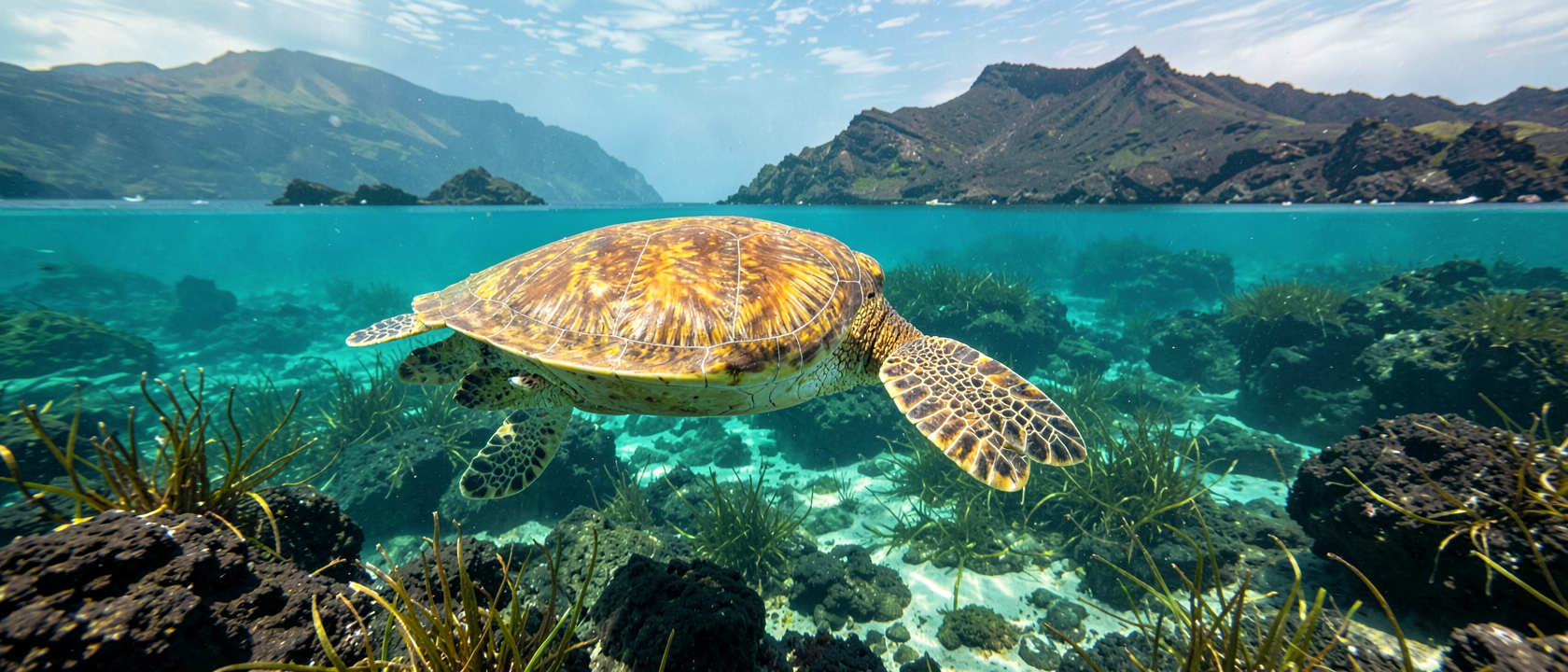
Nine Turtles. Three Years. Nobody Left.
All nine satellite-tagged yellow-morph green sea turtles (Chelonia mydas) tracked inside the Galápagos Marine Reserve stayed there for the entire study, not one crossed into open ocean, despite the expectation that at least some would eventually head west across the Pacific. That finding comes from a study published August 27, 2026, in Frontiers in Amphibian and Reptile Science, led by Dr. John W. Rowe of Alma College and co-authored by Dr. Juan Pablo Muñoz Pérez of Universidad San Francisco de Quito, along with six additional researchers. The nine adults, seven males and two females, were caught by hand in shallow coastal waters off four Galápagos islands in 2015, fitted with Argos satellite transmitter tags, and tracked for between 45 and 418 days each across a three-year observation window.
Their average individual home range worked out to roughly 578 square miles (1,498 square kilometers), though the variation between individuals was enormous, with a standard error of 2,913.9 km². Five of the nine spent the bulk of their tracked time in the waters around a single island.
Shallow Water, Personal Patch
Rather than heading into open ocean, the nine yellow-morph turtles stayed close to shore. Occasional offshore excursions reached up to about 15.5 miles (25 kilometers), but the animals consistently returned inshore. Inter-island movement, when it happened at all, was seasonal: the four individuals who crossed between islands did so only during the cooler months of April through October.
Rowe and the team interpret this not as a compressed version of typical green sea turtle migration but as something structurally different, individual foraging territory use. Adult green sea turtles are the only one of the seven living sea turtle species that are predominantly vegetarian, feeding on seagrasses and algae. The data suggest each animal worked its own patch of that resource within the reserve. That distinction matters: if behavior is organized at the level of the individual rather than the population, it changes what the reserve is actually protecting.
The Textbook Is Wrong (For These Turtles)
Green sea turtles are among the most cited examples of long-distance animal navigation, crossing entire ocean basins guided by Earth’s magnetic field, oceanic currents, and the sun. That reputation is earned. The 2026 paper does not overturn it globally. What it does is follow nine specific yellow-morph individuals by satellite for up to 418 days each in the Galápagos, and find that not one departed, the most wide-ranging of the nine never cleared the outer boundary of the reserve.
The assumption this study contradicts is not that sea turtles migrate. It is that this population, in this location, follows the same template as the rest of the species. Nine independent tracking records showing the same pattern over three years call for an explanation, not a dismissal.
What Evolution Might Be Keeping Around
Yellow-morph and black-morph green turtles are genetically distinct forms of the same species. The Galápagos is the only place on Earth where both coexist and share feeding grounds. Yellow morphs grow faster than black morphs when young, which points toward physiological differences that remain uncharacterized.
Rowe and the team frame the observed site fidelity as a possible alternative life-history strategy rather than a failure to migrate. The Galápagos Marine Reserve covers 76,448 square miles (198,000 square kilometers) of formally protected water with reliable food resources. If the energetic cost and navigational risk of an open-ocean crossing can be avoided by settling into a well-stocked local reserve, staying may be the better trade-off for an animal whose physiology already runs on a different clock than its black-morph neighbor. The authors present this as an interpretation consistent with the data, not a demonstrated mechanism, but the faster juvenile growth of yellow morphs gives the interpretation something real to anchor to.
What Three Years Cannot Tell You
The two females are the loose thread. Female yellow-morph green turtles are not known to lay eggs on Galápagos beaches; the working assumption is that they eventually travel to natal beaches somewhere in the western Indo-Pacific. No such departure appeared in either female’s tracking data. Rowe and the team acknowledge explicitly that three years may not be long enough to capture a periodic long-distance event: a female that nests every two to five or more years could have been between nesting seasons for the entire study window, and a transmitter tag may have dropped off before any departure occurred. Whether a longer tracking window would reveal a nesting-season journey, and whether what looks like individual foraging strategy is heritable or simply a response to local conditions, remain open questions.
Ainoa, the Explorer Who Never Left the Garden
Among the nine tagged turtles, one named Ainoa, originally caught off San Cristóbal, logged the most ambitious itinerary: island-hopping to Santa Cruz and then on to Isabela. Pull the frame back to the full 76,448 square miles of the Galápagos Marine Reserve, and Ainoa never came close to its outer edge. The most well-traveled turtle in the cohort, and she still barely left the front yard.