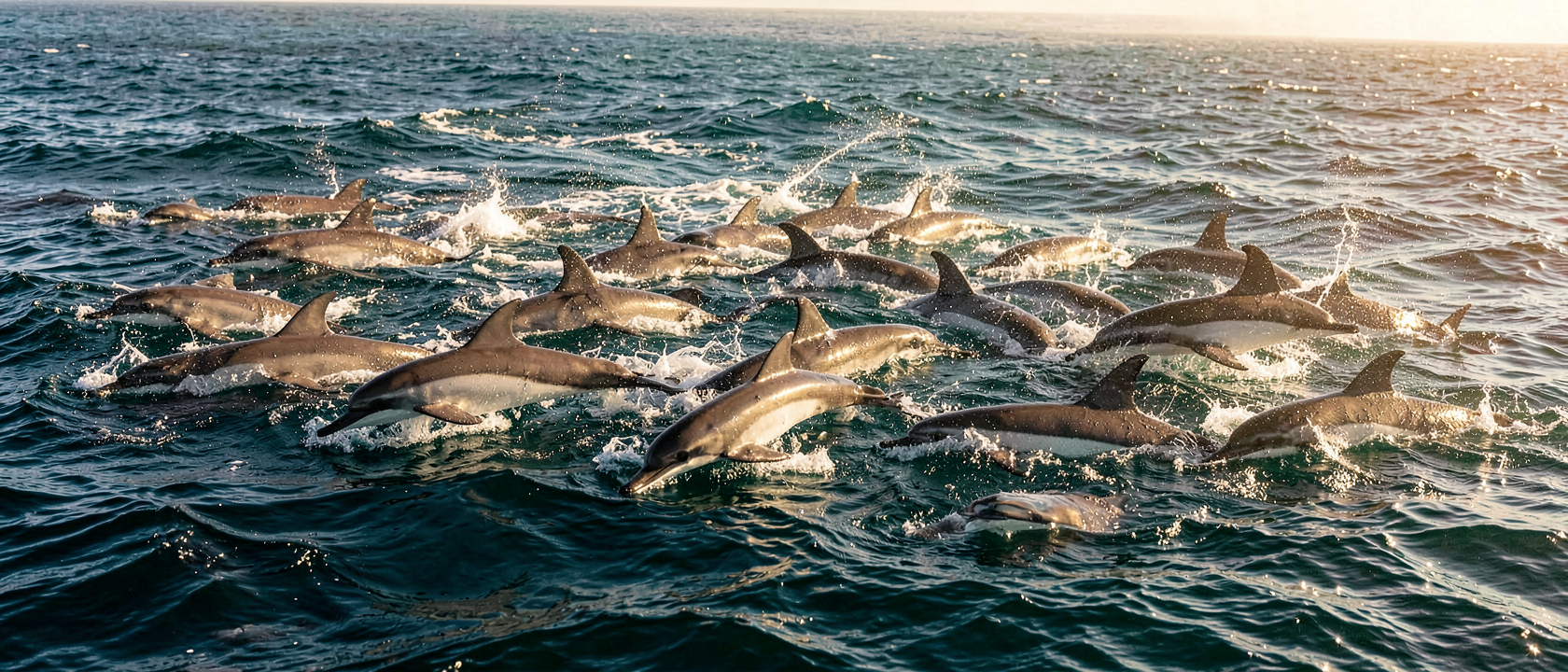
The navy’s sonar wasn’t loud enough to be legal trouble, and the dolphins left anyway
A study published October 23, 2024, in Royal Society Open Science ran controlled sonar exposures on 34 groups of short-beaked common dolphins (Delphinus delphis delphis) and long-beaked common dolphins (Delphinus delphis bairdii) off Santa Catalina Island, southern California, with groups comprising thousands of individual animals. The team, led by Brandon Southall of UC Santa Cruz and Southall Environmental Associates, exposed the groups to mid-frequency active sonar signals at 3.5 to 4 kHz, the frequency range most commonly used in US Navy tactical operations, at a broadband source level of 212 dB re 1 µPa RMS, emitted in 1.6-second pings every 25 seconds. Both subspecies showed directed, sustained avoidance. Group formations restructured. Movement patterns changed. None of that happened during control runs with no sonar. The received sound levels at which these responses occurred were, in Southall’s characterization, orders of magnitude lower than those predicted by existing regulatory impact assessments. This is also the first time direct, quantitative behavioral data for these subspecies under controlled sonar conditions have existed at all. Prior to October 2024, regulatory assessments had no empirical behavioral baseline to build on.
Why sonar hits dolphins somewhere more fundamental than hearing
The 3 to 4 kHz window sits near the center of the frequency band common dolphins use for communication and coordination, not at the margins. Groups that can number in the thousands hold together through acoustic signaling. Coordinated foraging in delphinids, corralling fish through echolocation and group vocalization, depends on precise acoustic timing across the group. When a sonar signal enters at 3.5 to 4 kHz, it is not arriving in some unoccupied spectral corner; it lands directly in the frequency band these animals use to eat, stay together, and coordinate at speed. Sustained directional avoidance and fine-scale group restructuring are exactly the behaviors you would expect from animals whose primary communication and coordination infrastructure has been interrupted at the frequencies it runs on. In the study authors’ framing, what manifested was acoustic interference expressed as social and foraging disruption, not a hearing threshold problem.
That exact frequency range has already been in the courtroom
The 3 to 4 kHz band overlaps with the frequency range consistently implicated in documented mass cetacean strandings coinciding with naval sonar operations, incidents most prominently involving deep-diving beaked whales. Those events have been studied, litigated, and partially regulated for years, but each round of regulation shared the same gap: no direct, quantitative measurements of how free-ranging dolphins respond at these frequencies. The California study provides those measurements. Whether the pronounced sensitivity documented in D. d. delphis and D. d. bairdii reflects the same acoustic vulnerability underlying documented cetacean mass mortality events is not established, that connection remains a research question, not a confirmed link. What is established is that common dolphins are responding decisively within the exact frequency territory where cetacean deaths have already been traced to sonar.
Two assumptions just failed simultaneously, and one of them was supposed to be the protection
The first is the policy assumption. Regulatory impact assessments for military sonar have been built on modeled thresholds assumed to approximate the levels at which dolphins are actually disturbed. The October 23, 2024, measurements do not refine that assumption, they contradict it. Behavioral responses in both subspecies occurred at received sound levels orders of magnitude below what the regulatory models identified as biologically significant. Since those models are what legal environmental assessments rest on, the gap is not an academic footnote.
The second myth is methodological, and it is the one that allowed the first to go unchallenged. Fine-scale spatial behavior of fast, socially fluid dolphin groups has long been treated as essentially unmeasurable directly in the wild. The California study dismantled this with a system combining drone aerial photogrammetry, which geolocates individual dolphins with centimeter-level precision from non-invasive overhead footage, with a network of drifting underwater acoustic recorders and shore-based visual observers. The drone photogrammetry approach was pioneered over the preceding decade by co-author John Durban at Southall Environmental Associates. The Southall team extended it to objective quantification of fine-scale behavioral change in moving groups, producing the most precise direct behavioral measurements ever generated for these subspecies under sonar exposure.
Three questions the study raises and does not answer
Whether regulatory bodies will revise their thresholds in response to direct behavioral measurements that contradict the models behind those thresholds is an institutional question, not a scientific one. The study measured acute behavioral responses during and immediately after sonar exposure; whether repeated exposure translates into population-level or fitness consequences is not addressed. A companion study by Casey et al. published in PLOS ONE in 2024, found that common dolphins altered their whistle production during 3 to 4 kHz sonar exposures and that this acoustic response persisted across successive exposures within a single experiment rather than fading, suggesting no short-term habituation. What happens across longer time scales is untested.
The third open question is geographic. The 34 groups studied off Santa Catalina Island represent local populations. Whether common dolphins elsewhere, in different ocean basins with different acoustic environments and population histories, share this sensitivity is unknown. One within-study difference also remains unexplained: short-beaked common dolphins, across 14 controlled exposure experiments, showed a direct relationship between response probability and received sonar level, while long-beaked common dolphins, across 20 controlled exposure experiments, showed less consistent movement responses. The researchers note that contextual differences may have limited which behavioral changes were detectable, but a biological explanation has not been established.