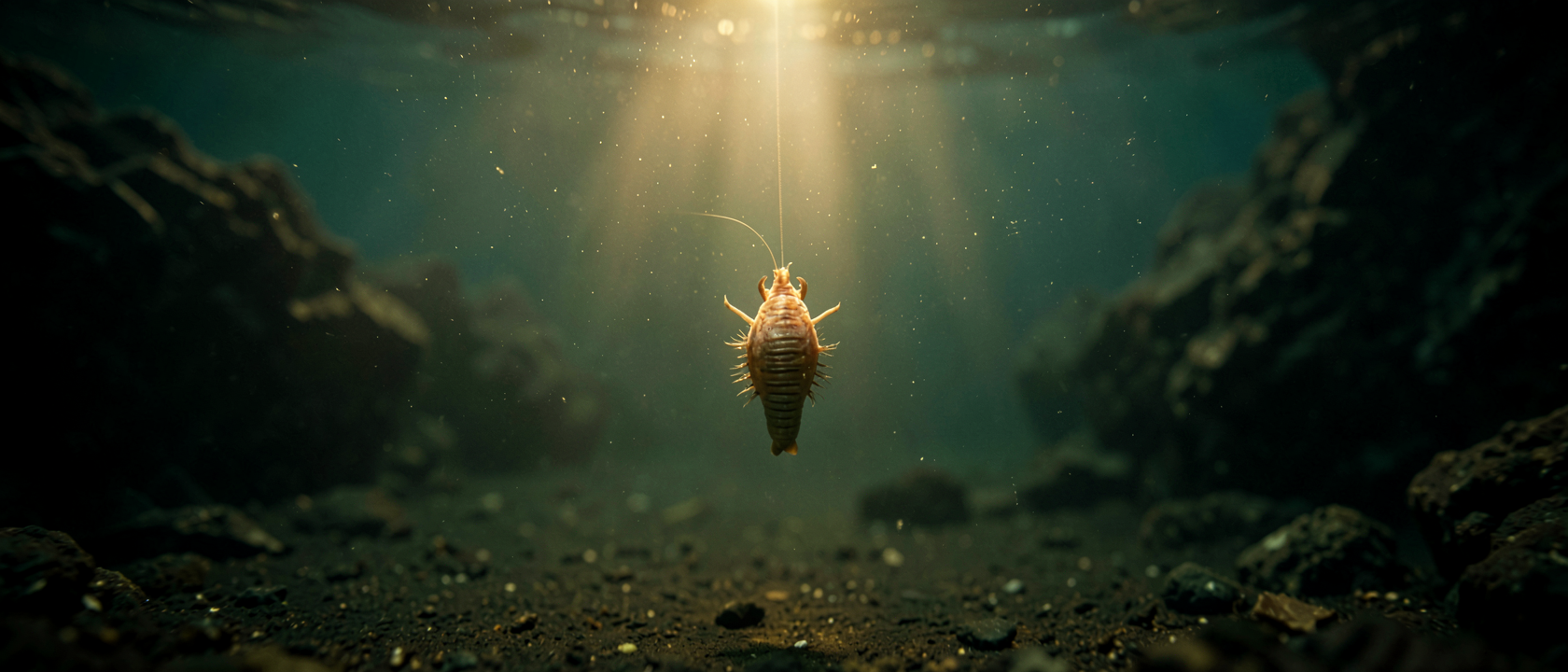
The Worm That Kept Its Mouth
Every living thorny-headed worm is mouthless. The roughly 1,400 described species of Acanthocephala anchor to a host’s gut wall using a retractable, spine-studded proboscis and absorb nutrients directly through their outer body surface, no opening at the front end, no digestive tract behind it. That is the complete anatomy.
A fossil from Inner Mongolia has both the proboscis and a set of jaws.
The specimen, named Juracanthocephalus daohugouensis in a study led by Cihang Luo and colleagues at the Nanjing Institute of Geology and Palaeontology, Chinese Academy of Sciences, and published in Nature on April 9, 2025, is the oldest known body fossil of any thorny-headed worm on record. A single male individual, approximately 0.4 to 0.8 inches (1 to 2 centimeters) long, it was recovered from the Daohugou Lagerstätte, a volcanic-lake deposit in Ningcheng County, Inner Mongolia, northeastern China, dated to approximately 165 million years ago, in the Middle Jurassic.
The research team analyzed it using scanning electron microscopy, backscatter scanning electron imaging, and energy-dispersive X-ray spectroscopy. Near the anterior trunk, where a closed tip should have been, they found a jaw apparatus: clustered tooth-like units in converging paired rows, increasing in size toward the rear. At the opposite end sat a bursa, the bell-shaped male reproductive structure that is a diagnostic marker of Acanthocephala. The hooked proboscis and bursa together confirm this animal belongs to the lineage. The jaws confirm it was doing something that lineage no longer does.
What the Anatomy Is Actually Telling Us
A modern thorny-headed worm is functionally a hook glued to a bag of gonads. The proboscis locks into a host’s gut wall; sustenance moves inward through the tegument, not through any opening, because there is none.
J. daohugouensis carries that same proboscis, and its trunk bears 38 lines of transverse setaceous combs consistent with modern acanthocephalan body plans. The Luo et al. study also reports a possible alimentary tract structure preserved in the proboscis region alongside the jaw apparatus. The trunk itself shows no clear gut, so whether the digestive system was already partially reduced is a question the preservation cannot settle. What it can settle is whether jaws were ever part of this body plan. They were.
Gutlessness in modern Acanthocephala is not the starting condition. It is an endpoint the lineage arrived at progressively.
The Rotifer Problem, Solved in Rock
Molecular phylogenetics had already placed thorny-headed worms inside the rotifers, a group of microscopic free-living aquatic animals classified under Syndermata. Rotifers feed using hard internal jaw-plates called trophi. Placed next to an obligate gut parasite with no mouth, that proposed ancestry looked like a sequencing curiosity rather than a biological reality.
The jaws of J. daohugouensis, the Luo et al. study reports, are structurally comparable to those trophi. The phylogenetic analysis the team constructed, covering 68 taxa and 247 characters, places Juracanthocephalus at a position bridging Seisonidea (members of Rotifera that live on the exterior of other animals) and Acanthocephala proper. The fossil provides the molecular tree with an anatomical body to inhabit: the shared jaw morphology as a genuine inherited feature, not an artifact of gene sequencing.
The Luo et al. study raises a second unexpected angle. J. daohugouensis was found in terrestrial lacustrine sediments, while modern thorny-headed worms are predominantly known from marine environments. The authors propose the lineage may have first adapted to terrestrial vertebrate hosts before colonizing marine ecosystems, inverting the assumption that the parasitic strategy developed in the sea.
They Were Never Flatworms. They Were Never Penis Worms. They Were Always Rotifers.
For much of their taxonomic history, thorny-headed worms were classified alongside flatworms (Platyhelminthes) or penis worms (Priapulida), groupings driven by superficial overlap: cylindrical body plans, parasitic or burrowing lifestyles, no obvious anatomical bridge to anything else. When molecular analysis shifted them into Syndermata, anatomists had a defensible objection: a gutless internal parasite and a free-swimming filter-feeder the size of a dust particle look and function nothing alike.
J. daohugouensis makes that objection substantially harder to sustain. An animal carrying the proboscis and bursa of Acanthocephala and the jaw morphology otherwise known from their proposed free-living relatives is the missing body plan: the one that explains how a jaw-bearing, free-feeding ancestor became the gutless parasite anchored to the intestine of a fish, a bird, or, occasionally, a human. The fossil wins the argument by existing.
What One Worm Cannot Answer
Before this specimen, the entire physical fossil record of Acanthocephala consisted of eggs found in a Late Cretaceous coprolite attributed likely to a crocodyliform, recovered from the Bauru Group of Brazil and dated to roughly 70 to 80 million years ago. No body fossil had ever been described. That one specimen is, currently, the entire body-fossil record of the group.
What it cannot say: whether the jaw apparatus and possible alimentary tract were still functional or already vestigial. The holotype is male, so what the female looked like is entirely unknown. The worm was recovered loose in sediment rather than inside a host, leaving its Jurassic host identity unresolved. Co-author Edmund Jarzembowski of the Natural History Museum, London, has raised dinosaurs as a speculative possibility, but that is conjecture, not a finding.
Of the roughly 1,400 living species of thorny-headed worms, complete life cycles have been described for only approximately 25. One volcanic lake in Inner Mongolia held the exception for 165 million years.