
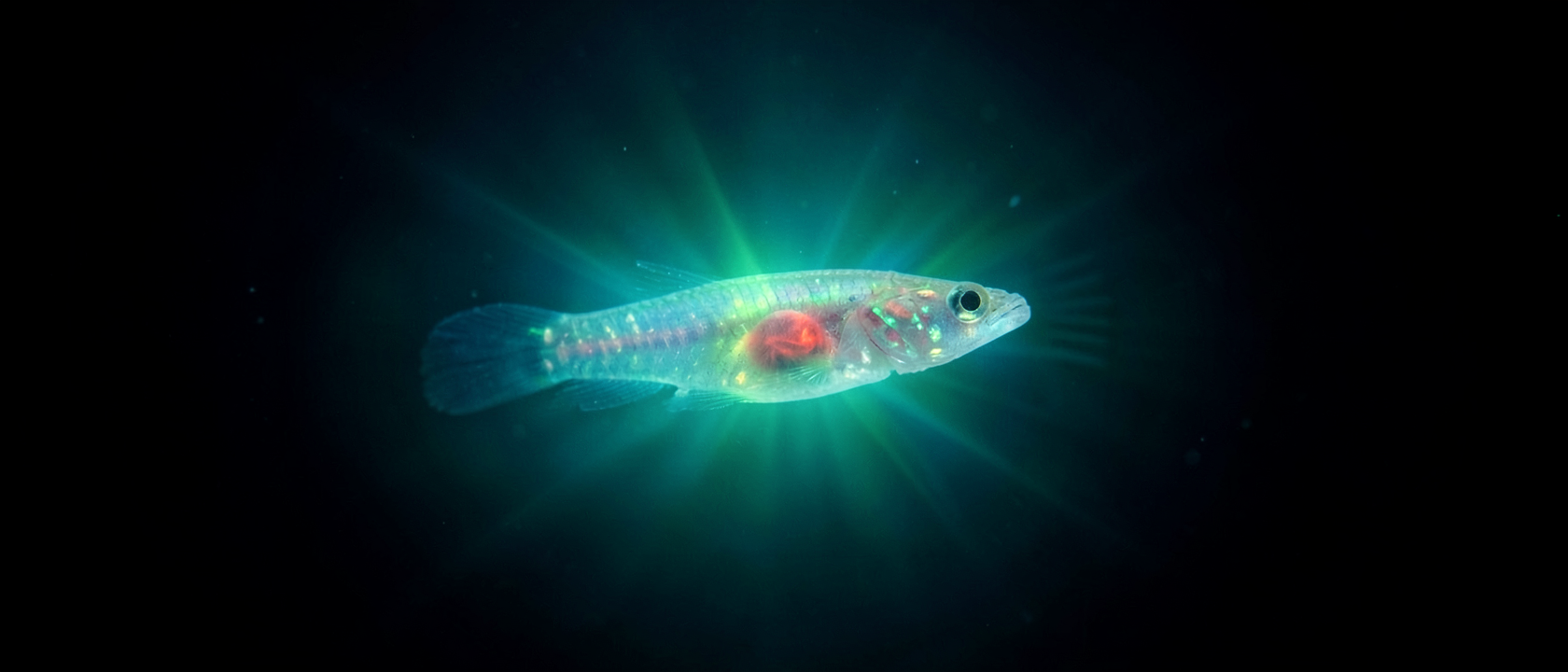
A Laser Made a Zebrafish’s Heart Beat 50 Percent Faster
A zebrafish larva’s (Danio rerio) resting heart rate rose from about 2 beats per second to about 2.7 beats per second, a jump of roughly 50 percent, and no sound wave ever touched its ear. Xiaoshuai Liu and colleagues at Guangzhou University, China, published the finding in Nature Communications in 2026, after focusing a laser directly onto the otolith, the tiny ear-stone sitting inside the fish’s inner ear. The moment the beam switched off, the heart rate drifted back down to its resting pace. The larvae were 6 days post-fertilization (dpf), an age the team chose because the auditory and cardiovascular systems are already working while the body stays clear enough to see straight through.
Why a Beam of Light Can Impersonate a Sound
An otolith is a crystal of calcium carbonate, no bigger than a speck of dust, resting on a bed of sensory hair cells. In ordinary hearing, a pressure wave in the water jostles that crystal, the crystal bends the hair cells’ ciliary bundles (the hair-like projections that do the actual sensing), and the bent cells fire a signal down the auditory nerve. Liu’s team skipped the water entirely. Optical tweezers, two alternating infrared laser beams at 1064 nanometers, refreshed 100,000 times a second, use the physical push of photons, called radiation pressure, to grab and move objects this small. Aimed at the otolith, that push did exactly what a sound wave does: it bent the same hair cells, which fired straight into the fish’s auditory-processing brain regions. By adjusting how hard, how fast, and in what rhythm the beam moved the crystal, the researchers dialed in something like loudness, pitch, and rhythm, building the signal from the crystal outward instead of from the water inward. Earlier work with the same optical-trapping idea had already shown that nudging a zebrafish larva’s otolith could trigger corrective tail flicks and eye rolls, the same reflexes a real sound or a real tilt would produce. Liu’s team took that one step further and pointed the beam at the heart.
An Ear Wired Straight to a Heartbeat
The team then gave healthy larvae drugs that break the heart in three specific ways, and set the laser to play music at them. In larvae slowed by doxorubicin, where heart rate had fallen to 1.50 ± 0.05 Hz against a healthy 2.30 ± 0.05 Hz, ten minutes of the optically driven stimulus pushed the rate back up to 2.20 ± 0.05 Hz. In larvae given sunitinib, which produces a desynchronized upper and lower heart chamber known as an AV block, normal coordination returned in 6 of 7 fish. In larvae with sunitinib-induced pauses in the heartbeat, two to three dropped beats every 30 seconds, normal rhythm returned in 5 of 7 fish. Some of these fixes held even after the laser stopped. That is a real, traceable route from the inner ear to the heart muscle in this species, not a folk association between music and a calmer pulse. What that route looks like inside the fish’s nervous system, nobody has mapped yet.
The Myth This Kills: Light Is for Eyes, Sound Is for Ears
The old idea that light goes only to the eyes and sound only to the ears does not survive this experiment. The hair cells sitting under the otolith had no way of knowing whether the crystal above them was pushed by a wave of water or a wave of photons. They fired the identical signal either way, straight into the brain’s auditory regions. Mechanically speaking, inside this larva’s ear, light became a sound. That is not a figure of speech; it is what the hair cells’ own wiring did with the input.
What’s Still Unknown
Liu calls the work, in his own words, a “very preliminary proof-of-concept,” and three real gaps back that up. Whether the larva experiences any of this as sound in a subjective sense is not something the team can answer; there is no way to ask a zebrafish larva what it heard. The exact neural pathway carrying a signal from the ear to the heart muscle has not been traced. And optical tweezers only reach a few micrometers into tissue, so whether any version of this works past a transparent larva, let alone in a larger animal, has not been tested.
The Joke: A Fish With No Explanation
Somewhere in a sample chamber at Guangzhou University, one zebrafish larva is absolutely certain it heard a drumbeat. No speaker in the room, no flashlight it noticed, just a crystal in its head that suddenly had opinions about rhythm. As far as this larva is concerned, its own ear started making things up, and its heart, loyally, sped up to keep time.