
The Experiment
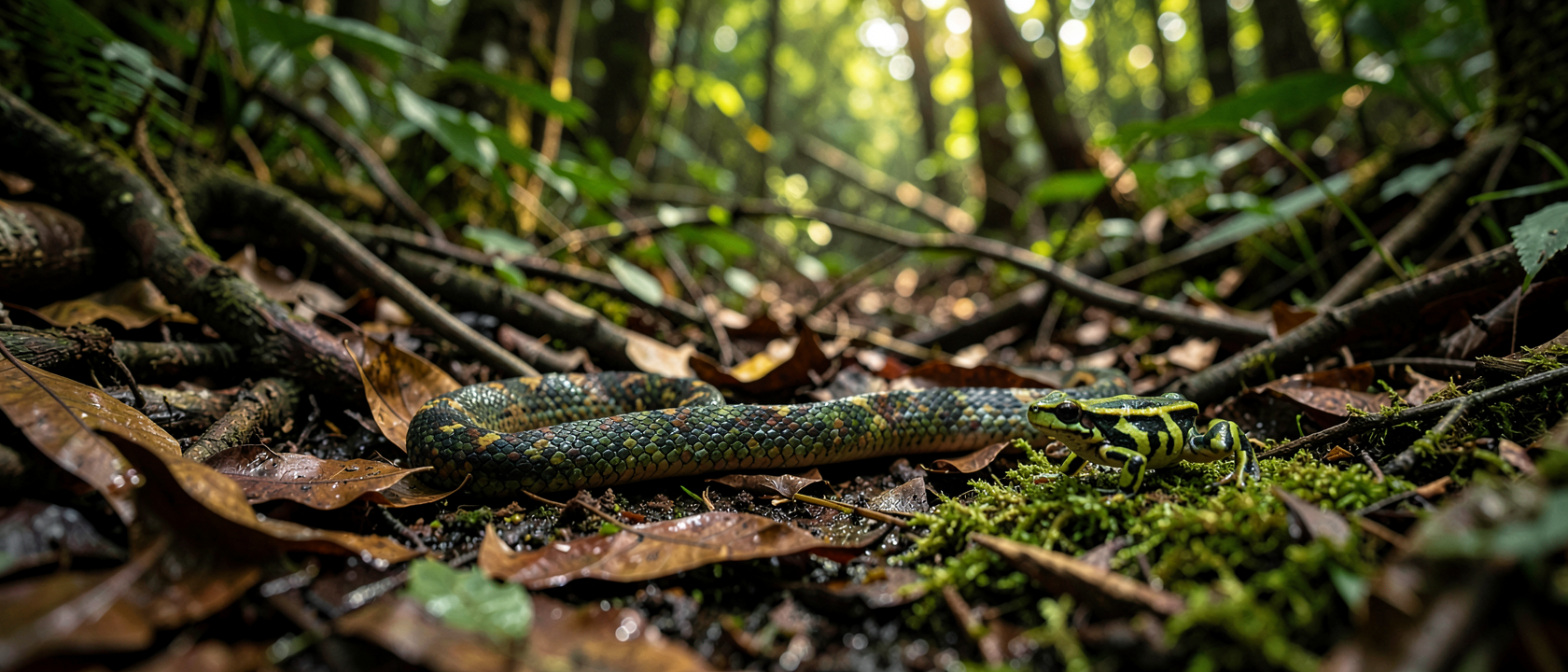
Ten royal ground snakes (Erythrolamprus reginae), collected from the Colombian Amazon, were starved for several days and then each offered a single meal: a three-striped poison dart frog (Ameerega trivittata), a species whose skin carries toxins capable of shutting down nerve and muscle function. Six of the ten snakes refused to touch it. Four attacked and killed their frog. Before swallowing it, each of those four dragged the carcass across the ground. Three of the four snakes that ate survived.
The work comes from biologist Valeria Ramírez Castañeda and evolutionary biologist Rebecca Tarvin, both at the University of California, Berkeley, part of a larger study on how this snake handles toxic prey.
Why Drag the Body First
The frog’s defense sits on its skin surface: histrionicotoxins, pumiliotoxins, and decahydroquinolines, compounds that jam proteins nerve and muscle cells depend on to function. Dragging the frog across the ground acts like a crude scouring pad, stripping away some of that surface dose before the snake opens its mouth. Ramírez Castañeda and her colleagues note the behavior only showed up with this particular frog species, not with other prey the snakes were offered, and it also took these snakes longer to swallow A. trivittata than other meals, a sign the frog was handled differently from the start.
The researchers compare it to a tactic seen in some birds, which rub toxic prey against branches or ground before eating. Neither case requires cleverness so much as physics: friction removes poison that would otherwise ride straight into the gut. Whether the dragging actually breaks the toxins down or simply scrapes a portion of them off the skin is still a hypothesis, not a confirmed mechanism.
The Second Defense, Hidden Inside
Dragging does not remove all the toxin, which means something else has to deal with what is left. In cell-culture experiments, Tarvin’s team found that extract from the snakes’ livers could partially restore the activity of sodium channels that the frog’s alkaloids had shut down, and it did the same against neosaxitoxin, a toxin that has nothing to do with this frog’s actual diet. That points to toxin-binding proteins in the liver doing real work against compounds the snake may never naturally encounter. The team also saw liver transporters become more active after the snakes ate the frog, a pattern consistent with the organ clearing toxin from the bloodstream.
What is not yet settled is how those proteins operate. One possibility is that liver enzymes break the toxins down into harmless fragments, something like the way a human liver processes alcohol or nicotine. The other is that the liver carries proteins that simply bind the toxin and take it out of circulation without changing its chemistry, a kind of sponge rather than a furnace. Nobody has determined which mechanism does the heavier lifting, or whether both run at once.
The Myth This Kills
It is tempting to read three survivors out of four as a predator that has simply solved the toxin problem. But six of the ten snakes in the experiment would not even attempt the frog, and the four that did took longer to swallow it than they did with other prey. The researchers read that hesitation as evidence against an older assumption: that this species eats toxic frogs without a second thought. The avoidance, the extra handling time, the dragging, all of it says the frog remains a real threat, managed rather than defeated, not a meal this snake has stopped worrying about.
What’s Still Unknown
Three snakes survived eating a frog capable of disabling their nervous systems, and there is no way yet to say whether they cleared the toxin that reached their bloodstream or simply never absorbed enough of it to die, thanks to the dragging. A snake that detoxifies a full dose and a snake that merely survives a reduced one look identical from the outside: both are just alive the next morning. Separating those two stories requires measuring what toxin load actually made it past the skin-wiping and into the body, and that work is not finished. It is also still unclear why six of the ten snakes refused the frog outright, whether that is learned caution, something they can smell or taste on the skin, or just individual variation between snakes.
Tarvin has framed the broader question beyond this one species: a few milligrams of a single compound can reshape every interaction in an ecosystem, and antitoxin strategies like this one are part of how predator and prey keep renegotiating that balance. For the royal ground snake specifically, the open question is blunt: is the dragging the whole story, or is it buying time for a liver that is doing something science has not yet pinned down?