
The Bone Collector
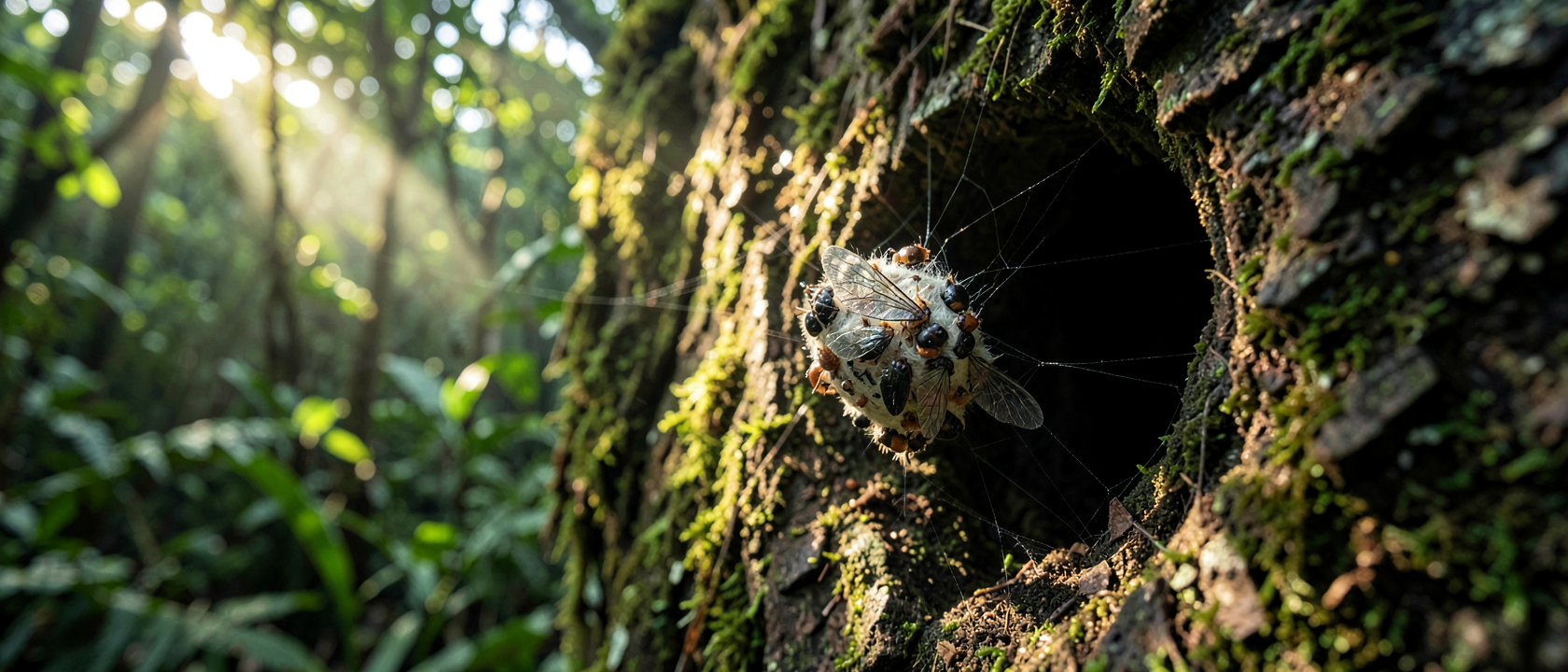
A caterpillar living in one Hawaiian mountain range builds itself a coat out of the dead: severed ant heads, fly wings and legs, weevil heads, and the shed skins of spiders, all glued onto a portable silk case it hauls around like a shell. The species belongs to Hyposmocoma, the Hawaiian genus already known for “fancy case” caterpillars that build and carry their own silk homes, but it has not yet been given a scientific name. It was described by University of Hawaiʻi at Mānoa entomologist Daniel Rubinoff and colleagues Michael San Jose and Camiel Doorenweerd, published April 24, 2025, in the journal Science. It has turned up in exactly one place on Earth: a patch of forest of 5.8 square miles (15 square kilometers) in the Waiʻanae mountain range on Oʻahu.
How It Builds Its Coat of Arms
The caterpillar treats every scrap of debris like raw material to be graded before use. It picks up a fragment, an ant head here, a spider leg there, and turns it over with its mandibles (its jaws), poking and testing with its front legs to size it up. A piece that’s too large gets chewed down until it fits the shape of the case. Only then does the caterpillar glue it into place, using silk it spins itself, adding one grim plate at a time. Researchers offered it other building materials, sand, lichen, and plant fiber, that related Hyposmocoma species use for their own cases. It refused all of them. When arthropod remains were available, only arthropod remains would do.
Why Wear the Dead
Researchers propose that the case works as a disguise for scent rather than sight: wearing the leftovers of a spider’s old meals may mask the caterpillar’s own odor, letting it pass as background rather than as food inside a web it has no way of escaping if discovered. That is an interpretation offered by the study’s authors, not a mechanism proven directly. What is documented is what the disguise buys: the caterpillar lives inside silk-lined retreats built into tree hollows, logs, and rock cavities, alongside webs belonging to at least four spider species, none native to Hawaii. From there it scavenges insects the spider has already killed or weakened, and it has been observed eating trapped prey outright. That makes it a genuine carnivore, in an order where fewer than 0.13% of the roughly 200,000 described moth and butterfly species eat anything but plants or fungi.
The Caterpillars Are Not Fine, Actually
The default picture of a caterpillar is a leaf-chewer marking time until it grows wings, harmless by definition. This one runs on flesh instead. In captivity, it has been seen attacking slow-moving prey outright, and when larvae were housed together, they attacked each other. Predatory caterpillars exist elsewhere in the world, scattered thin across a handful of unrelated lineages, but this one didn’t just join that small club. It built its case, and its whole life, inside the home of the one animal most caterpillars are built to avoid.
What Nobody Can Explain Yet
Genetic analysis places this caterpillar’s lineage at more than 6 million years old, older than Oʻahu itself, which formed roughly 3 million years ago. That means its ancestors evolved somewhere else first and arrived on the island later. But every other Hyposmocoma lineage shows up as multiple related species spread across several Hawaiian islands, cousins on cousins. This one has none. No sister species has ever been found, on Oʻahu or anywhere else. Researchers suspect relatives once lived on an older island that has since eroded away, or that those relatives simply went extinct, but neither has been confirmed. Outside scientists, including Harvard entomologist Naomi Pierce, have noted the species may not have much time left either, though exactly how little is itself unresolved. It is a lineage on its own, with no known relatives anywhere.
Nearly Twenty Years to Notice
Nearly two decades before the Science paper appeared, Rubinoff was walking through the Waiʻanae Mountains looking for something else: ordinary Hyposmocoma caterpillars that build their cases out of rotting wood. He noticed an odd one sitting near a spider web inside a tree hole and had no idea what he was looking at. It took nearly 20 years of fieldwork and 62 specimens, all from that same stretch of forest and nowhere else, before he and his colleagues could confirm it wasn’t a fluke: it was a distinct, carnivorous species. Rubinoff chose the nickname himself, borrowed from the serial killer in Jeffery Deaver’s 1997 novel The Bone Collector, and has said it fits the habit, tongue in cheek, given that arthropods don’t actually have bones.