
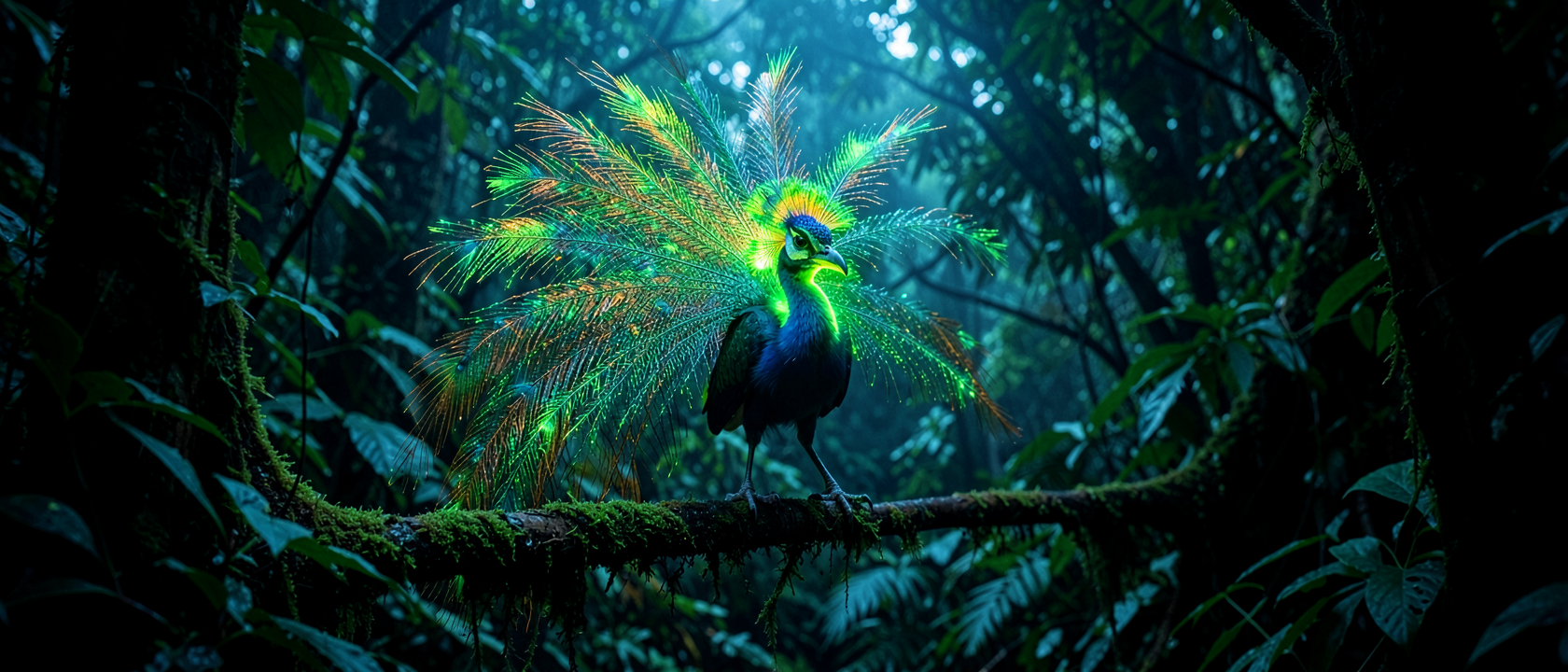
A Dance Under a Second Light
Point a UV flashlight at a bird-of-paradise specimen and its mouth lights up green-yellow, like something switched on inside it. Two centuries of naturalists studied these birds up close and never caught it, because human eyes can’t see it without help. A 2025 study found that 37 of the 45 known species of birds-of-paradise biofluoresce under ultraviolet and blue light, a signal invisible to the naked eye. These are already the loudest performers in the bird world: fanned capes, spinning dances, electric-blue chest shields flipped open on cue. All of that happens in visible light. What this study found happens somewhere else on the spectrum entirely.
The work is by Rene P. Martin (University of Nebraska-Lincoln, previously a postdoctoral researcher at the American Museum of Natural History), Emily M. Carr (a Ph.D. student at the Museum’s Richard Gilder Graduate School), and John S. Sparks (an ichthyologist and curator at the Museum), published February 1, 2025, in Royal Society Open Science. The team worked through the Museum’s collection of birds-of-paradise specimens, some collected as far back as the 1800s, including species such as the greater bird-of-paradise (Paradisaea apoda), covering all 45 described species in the family. They shone ultraviolet and blue light on every one of them.
Glowing in Exactly the Right Places
To separate a true glow from ordinary reflected color, the researchers photographed specimens under UV and blue light using filters that block the reflected wavelengths and let only the re-emitted light through. Biofluorescence, in plain terms, is what happens when a material absorbs light at one wavelength and sends it back out at another, longer one. It’s a completely different mechanism from the iridescent, structural color that already makes birds-of-paradise plumage flash blue and bronze in daylight, that color comes from how feathers are built and bends light physically; this glow comes from a chemical reaction inside the tissue itself.
The map of where the glow shows up is the genuinely interesting part. In males, it concentrates in the inner mouth and bill, the feet, and feathers on the head, neck, and belly, the exact parts a male angles toward a female mid-display. Females, who don’t perform these routines, fluoresce mainly on chest and belly plumage instead. The glow isn’t painted evenly across the bird. It tracks the choreography, showing up precisely where the performance points.
A Signal Built for the Forest and the Eye
The paper’s authors note that in several closely related species, the pigments inside the birds’ own eyes peak at wavelengths, around 520 and 560 nanometers, that line up with the fluorescence the specimens give off. That match suggests these birds may be tuned to actually see their own glow. Little is known about bird-of-paradise vision generally, so this is an inference from the color-matching data, not a direct test of what any bird perceives.
The behavior it might support has already been described in the wild: during courtship, some males raise their wings around the face to form a dark black halo, then hold the mouth open at the center of that frame for 30 seconds or longer. Against the dim light of an equatorial forest understory, a fluorescent highlight would add contrast that plain reflected color struggles to produce in the shade. The researchers propose this could sharpen how well a female judges a male in the instant she has to look, and might feed into how males rank against each other for mating success. That’s the authors’ proposed explanation, offered as a hypothesis, not a confirmed behavior.
Not Every Show-Off Glows
It would be tempting to assume every flamboyant performer in the bird world lights up under UV the same way. Bowerbirds build elaborate stages and decorate them like curators. Fairy-wrens run their own showy courtship routines. In earlier museum work, Sparks tested exactly those birds and found no biofluorescence in either group at all, while the birds-of-paradise specimens glowed bright green-yellow.
So this isn’t a case of flashy courtship predicting a UV glow across the board. It’s a result specific to birds-of-paradise, an outlier rather than a pattern, which is exactly why it was worth checking in the first place. The next time someone tells you showy animals just tend to glow, you’ll know it’s a coin flip at best, most of them don’t.
What Nobody Has Seen Yet
Everything above comes from museum specimens photographed under laboratory light, not from live birds performing in a forest. No one has yet filmed a bird-of-paradise using this glow mid-display in the wild, so the signaling role stays a proposal. The researchers themselves raise an alternative: the fluorescence could simply be a byproduct of a feather protein that happens to make good structural material, with no signaling function attached at all.
Eight of the 45 species showed no fluorescence whatsoever. All eight sit in three genera, Lycocorax, Manucodia, and Phonygammus, which form the sister group that branched off earlier in the family’s evolutionary tree, separate from the other 14 genera that all glow. Whether that early split explains the missing glow, or something else does, isn’t known. Both questions remain for future work: what a female actually sees when she looks at that lit-up mouth, and why eight close relatives never picked up the trick at all.