
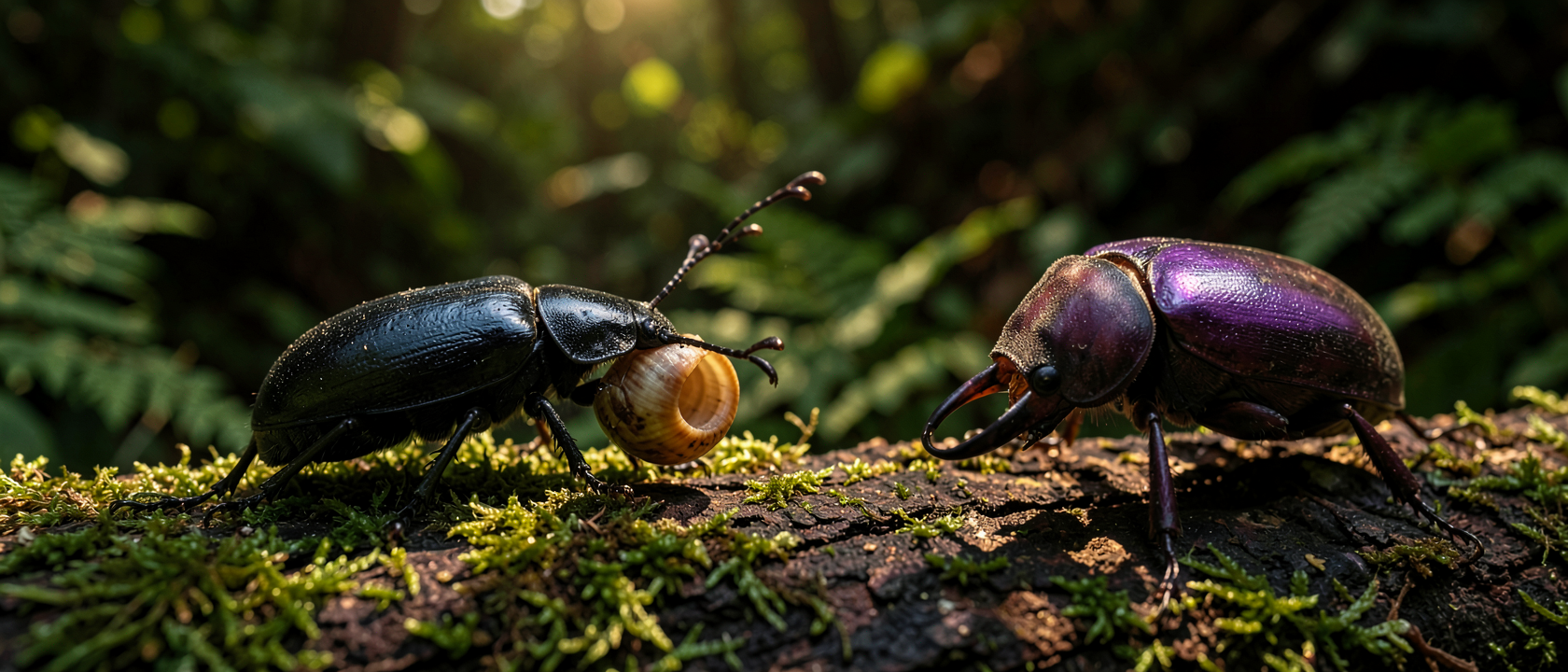
Carabus blaptoides, a flightless ground beetle that hunts snails across the Japanese archipelago (also known by the older name Damaster blaptoides), comes in two builds that look like they should belong to two different species. One has a long, slender head and a narrow thorax built to reach deep inside a large snail’s shell. The other has a short, wide head with heavy mandibles built to crush a smaller shell outright. The split doesn’t run along a coastline the way you’d expect. It shows up inside Honshu, Japan’s largest island, a single unbroken landmass of about 88,021 square miles (227,974 square kilometers).
Junji Konuma of Toho University, working with Nobuaki Nagata of the National Museum of Nature and Science and Teiji Sota of Kyoto University, confirmed the pattern with genetic data from 170 beetles at 70 sites, paired with body-shape measurements from 50 populations. The study appeared in the Biological Journal of the Linnean Society on August 17, 2026.
A Head Built for One Job
Underneath both face shapes sits the same limitation. Carabus blaptoides has reduced hindwings, the flight wings normally folded under a beetle’s hard forewing covers, so it never developed the ability to fly. Every population gets around on foot, one leg at a time, one generation at a time. That already caps how far any single beetle’s genes can travel before feeding strategy enters the picture at all. Slender beetles push their long heads deep into a large snail’s shell and draw the animal out whole. Stout beetles skip the digging and crack a small shell open with raw jaw strength. Earlier work by Konuma and Sota, looking at two named subspecies, the slender Carabus blaptoides fortunei and the stout Carabus blaptoides capito, found that their hybrids grow intermediate heads and feed more generally, but perform worse than either specialized parent.
Whichever Shape Wins Locally
Konuma’s team reads the geographic pattern as the fingerprint of local prey size. Where the available snails run large, a long reaching head keeps winning. Where they run small, a stout crushing head keeps winning, and each version gets passed down because it outperforms the alternative on the shells actually present in that patch of forest. The very trait that limits gene flow, a beetle stuck walking on its own legs, is what lets each population lock onto its own local answer instead of blending into some national average shape. Nobody is choosing a strategy. Whatever head kept working on the local snails is the head that stuck.
The Myth: You Need an Ocean for This
The standard picture of adaptive radiation, populations splitting into distinct forms, has leaned on hard barriers: a strait, open water, a chain of islands. Divergence between Hokkaido, Sado Island, and the rest fits that story easily. Honshu breaks it. Konuma’s team applied a statistical method called Ornstein-Uhlenbeck modeling, which tests whether a trait is being pulled toward specific optima by selection rather than drifting at random, and found that body shape across Japan fit models with multiple selective optima far better than a model of undirected drift. Two of those optima, one for western Japan and one for eastern Japan, closely matched the reconstructed head shapes of the western and eastern ancestral populations. That split runs straight through the middle of a single island, with no strait and no channel between the two halves. Distance and local differences in prey did the work an ocean usually gets credit for.
What the Study Doesn’t Answer
The paper doesn’t report the actual snail-size measurements region by region, so the idea that big snails favor slender heads and small snails favor stout ones, plausible as it is, isn’t yet backed by hard numbers. It also doesn’t date when the two shapes split from a shared ancestor. And with eight recognized subspecies of Carabus blaptoides across Japan, it isn’t clear from the published findings how many were directly represented among the 70 sampling sites, and how many are simply assumed to follow the same east-west pattern found in the rest of the data.