
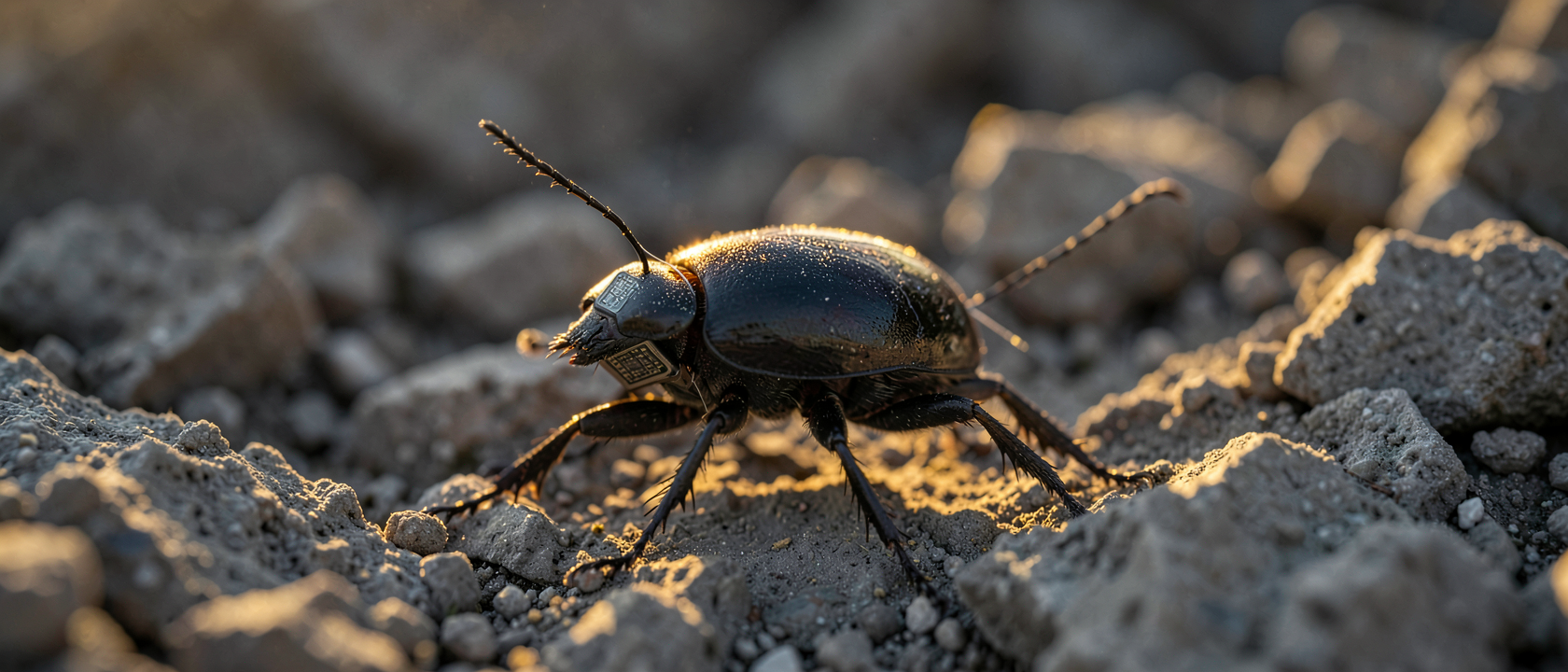
Meet the ZoBorg
Small robots built to climb from a flat floor onto a vertical wall still struggle with that exact move. A darkling beetle wearing a microchip backpack pulls it off in 71.2% of attempts, steered the whole way by a human holding a video game controller. Researchers at The University of Queensland, UNSW Sydney, and Nanyang Technological University built the rig and call the result the ZoBorg: a living Zophobas morio beetle, wired up and driven like a character on a screen.
Zophobas morio, known in its larval stage as the superworm, is an unremarkable-looking animal: up to 1.26 inches (32 millimeters) long, about 0.3 inches (8 millimeters) tall, weighing somewhere between 750 and 950 milligrams. The backpack sits on its back like a small saddle, removable, with wires running to its antennae and its hardened forewings, called elytra. The same wired beetle also cleared steps as tall as 0.31 inches (8 millimeters) in more than 92% of attempts, in under a second each time.
The Electrical Reins
The backpack doesn’t give the beetle anything new; it talks to what’s already there. In the study, published in Advanced Science in 2025 by Lachlan Fitzgerald, H. Nhan Le, Robbie S. Wilson, H. Duoc Nguyen, Thanh Nho Do, and T. Thang Vo-Doan, electrodes implanted into each elytron and a counter-electrode placed in the pronotum, the plate behind the beetle’s head, send small pulses the beetle’s nervous system reads as instructions. Stimulate both antennae together and it turns or slows down. Pulse both elytra together and it walks forward. Pulse just one elytron and it steps sideways. Four signals, one beetle, no new limbs.
What happens after each pulse is pure beetle: adhesive footpads, gripping claws, a body stiff enough to climb but flexible enough to bend, and an exoskeleton lined with sensors that read texture and vibration as it moves. That machinery is good enough that the same beetle has climbed while carrying a battery equal to its own body weight.
Why Hijack a Beetle Instead of Building a Robot
Building something that grips like a claw, senses like a foot, and bends like a joint, all at insect scale, is one of the genuinely hard problems in small robotics. Evolution already solved it, in this animal, over a very long time. The ZoBorg project sidesteps the problem instead of solving it: the beetle supplies the grip, the sensing, and the climbing, and the backpack supplies only the steering.
Engineer T. Thang Vo-Doan of The University of Queensland has said the control system doesn’t shorten a beetle’s life. Zophobas morio adults live roughly three months, and the beetles in these trials were kept afterward on wheat-bran bedding with fresh apple slices for whatever remained of that span. This isn’t a use-once setup; the beetle goes home.
Vo-Doan put the point behind the project in his own words: “If people have been trapped under an extensive amount of rubble, you want to be able to find them as quickly as possible and start planning how to get them out.”
The Terrain Robots Still Can’t Handle
There’s a quiet assumption behind most robot stories: once the machine exists, it wins, no feeding required. The ZoBorg findings complicate that at one exact point. The study notes that robots at this scale remain challenged by precisely the move the beetles pull off most often: the jump from a flat floor onto a vertical surface, which the beetles managed in 71.2% of attempts within five seconds.
That’s narrower than “beetles beat robots,” and more interesting for it. The floor-to-wall transition, exactly the kind of obstacle a collapsed building throws up constantly, is a real unsolved problem in small-scale robotics. A beetle with a chip on its back currently clears it more often than the robots designed to replace it.
What’s Not Built Yet
Nothing about the ZoBorg decides where to go on its own. A person holds the controller and makes every turn, every stop, every climb. There’s no onboard camera yet and no inertial measurement unit, the sensor package that would let the system track its own motion without a human watching. The research team has said both are planned, along with a smaller power system, but neither is part of the current platform.
No ZoBorg has searched real rubble. What exists so far is obstacles and vertical walls in a lab, not a collapsed building or a mine shaft. Whether a beetle with a backpack can do in the field what it does on a bench is, so far, simply unknown.
The Beetle’s Commute
As far as the beetle is concerned, it was minding its own business on a pile of wheat bran when someone picked up a controller and decided it was climbing day.