
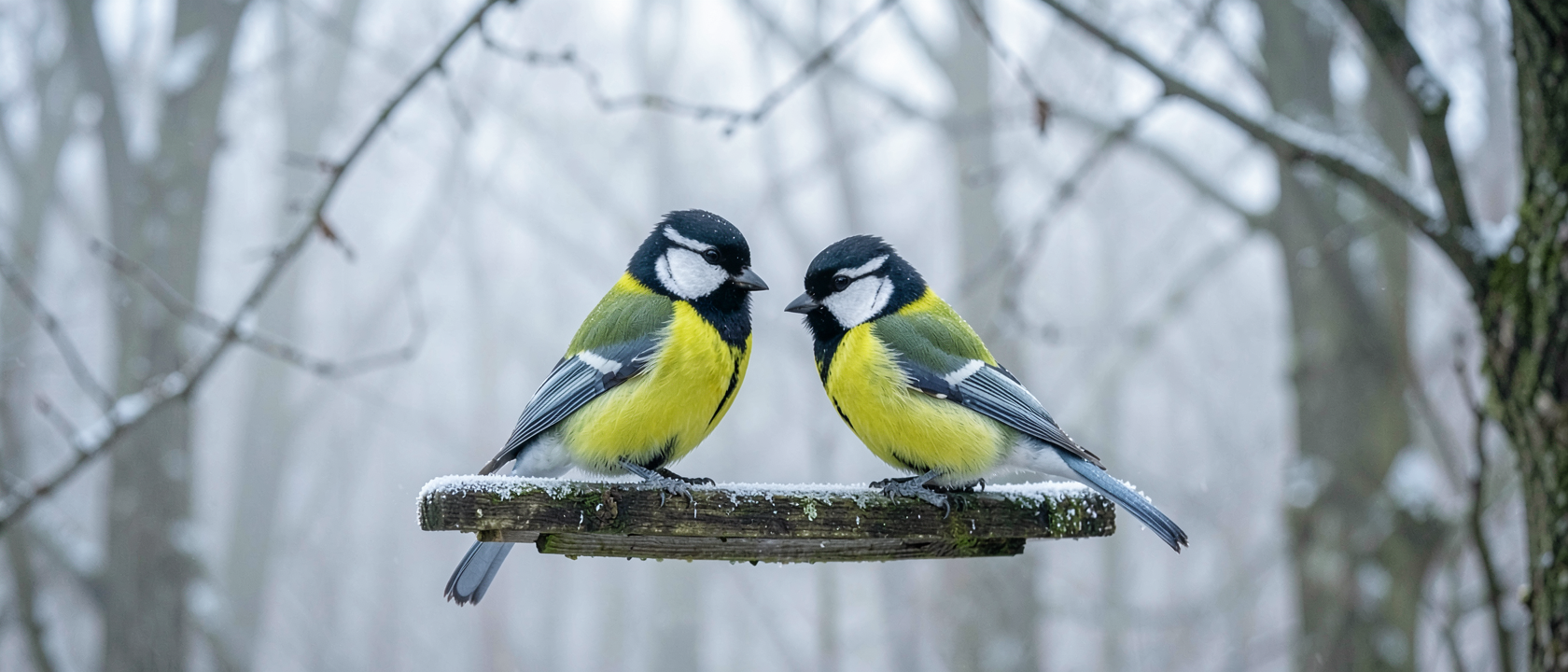
The Breakup Shows Up Months Before the Nest Box Is Empty
Great tits (Parus major) that won’t re-pair the following spring don’t wait until spring to start pulling away. A study of the long-running Wytham Woods great tit project in Oxford, England, found that pairs headed for a split had already cut back on seeing each other at winter feeding stations, months before the breakup would show up as an empty nest box. The research, led by Oxford PhD candidate Adelaide Daisy Abraham with Dr. Josh Firth of the University of Leeds and Professor Ben Sheldon, was published in Proceedings of the Royal Society B on July 30, 2025.
How You Track a Breakup With a Loyalty Card for Birds
None of this would be visible without the hardware. Birds at Wytham Woods, part of a tracking effort that has run for more than 75 years, carry small RFID tags (radio-frequency identification, the same idea behind a key fob or a store loyalty card), and feeding stations scattered through the woods log every visit automatically, time-stamped, bird by bird. Over three years of data, the researchers cross-referenced thousands of these visits to build what they call association networks: records of which birds kept showing up near which others, and how closely their visit timing lined up. They then checked those networks against the known breeding pairs from the season before and the season after. No one watched a single bird through binoculars. The feeders logged everything, automatically, down to the minute, which is precisely why a pattern this subtle could be caught at all. A human observer would have had to watch hundreds of individually marked birds across an entire woodland, every day, all winter, just to notice what the tags turned up as a byproduct of birds simply eating breakfast.
Some Pairs Lean In, Some Quietly Stop Showing Up
The pattern that came out of those networks split cleanly in two. Pairs that stayed together into spring showed more overlap at the feeders as winter wore on, with more joint visits and arrival times that synced up more closely over the weeks. Pairs that went on to divorce showed the mirror image: joint visits thinned out, timing drifted apart, and some birds ended up feeding at entirely different times of day, on separate schedules in everything but name. Abraham described it as a clear behavioral signature that can forecast a pair’s odds of splitting by spring, and called divorce a socially driven process that unfolds over time rather than a single event. Sheldon framed the finding as a step toward understanding the social mechanics behind pair bonding and fidelity in the wild. The bond between mates, on this evidence, isn’t a switch that flips on at breeding season. It’s something kept up, or let slide, one feeder visit at a time.
The Myth: “Birds Decide to Split at Breeding Time”
Ornithologists have used the word “divorce” for decades to describe mates that fail to re-pair the following season, so the concept itself isn’t new. What this study overturns is the timing people assume sits behind it: the idea that the decision, whatever it is, happens at or near the moment of breeding, a sudden non-renewal. The data say otherwise. The social distance between birds headed for divorce was measurable in early winter, months before either bird could have made any breeding decision at all. Whatever drove the split, it had already been running quietly for weeks before anyone, human or bird, called it final.
What Nobody Knows Yet: Why the Drift Starts at All
The study documents the drift with real precision, fine enough to watch faithful and divorcing pairs’ behavior pull apart week by week. What it doesn’t explain is why some pairs start drifting in the first place. A poor breeding season the year before, a mismatch in temperament, one bird finding a better setup at another feeder: all plausible, none confirmed by this dataset. It also can’t say whether the winter distancing causes the eventual split or simply reflects a decision already made somewhere outside the feeders’ view. Firth has noted that following individual birds across seasons shows how wild relationships form and break down in ways short-term studies can’t catch, but he and his co-authors are clear that further field experiments are needed to work out the fine-scale dynamics of bonding and separation. For now the forecast holds up; what it is actually a forecast of remains an open question.