
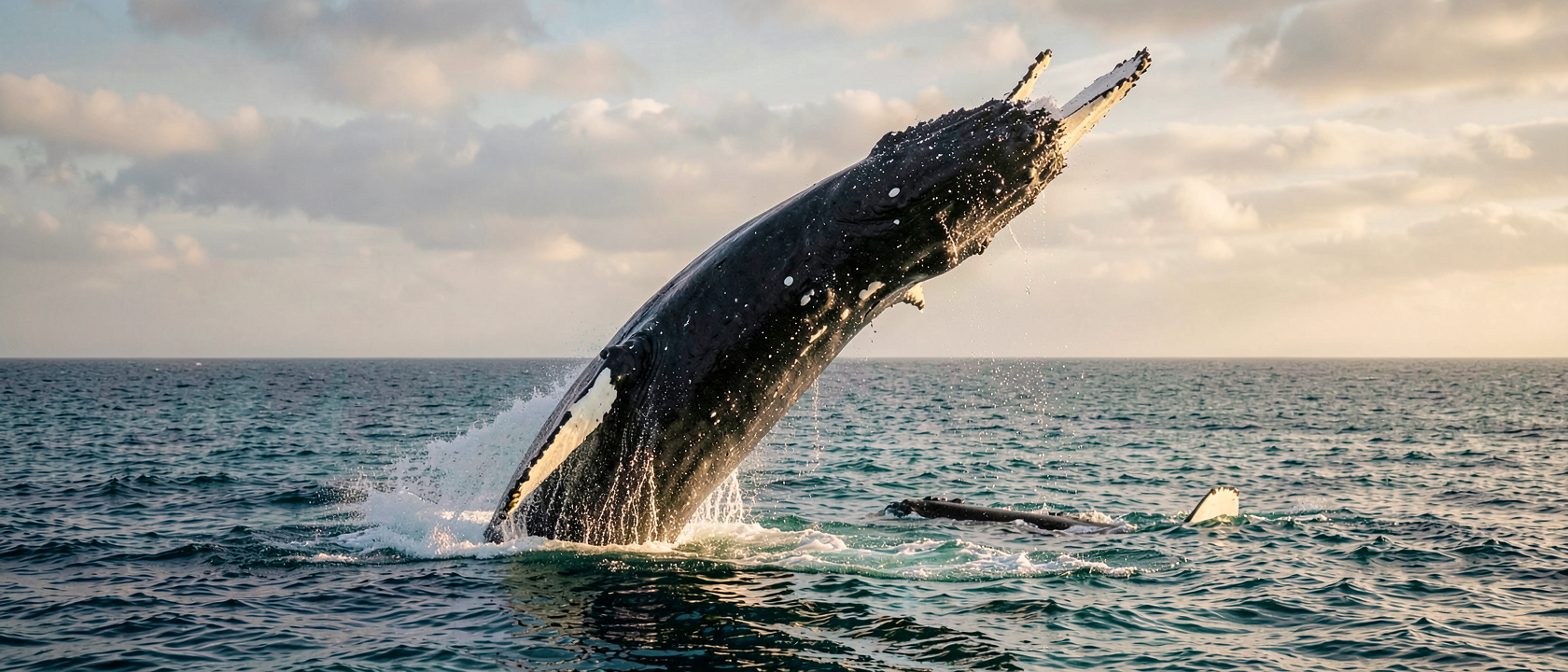
One humpback whale (Megaptera novaeangliae) swam just over 9,300 miles (15,000 km) between breeding grounds in Brazil and Australia, the longest journey ever documented for the species. A second whale crossed the same stretch of ocean going the other way. Humpbacks migrate farther than almost any other mammal on Earth. Just never like this.
The Crossing
The find comes from a study led by Cristina Castro Ayala, Stephanie Stack and colleagues at the Pacific Whale Foundation, published in Royal Society Open Science. The team combed through 19,283 photo-identification images collected between 1984 and 2025 by research groups and citizen scientists working with two humpback populations that breed an ocean apart: one off eastern Australia, centered on Hervey Bay, Queensland, and one off Brazil, centered on Bahia and São Paulo. Buried in that archive were two whales that showed up on both sides.
The first was photographed in Hervey Bay in 2007, seen there again in 2013, then turned up off São Paulo in 2019, a minimum straight-line distance of about 8,700 miles (14,200 km). The second went the other way: photographed off Bahia in 2003, then photographed in Hervey Bay in September 2025, just over 9,300 miles (15,000 km) later, a new distance record for the species. It edges out the previous record holder, a humpback tracked from Colombia to Zanzibar. “It’s a very rare event, but it is a really wonderful demonstration of just how wide-ranging these animals are,” said Phillip Clapham, a former head of a NOAA whale research program who had no part in the study.
How You Recognize a Whale You’ve Never Met
Nobody tagged either animal. Nobody caught the same whale twice at sea. The match came from the fluke, the two lobes of a humpback’s tail, which carries a pattern of black-and-white pigment and a jagged trailing edge unique to that individual and stable for life. It functions as a fingerprint that swims. Researchers ran the photographs through an automated image-recognition algorithm built to read those two features and search them against enormous archives, then checked every candidate match by eye. That is the entire trick: a photo taken off Queensland in one decade links to a photo taken off Brazil in another without anyone ever re-finding the same animal. The method itself is routine in humpback research. What was new here is what it turned up: one identity, two oceans.
Why Would a Whale Do That
Humpbacks typically run fixed routes between cold feeding grounds thick with krill and small fish, and warm tropical breeding grounds. Calves learn the route by following their mothers, so it is migration by inheritance, not exploration. Southern Hemisphere humpbacks also have an easier time attempting long detours than their Northern Hemisphere relatives simply because there are fewer continents standing in the way.
Stack’s working explanation, offered by the researchers as a hypothesis and not a settled finding, is that neither whale set out for the opposite ocean on purpose. More likely, each one crossed paths with whales from a different breeding population at a shared feeding ground and simply followed that group when it moved off to breed somewhere new. The team calls the broader idea the Southern Ocean Exchange hypothesis: as whale numbers recover and feeding conditions shift, different populations may get more chances to mix where their ranges overlap. This was not a whale that decided to swim to Brazil. It went home with the wrong crowd.
The Myth This Kills
The standing assumption was that Australia’s and Brazil’s humpback breeding populations are separate, largely isolated groups running different routes with minimal overlap. “There’s never been any photographic evidence linking these two populations before,” Stack said. Two individuals photographed on both sides, years apart, is direct evidence against strict isolation. “Finding not one but two individuals that have crossed between Australia and Brazil challenges what we thought we knew about how separate these populations really are,” she said.
That does not make them one population. Across more than four decades of records covering nearly 20,000 individual whales, only these two crossed, about 0.01 percent of everyone photographed. The gap between sightings, 6 years for one whale and 22 years for the other, suggests events this rare happen once in a whale’s life, if that. The boundary between the two populations has not collapsed. It is simply leakier than the textbook model assumed.
What Nobody Knows
The photographs only catch each whale at the start and the end of its journey. Nobody knows what route either one actually swam between Australia and Brazil, whether it was a straight line, a loop, or a string of stops at feeding grounds along the way. Nobody knows why either whale made the switch in the first place. And nobody knows whether these two were one-off flukes or the visible edge of a habit running quietly, at low frequency, under four decades of photography.
Stack and her co-authors think that question may stop being academic. If Antarctic sea ice and the distribution of Antarctic krill keep shifting with the climate, the feeding grounds where different humpback populations meet could shift too, and following the wrong crowd home might stop being a once-in-a-lifetime accident. “Despite their rarity, these exchanges matter for the long-term health of whale populations,” Stack said.