
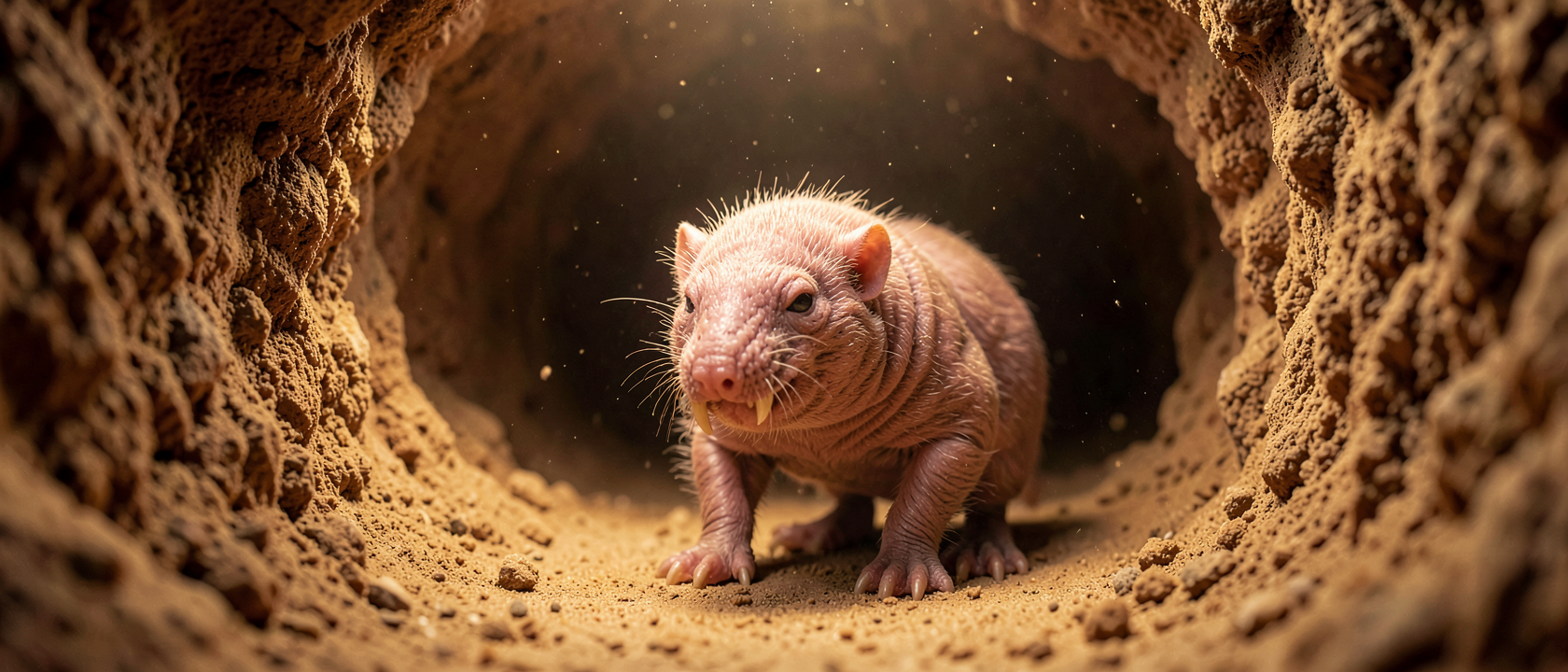
A mutation that kills mice did nothing to a naked mole rat
A single gene fusion called EML4-ALK is one of the most reliable ways to grow a tumor in a laboratory. Splice it into a mouse’s lung tissue and cancer shows up within weeks; it is the same fusion that drives a subset of human lung cancers. Researchers at Moffitt Cancer Center used CRISPR gene editing to insert that exact fusion into naked mole rats (Heterocephalus glaber), the wrinkled, nearly hairless, nearly blind rodent that builds tunnel colonies of up to 300 animals across parts of Ethiopia, Somalia, and Kenya. The mutation that reliably kills mice did, in this animal, nothing. No tumors. No detectable disease. The study was published September 8, 2025, in Cancer Discovery.
Three hits, not one
The researchers did not stop there. They added a second change: deleting two tumor-suppressor genes, p53 and Rb1, the genes whose job is normally to stop a damaged cell from dividing out of control. Only with all three changes stacked together, the EML4-ALK fusion plus the loss of both p53 and Rb1, did tumors appear. About 30% of the genetically altered naked mole rats developed aggressive lung tumors. Under the microscope, those tumors closely resembled pleomorphic carcinoma, a rare and aggressive human lung cancer subtype with no targeted therapy. The tumors were also genetically diverse from cell to cell, and infiltrated by immune cells, including T cells and macrophages. One mutation: nothing. Three, stacked: cancer, in roughly a third of the animals.
Why a famously cancer-resistant animal needed three hits
In mice, a single oncogene switch is often enough to start a tumor growing. In human cells, it typically is not: oncogene activation alone tends to leave a cell’s safety brakes, including p53 and the retinoblastoma protein, intact, and a tumor generally needs those brakes disabled too before it can grow. The Moffitt team reads the naked mole rat result the same way. It took a multi-step process, an oncogene plus two suppressor losses, to produce a tumor, which is close to the layered damage thought to be required in human cancer. That makes the naked mole rat look less like a mouse wearing better armor and more like a slow, high-threshold version of a human lung cell. The resistance is not a wall; it is a sequence, and the animals in this study needed to clear every step of it before a tumor could take hold.
The myth: naked mole rats “don’t get cancer”
Naked mole rats have carried a reputation, in documentaries and in casual conversation, as an animal that simply does not get cancer, full stop. This study contradicts that directly. About 30% of the engineered animals developed aggressive lung tumors once they carried all three genetic changes. The real finding is not immunity, it is a higher bar: a naked mole rat’s cells apparently need three coordinated hits where a mouse’s need only one. That is a difference in how much damage it takes to start the process, not a difference in kind. It is also, if you have ever repeated the “cancer-proof rodent” line at a dinner table, a pretty satisfying correction to make yourself.
What the study doesn’t explain
The paper does not say why naked mole rats need three hits instead of one. Whatever gives their cells that extra buffer against a single mutation remains unidentified. Moffitt researcher Joseph Kissil, who worked on the study, described the result as a start rather than an answer, saying it opens the door to future studies, particularly into how the immune cells inside these tumors behave at the earliest stages of growth, before a tumor is established, and whether that behavior could eventually point toward treatment strategies for pleomorphic carcinoma in humans, a disease that currently has none. It is also worth noting that this is the first genetically engineered cancer model ever built in this species; naked mole rats are slower to breed and harder to keep than laboratory mice, which has likely kept this kind of experiment rare.