
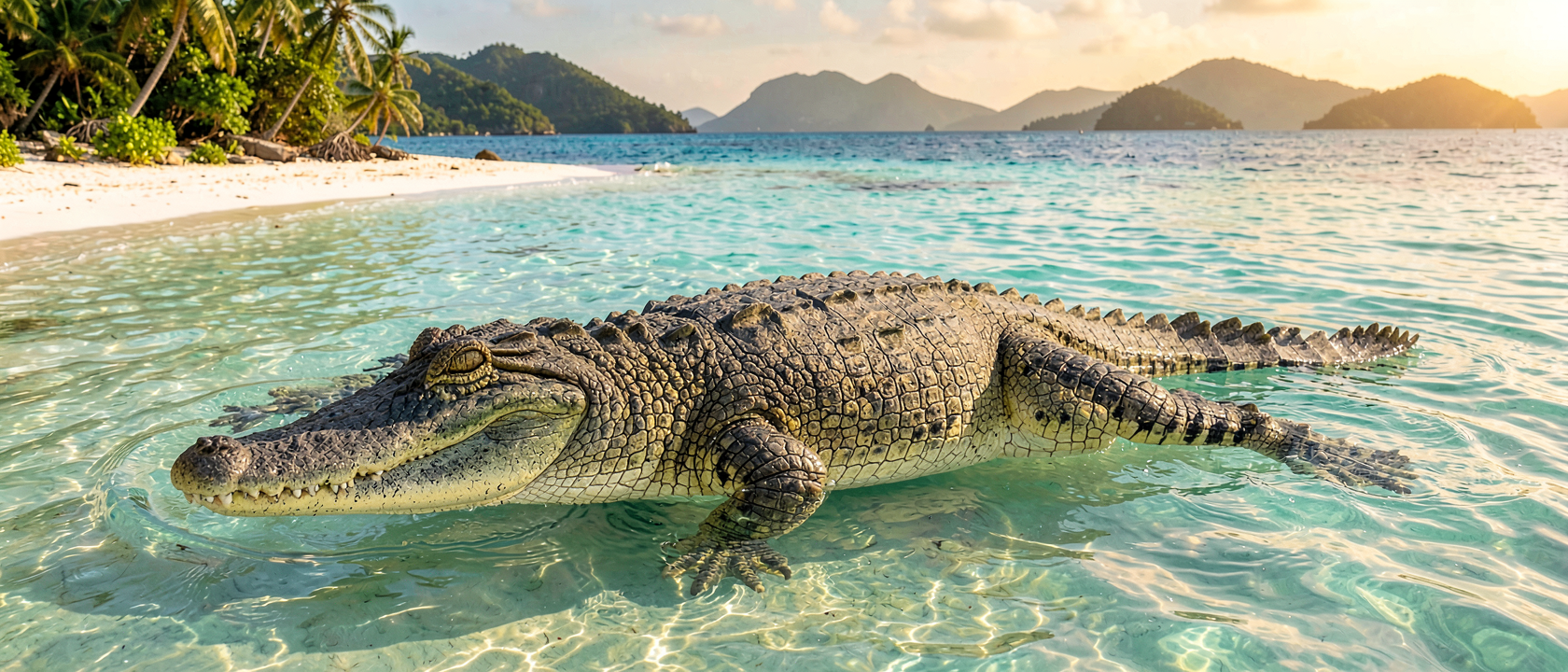
The Crocodile That Swam to Paradise
The Seychelles sit more than 1,864 miles (3,000 km) from the nearest wild population of saltwater crocodiles. Saltwater crocodiles lived there anyway, for who knows how long, before people arrived. A paper published January 28, 2026 in Royal Society Open Science, written by Stefanie Agne, Patrick Arnold, Berthilde Belle, Nicolas Straube, Michael Hofreiter and Frank Glaw of the Bavarian State Collections of Natural History and the University of Potsdam, sequenced mitochondrial DNA from museum skulls and teeth belonging to the archipelago’s extinct crocodile population. The animals turned out to be Crocodylus porosus, the saltwater crocodile found today from India to northern Australia, not Nile crocodiles and not a species unique to the islands, as some researchers once suspected. Frank Glaw, the study’s senior author, puts the minimum crossing distance at 1,864 miles (3,000 km) of open Indian Ocean, and says the true distance covered may have been considerably longer.
The Tongue That Makes the Ocean Survivable
Saltwater crocodiles carry something freshwater crocodiles and Nile crocodiles (Crocodylus niloticus) do not have in comparable form: specialized glands on the tongue built to excrete excess salt. The glands let Crocodylus porosus sit in full seawater for extended stretches without the dehydration that would kill most reptiles long before a crossing like that one ended. Researchers describe the rest of the trip as drifting more than swimming, an animal that lets the current do the work, burning far less energy than one fighting it the whole way. That exact mechanism has never been directly observed. It is the explanation that fits the genetics, a hypothesis about how the crossing was made rather than a recorded migration.
Why the Gland Was Worth Keeping
That salt tolerance, the study’s authors argue, is also the reason Crocodylus porosus reads as a single species at all, despite a historic range that once ran roughly 7,500 miles (12,000 km) end to end, from Vanuatu in the Pacific to the Seychelles in the Indian Ocean. Stefanie Agne of the University of Potsdam, the paper’s first author, says the genetic patterns point to populations staying connected across huge distances and long stretches of time, a sign of a species that keeps moving rather than settling into isolated pockets. It is an interpretation, not a tally of individual journeys, but it explains something that ought to look strange: a crocodile scattered across a third of the globe should have split into several species by now. Mostly, it hasn’t. The same gland that handles seawater, in this reading, is what keeps the species from splitting apart.
The Nile Crocodile That Wasn’t
For decades the assumption ran the other way. Western naturalists took the Seychelles crocodiles for Nile crocodiles, Crocodylus niloticus, somehow carried or introduced from Africa, the geographically tidy answer. In 1994, researchers working from skeletal traits challenged that story, arguing the Seychelles population was in fact the saltwater crocodile, native to the east rather than the west. The 2026 mitochondrial DNA confirms that 1994 call directly. Three decades later, the overlooked anatomists turn out to have been right, and the African-origin story is the one that dies.
What the Mothers Don’t Tell Us
Mitochondrial DNA only tells half the story, because it passes down the maternal line alone. It can show which female lineage made the crossing to the Seychelles; it says nothing about the fathers, and it can miss finer population differences that nuclear DNA might carry. The study’s own sampling makes the limit visible: full mitochondrial genomes from 11 museum specimens across five Crocodylus species, plus a further 187 saltwater crocodiles checked at one mitochondrial region and 13 more at another, turned up 19 distinct genetic signatures with no clear geographic pattern separating one population from another. Whether a look at nuclear DNA would carve that single genetic picture into more populations, telling apart a crocodile from northern Australia from one that once lived in the Seychelles, is not something this data can answer. That question is waiting on future sequencing.
The Population That Lasted Decades, Not Centuries
Expedition records from more than 250 years ago describe crocodiles as common along the Seychelles coastline. Permanent settlers arrived in 1770. Within 50 years the crocodiles were gone, hunted out of an archipelago their ancestors had reached by drifting across open ocean that stops almost everything else in its class. A population that out-traveled nearly any other reptile, spread across two oceans by sheer persistence, lasted only decades once people showed up. What survives of it now sits in museum drawers in the Seychelles, London and Paris: skulls and teeth that waited roughly two centuries for someone to read what was in them.