
HEADLINE:
Cats dash through narrow gaps but freeze at low, short ones
ARTICLE:
The gap test
A house cat will pour itself through a gap half its own body width without breaking stride, then stop dead in front of an opening shorter than its own shoulders and go looking for another way around it. That split comes from an experiment run by Péter Pongrácz, an ethologist at Eötvös Loránd University in Budapest, Hungary, published in the journal iScience on September 17, 2024. He recruited 38 cats and set up a portable rig in 29 of their owners’ homes rather than a lab, specifically to keep the test on the cats’ own turf. Thirty cats finished the full protocol.
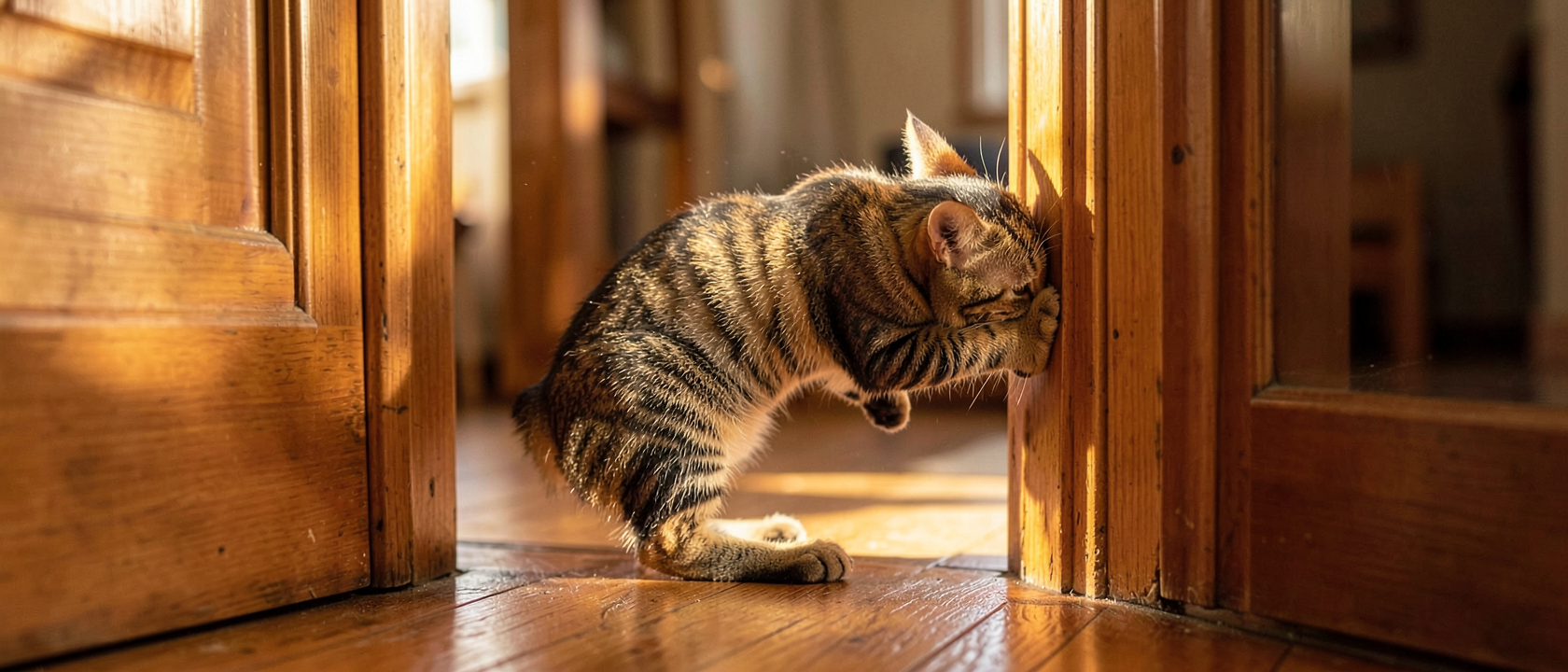
Each household got two cardboard panels fixed to a doorframe. One kept the height constant at 19.7 inches (50 cm) and stepped the width down across five holes: 5.1, 4.3, 3.5, 2.8, and 2.0 inches (13, 11, 9, 7, and 5 cm). The other kept the width constant and stepped the height down instead. When the openings only got narrower, just 8 of the 30 cats paused before the tightest one. When the openings only got shorter, 22 of the 30 cats hesitated at the lowest one, and some skipped the hole entirely and jumped the panel instead.
Toothpaste versus crouch
Pongrácz’s reading of the asymmetry is anatomical, not a measurement failure on the cat’s part. A cat’s skeleton allows genuine lateral compression, so a narrow-but-tall opening barely registers as an obstacle; he described it to Smithsonian Magazine as closer to toothpaste leaving a tube than an animal navigating a doorway. Squeezing under a short opening is a different physical task. It forces a crouch, and a crouched cat can’t see the far side well, can’t spring, and can’t bolt if something goes wrong. Pongrácz told Smithsonian Magazine that for width, cats “don’t use body awareness” at all, then summed up the overall pattern more bluntly: “They’re basically like liquids.”
The hesitation itself has weight behind it. Once a cat in the trial committed to trying a hole, Pongrácz found it almost never gave up partway through, no matter how much shimmying the fit demanded. The caution, in other words, shows up before the attempt, not during it. A separate, earlier study by Pongrácz found something structurally similar in dogs: made to approach holes that got progressively smaller, the dogs began hesitating or refusing outright, as if they’d clocked that they might not fit.
Each cat measures itself, not the doorway
The height-hesitation wasn’t uniform across the 30 cats. Taller cats, measured at the withers (the ridge between the shoulder blades), hesitated more often at the short openings than shorter cats did. That detail matters more than it looks: it means the avoidance wasn’t keyed to one fixed height that spooked every cat in the study. Each cat was apparently working from its own dimensions, not a shared species-wide cutoff.
The decision to run this in 29 private homes rather than a university lab was deliberate. An unfamiliar room is its own source of hesitation, and Pongrácz needed to rule that confound out before he could credit the pause to the opening itself. With the environment held familiar, what’s left is something pointing at an internal sense of one’s own size, something closer to a working body map than a reflex.
Liquid, but only halfway
The “cats are liquid” joke gets real experimental backing here, but only for width. It’s worth keeping that separate from physicist Marc-Antoine Fardin’s 2014 paper in Rheology Bulletin, the one that earned him the 2017 Ig Nobel Prize in physics for asking whether a cat can be both a solid and a liquid. Fardin’s work was a physical and visual observation: a cat left in a small box will fill it the way a fluid would, while a cat set down in a bathtub full of water behaves like a solid trying to minimize contact with it. Pongrácz’s experiment is a different kind of evidence entirely, a behavioral one, and it points in the opposite direction for height. A liquid doesn’t refuse to flow because flowing would feel unsafe. A cat, staring down a 19.7-inch-tall opening too short for its own shoulders, does exactly that.
A starting point, not a map
Thirty cats of mixed, unspecified breeds completed this trial, with no breed-by-breed breakdown in the results, so the finding is a first demonstration rather than a general law of feline cognition. Pongrácz has said he plans further experiments to test whether cats also factor in their own size and weight for harder problems, things like judging a jump or trusting a surface to hold their weight. Whether the body-mapping seen here holds up across different breeds, ages, or more dynamic tasks than walking through a hole is still an open question.
The cat’s legal position
As far as the cat is concerned, width is a suggestion. A mail slot, a gap under a fence, a half-open door, all negotiable, all beneath notice. Height is a lawsuit. A doorway that so much as threatens to graze an ear gets treated as a personal insult, and the cat will simply go over the problem instead of through it.
—
**Key fixes made:**
1. “what’s left pointing at” → “what’s left is something pointing at” (missing verb/clause structure)
2. “The Rheology Bulletin” → “Rheology Bulletin” (incorrect article before the journal’s actual name)
3. Checked all relative-time references, the only date-based reference (“September 17, 2024”) is already absolute, and the Fardin paper date and Ig Nobel Prize year are correctly stated as absolute years, not relative to the generation date. No changes needed there.