
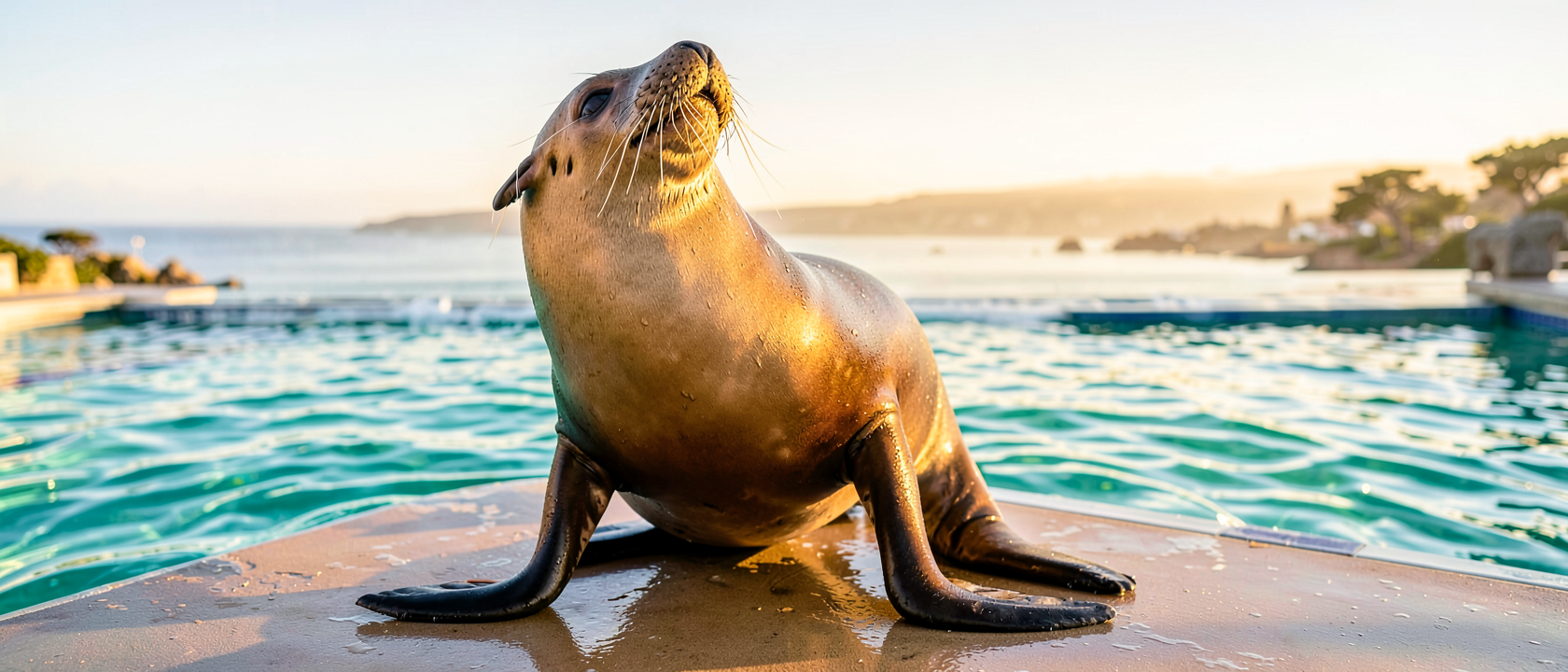
The Contest Nobody Expected Her to Win
Ronan, a 16-year-old California sea lion (Zalophus californianus) at UC Santa Cruz’s Long Marine Laboratory, now keeps a snare-drum beat more precisely than every one of ten human college students tested against her, at every tempo tried.
Comparative neuroscientist Peter Cook (New College of Florida and UC Santa Cruz), along with Carson Hood, Andrew Rouse, and Colleen Reichmuth, published the comparison in Scientific Reports in 2025. They had Ronan bob her head to a drum at 112, 120, and 128 beats per minute, then ran ten undergraduates through the identical task, waving a forearm instead of a head. Ronan’s average tempos landed at 113.1, 121.6, and 129.0 bpm. The humans averaged 112.4, 119.3, and 126.2 bpm. At every tempo tested, at least one of her timing measures beat every single student. This was a controlled experiment with repeated trials and a named research team, run on a sea lion, an animal with small rotating outer ears that separate her at a glance from the true seals she sometimes gets mistaken for.
Ronan came to the lab the hard way. She washed up on Highway 1 in 2009, stranded and malnourished, and wildlife agencies ruled her unreleasable. That is how a stranded pup ended up, years later, out-drumming a room full of undergraduates.
A Tenth of an Eyeblink
What got measured here wasn’t a vibe, it was milliseconds. At her most practiced tempo, Ronan’s timing wobbles by about 15 milliseconds from beat to beat, a margin Cook describes as “about a tenth of an eyeblink,” since a human blink runs around 150 milliseconds. The stranger detail is what happened as the tempo climbed. She did not get sloppier. She got sharper, tracking 128 bpm more tightly than 112 bpm, the opposite of what you’d expect from an animal simply replaying one memorized rhythm at whatever speed came closest.
Built, Not Born
Ronan wasn’t born keeping time. She was built to keep it, over years. As a juvenile she was trained first on a plain metronome, then on music, learning to shift her head-bob as the tempo moved under her. Between July 2023 and March 2024 alone she logged 1,684 stimulus exposures across 146 sessions, part of a career of short practice bouts stretching back over a decade. Cook has noted she’s markedly better now than she was as a young animal, evidence that this is a skill she kept sharpening over her lifetime, not a trick fixed early and never revisited.
The part that matters most is the 112 and 128 bpm trials: speeds she had never drummed to before. If she were just replaying a memorized tempo, a new speed should have thrown her. It didn’t. Cook and his coauthors read that as real entrainment, a system that locks onto a new beat rather than a fixed trick rehearsed at one setting. A sea lion has no evolutionary reason to care about a snare drum. This is a skill assembled the slow way, the way a musician’s timing gets built: repetition, maturation, years.
The Myth This Kills
That result overturns an assumption that followed Ronan since her first appearance in the Journal of Comparative Psychology in 2013. Some biomusicality researchers argued back then that her beat-keeping, while striking for a non-human, was still looser and less reliable than a human’s, on the theory that precise rhythm requires a capacity for complex vocal mimicry that a sea lion doesn’t have. The 2025 head-to-head test kills that framing outright. Same task, same units, and Ronan’s timing beat at least one human measure at every tempo tried. Very few animals manage beat-tracking like this at all, beyond humans, some parrots, and a handful of primates. The myth was never really “animals can’t keep a beat.” It was “a trained sea lion is charmingly close, but not as good as us.” The numbers say otherwise.
What Nobody Knows Yet
The study doesn’t say whether Ronan’s rhythm sense runs on the same neural wiring that lets a person tap a foot to a song. That question predates this paper and stays open after it. It’s also unclear whether she was born with the raw capacity and her training simply taught her to deploy it on command, or whether the training built the ability from nothing. And there’s no evidence yet that other sea lions, or other pinnipeds, can do anything like this. Researchers plan to test more sea lions, and Cook suspects others could learn some version of it, but he expects Ronan would still stand out. Right now she is one exhaustively trained animal, not a demonstrated trait of her species, and the team says so plainly.
The Better Deal
After each round of testing, the ten human volunteers got a thank-you and a debrief. Ronan got a toy stuffed with fish and ice. Nobody asked the students how they felt about that.