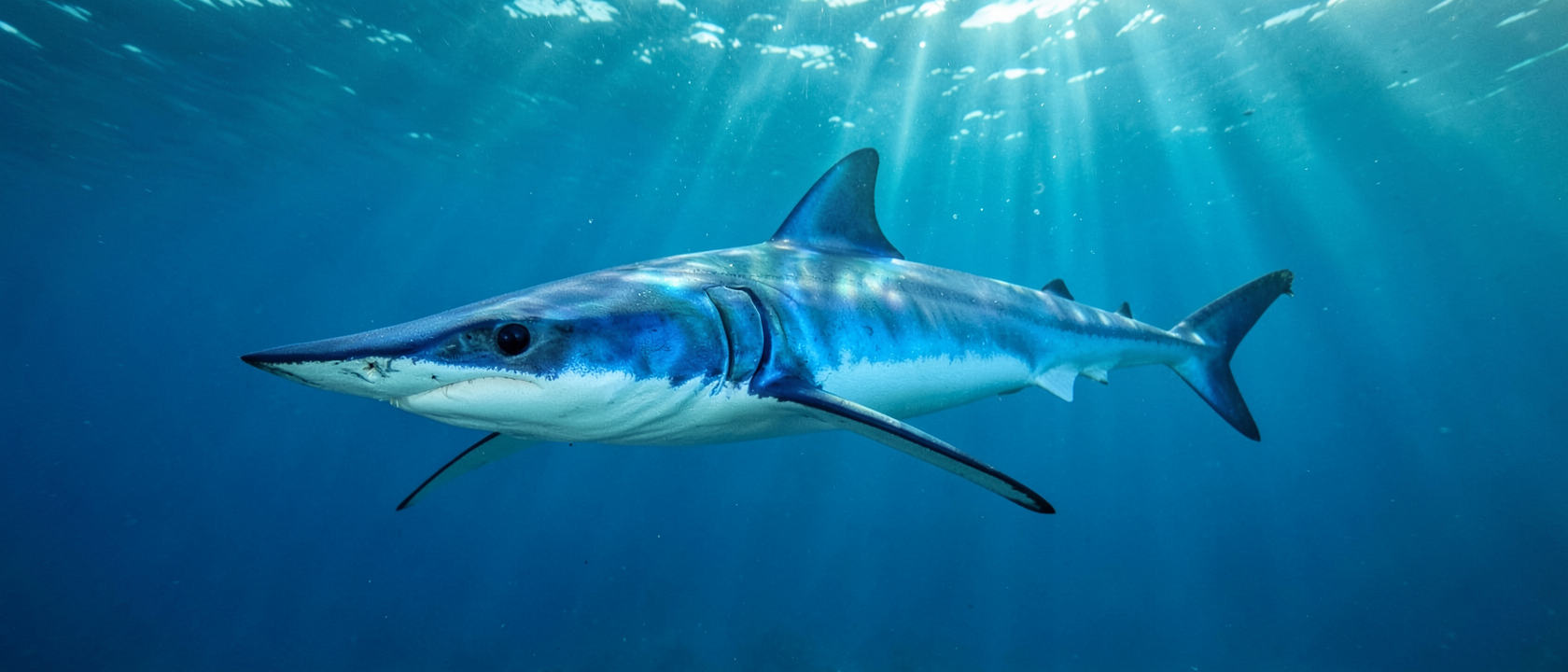
The Shark With No Fixed Color
The blue shark (Prionace glauca) might not be blue in the way anyone assumed, and it might not stay blue for long. Researchers at the City University of Hong Kong dissected the skin of this species and found something inside its dermal denticles, the tiny tooth-like scales that cover a shark from nose to tail, that had never been documented in any shark before: microscopic guanine crystals sitting next to sacs of melanin, arranged in a way that could let the animal actively shift its own color. The team, led by postdoctoral researcher Viktoriia Kamska and lab head Mason Dean, presented the work at the Society for Experimental Biology Annual Conference in Antwerp, Belgium, in July 2025. Blue, Kamska has noted, is one of the rarest colors nature produces at all, and the cobalt flank and white belly that give this species its name have long been assumed to be simple, fixed pigment, the same way most fish get their color. The CityU findings contradict that assumption directly. The blue is structural, built from layers of reflective crystal rather than dye, and structural color, unlike pigment, can change if the structure underneath it changes.
Bags of Mirrors, Bags of Black
Here is the machine underneath the color. Inside each denticle’s pulp cavity, the small internal chamber beneath the scale’s hard cap, sit stacks of guanine crystals spaced so narrowly that they reflect blue wavelengths of light straight back out. It is the same physical trick behind a butterfly wing or a peacock feather, where color comes from structure and not from dye. Right beside those crystal stacks are sacs of melanin, a dark pigment that soaks up the wavelengths the crystals do not reflect, which sharpens and deepens the blue instead of letting it wash out gray. The researchers described the two structures in blunt, physical terms: bags filled with mirrors, and bags with black absorbers, packed side by side in the same tiny cavity. Change the spacing between the mirror layers, even slightly, and the wavelength they reflect changes with it. Narrow the gaps and the skin reads blue; widen them and the color shifts toward green and gold. That is the whole mechanism in one move.
Camouflage Tuned to Depth
Here is what the mirrors might be for. The team’s hypothesis is that as a blue shark swims deeper, the rising water pressure could physically compress those guanine crystal layers, tightening the spacing and pushing the reflected color toward the darker blues that dominate deep water. If that holds up, the shark’s skin would be tracking its own depth in real time, adjusting its camouflage to match the light around it the way a room feels darker the farther you step from a window. It would make Prionace glauca the first shark species documented with a pressure-responsive color-change mechanism built into its skin, rather than a color that simply is what it is from birth to death.
Simulated, Not Yet Seen
None of this has been observed yet in a living, free-swimming blue shark. What exists so far is a computational model of the denticle structures, built from optical and electron microscopy and spectroscopy of skin samples, not footage of a shark changing shade at depth. Kamska and Dean are explicit that the next step is testing whether the mechanism actually operates in a real animal under real pressure changes in open water, not just on a screen. The exact trigger, whether it is pressure alone, humidity, or some combination of the two, is also still unconfirmed. Until then, this is a well-supported hypothesis about what the shark’s skin is built to do, not a filmed demonstration of it doing it.
The Ocean’s Original Mood Ring
As far as the blue shark is concerned, blue was never the whole story. It might be more of a starting color than a fixed one, and maybe not the one it keeps once it stops caring what is watching from above. Forget mood rings that need body heat and a plastic band: this is a fish quietly retuning its own crystal shelving on the way down, redecorating one denticle at a time as the sunlight runs out overhead. Chameleons have been running the guanine-crystal trick for years. The blue shark may have been running it too, just deeper, and a lot more quietly.