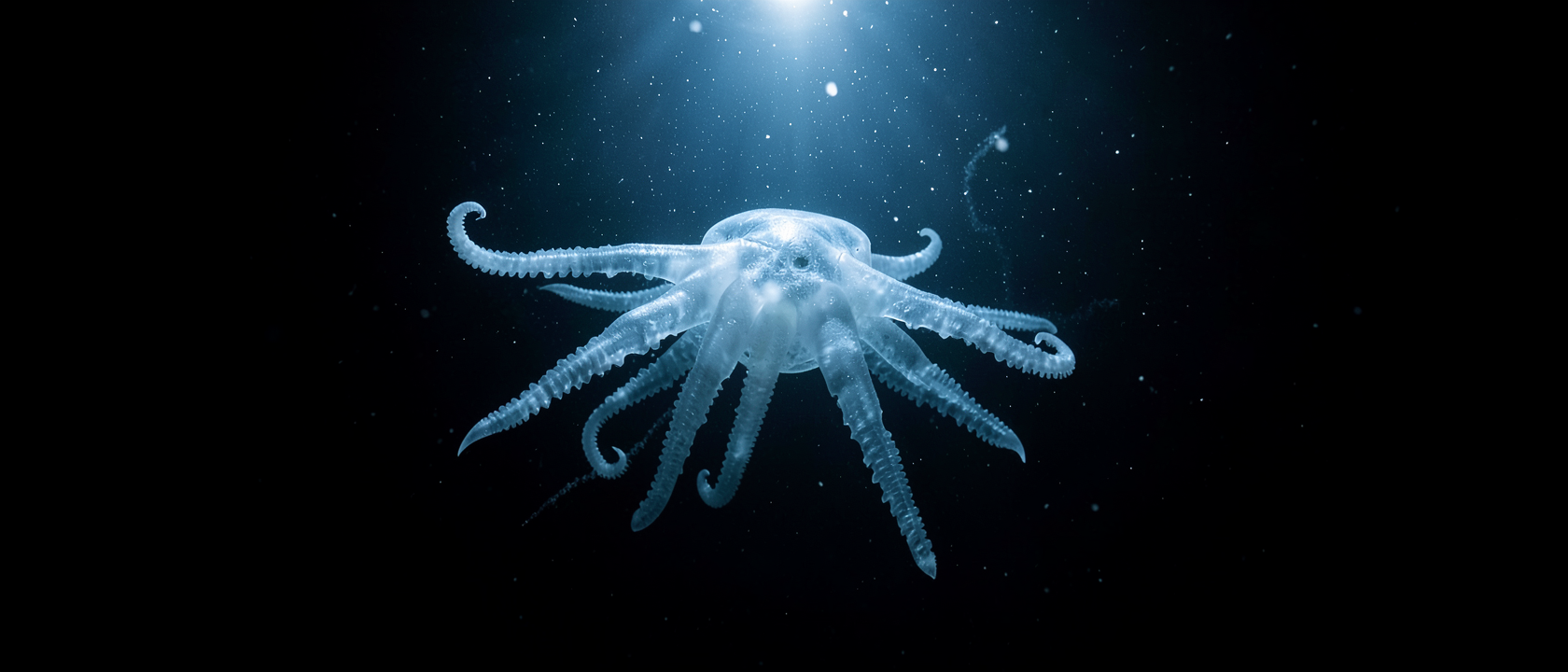
A hundred years of nothing, then a baby
For a century, the heaviest invertebrate on Earth existed, as far as science was concerned, as a collection of fragments: arm fragments from whale stomachs, beaks from whale and seabird stomachs, a few dead animals taken as bycatch. British zoologist Guy Coburn Robson formally described Mesonychoteuthis hamiltoni in 1925 from two brachial crowns (arm fragments) recovered from a sperm whale’s stomach, and for the 100 years after that paper appeared, not a single confirmed frame of a living individual in its habitat existed. Adults can reach 23 feet (7 m) in total length. The largest reliably weighed specimen, an adult female caught in the Ross Sea in 2007 and examined at the Museum of New Zealand Te Papa Tongarewa, registered 1,091 pounds (495 kg). When the confirmation finally came, on March 9, 2025, it was a juvenile barely 12 inches (30 cm) long.
ROV SuBastian, deployed from the research vessel Falkor (too) during a 35-day Ocean Census flagship expedition near the South Sandwich Islands in the South Atlantic Ocean, was descending through the water column when the animal appeared. It was not the target of the dive. At 1,969 feet (600 m) depth, a transparent, glassy juvenile colossal squid drifted into frame, and the footage ran live back to shore.
Why you could practically see through it
Transparency in juvenile colossal squid is not an incomplete version of the adult. It is a working strategy. The mesopelagic zone receives just enough diffuse light filtering down from above to silhouette an opaque body against it. A transparent body has no silhouette to betray. As M. hamiltoni matures, it loses that transparency and becomes the large, stocky, opaque animal familiar from strandings and bycatch. How exactly that transition unfolds, and across what timeframe, is not known.
The species identification came down to hooks. Both M. hamiltoni and the glacial glass squid (Galiteuthis glacialis) are transparent as juveniles, and both carry sharp hooks at the ends of their two longer tentacles. The structural difference is on the eight arms: colossal squid have swiveling hooks running along the middle sections of those arms; G. glacialis does not. That feature, visible on camera, was what two independent experts, Dr. Kat Bolstad of Auckland University of Technology and Dr. Aaron Evans, used to confirm the species identity. Neither was aboard the vessel.
The expert was on shore, and that was the point
The vessel’s telepresence system streamed the footage live to Bolstad and Evans while ROV SuBastian was still at depth. They reviewed it, checked the arm hooks, and confirmed the species. The identification held.
This is a methodological point, not just a logistical footnote. A longstanding assumption in deep-sea field work has been that a species identification of real consequence requires the right taxonomic authority to be physically on the boat. The colossal squid sighting documents a workable alternative: one live feed, two shore-based specialists, one definitive answer. As a replicable model for authenticating deep-sea firsts, the March 9, 2025 sighting is now the high-profile test case that passed.
It was not hiding in the abyss
The assumption built up across 100 years of indirect evidence was, effectively, that a live colossal squid in its habitat was structurally inaccessible. The animal was presumed to occupy depths too extreme or too remote to film, and the best available data would always come from prey remains and dying bycatch. That framing carried an implicit claim: that the gap in the record was the animal’s fault.
The March 9, 2025 footage directly contradicts it. The juvenile was present and filmable at 1,969 feet, the upper portion of the mesopelagic zone, well within the operational range of modern research ROVs. The species was not inaccessible. That juvenile, drifting in the water column, had no particular reason to be anywhere else. The gap in the record was a gap in looking.
The cockatoo pose, and the phone call that confirmed it
On January 25, 2025, an earlier Falkor (too) expedition in the Bellingshausen Sea near Antarctica was underway when Dr. Thom Linley of the Museum of New Zealand Te Papa Tongarewa, watching ROV footage live from the vessel’s mission control room, caught something on the monitor. A glacial glass squid (Galiteuthis glacialis) had appeared at 2,254 feet (687 m) depth, holding its arms loosely spread above its head, a posture researchers have named the “cockatoo pose.” Linley asked for the ROV’s descent to be paused. His read on the situation: “I know it’s a cute little squid, but this might be important.”
He contacted Dr. Bolstad. The footage was confirmed. The sighting became the first confirmed live record of G. glacialis in the Southern Ocean. One animal, one control room, one phone call. As an anecdote, it describes a single moment involving a single squid, and says nothing general about how G. glacialis behaves. What it does share with the colossal squid sighting two months later is the same basic architecture: a live feed, the right specialist on shore, and a question answered before the ROV surfaced.
What nobody has seen yet
The March 9, 2025 footage is a beginning, not a summary. How M. hamiltoni transitions from a 12-inch transparent juvenile to an animal approaching 1,091 pounds is entirely undocumented in the wild. No intermediate life stage has been filmed or described in situ. Adults have never been observed alive at depth; everything known about their morphology comes from dead or moribund individuals. Beak fragments recovered from sperm whale stomachs suggest specimens larger than any physically recovered individual may exist, but actual maximum size remains unconfirmed.
At the time the expedition’s findings were announced, one additional squid first-sighting captured by ROV SuBastian during the same expedition remained pending expert confirmation. The Southern Ocean, by researchers’ own framing, is vastly undercharted. The full life cycle of the heaviest invertebrate on the planet is, at this point, almost entirely unobserved, with one corner of the page turned.