The Oldest Ant in the World Was Already a Monster
The oldest confirmed ant in the fossil record was already, at 113 million years old, carrying one of the most extreme predatory jaw systems in insect evolutionary history.
That ant is Vulcanidris cratensis, described by entomologist Anderson Lepeco and colleagues at the Museum of Zoology, University of São Paulo, in a paper published in Current Biology on April 24, 2025. The specimen is a single flattened rock impression from Aptian limestone of the Crato Formation, northeastern Brazil, radiometrically dated to approximately 113 million years ago, Early Cretaceous, when non-avian dinosaurs still had roughly 47 million years ahead of them.
Before this find, the oldest known ant fossils came from amber in France and Myanmar, approximately 99 to 100 million years old. V. cratensis beats that record by roughly 13 million years, a margin large enough to restructure what we thought we knew about when ants first appeared and what they looked like when they did.
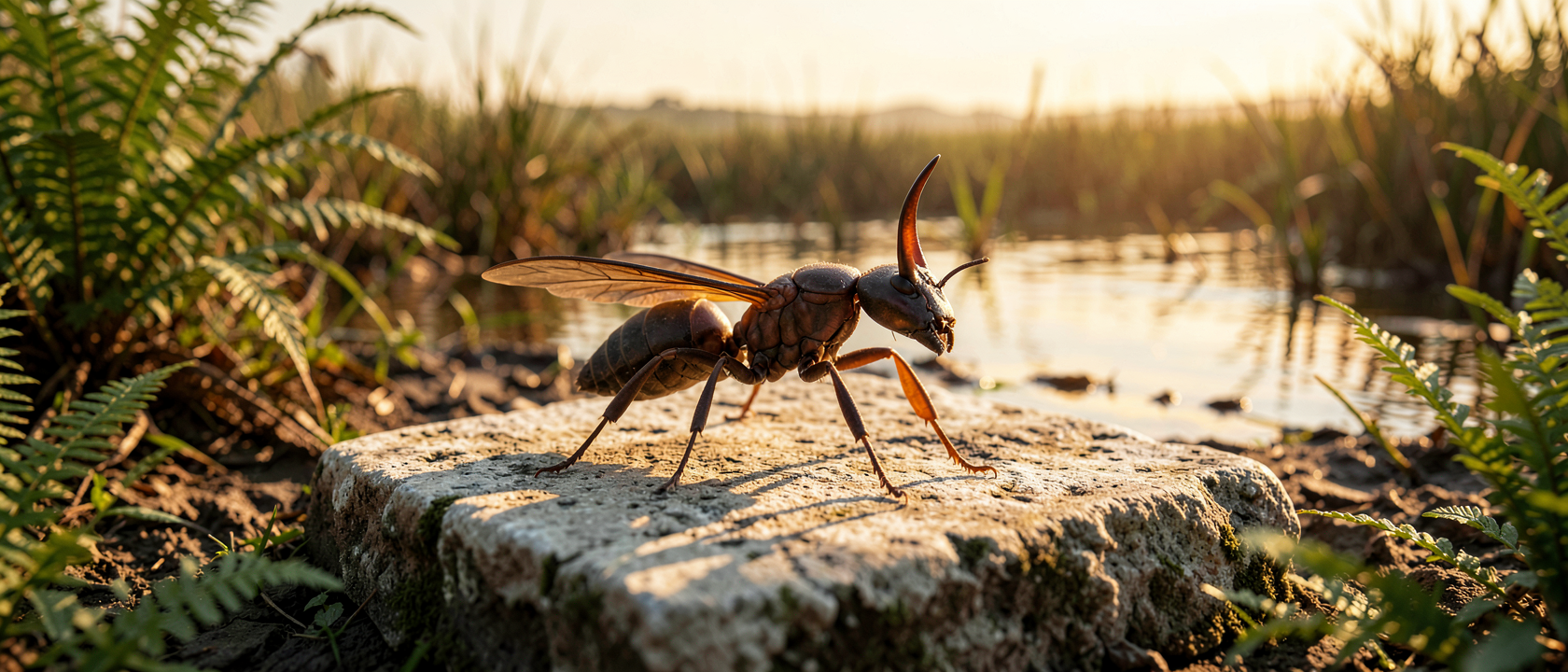
What it looked like: a winged ant just over half an inch long (13.5 mm), with scythe-like jaws that moved in a direction no living ant’s mandibles move.
Jaws That Moved the Wrong Way (On Purpose)
Every living ant closes its mandibles horizontally, the two blades sweeping toward each other from left and right. Hell ants, the extinct subfamily Haidomyrmecinae, to which V. cratensis belongs, did something structurally different: they snapped their jaws upward, vertically, bringing the mandible tips toward the front of the face.
The geometry matters because of what sits there. Hell ants carry a prominent projection of the clypeus, the shield-like plate at the front of the face, extending downward in front of the mouth. When the mandibles snap up, they close against that projection rather than against each other. The head becomes the other jaw. Prey caught between the upward-swinging mandibles and the downward-facing clypeal projection has nowhere to go.
Because V. cratensis survived as a compression fossil rather than a three-dimensional amber inclusion, the research team used micro-computed tomography (a non-destructive technique that reconstructs internal structure from X-ray slices) to extract the anatomy from the flattened limestone. The scans confirmed the vertically articulated mandibles and the orientation of the clypeal projection, enough to establish that the full hell ant predatory system was present and functional.
South America Changes the Map Entirely
The accumulated hell ant fossil record before this paper came from amber in Europe, Asia, and North America, all dating between roughly 80 and 100 million years ago. V. cratensis breaks that pattern in one specimen: it is the first hell ant found on the South American continent, and the first found as a rock impression rather than preserved in tree resin.
Those two novelties are connected. Amber forms in forested environments; the Crato Formation’s depositional environment is interpreted as a seasonal, semi-arid lacustrine wetland. Hell ants were living in landscapes that amber simply does not record. The amber census was a sampling artifact of which environments happen to preserve insects in three dimensions.
At 113 million years old, V. cratensis is approximately 13 million years older than any Northern Hemisphere hell ant specimen. Lepeco and colleagues conclude in the paper that South America was the most likely evolutionary origin point for Haidomyrmecinae. The authors also raise, as an interpretation rather than a settled finding, that hell ants may represent the earliest lineage to diverge within the ants as a whole, which would make that origin point relevant to the entire evolutionary history of Formicidae, the family that contains over 13,800 known species out of an estimated 22,000.
Complexity Did Not Need a Runway
A common working assumption holds that highly elaborated anatomical structures should leave a paper trail of simpler predecessors. Vulcanidris cratensis is a counter-case. At 113 million years old, it is the earliest confirmed ant specimen in existence, and it was already carrying the full hell ant predatory apparatus: vertically articulated mandibles, a clypeal projection configured to pin prey against them, a morphological syndrome so distinct from every other ant that it defines its own subfamily. No simpler intermediate hell ant precedes it in the record.
That absence does not prove there was no simpler phase, the lineage could have originated earlier and spent millions of years as something less extreme. What the evidence does undermine is the confidence with which the gradual-runway assumption had been applied to early ant morphology. Researchers had treated the amber-derived record as broadly representative; that record opened at around 99 to 100 million years ago and already showed fully elaborated hell ants. It was easy to read the 100-million-year mark as something close to the beginning. It was not.
Gone, and Nobody Knows Why
Hell ants are extinct. The entire subfamily Haidomyrmecinae, now confirmed to span roughly 113 to 79 million years ago, disappeared at or near the end of the Cretaceous, approximately 66 million years ago, leaving no living descendants. Among the more than 13,800 known living ant species, not one closes its mandibles vertically.
Lepeco and colleagues point to geological events near the Cretaceous boundary as a likely contributing factor. Researchers have also noted that the spread of flowering plants across the late Cretaceous restructured ground-level habitats and prey communities; whether that specifically disadvantaged the hell ant hunting strategy remains a hypothesis, not a finding supported by direct evidence for Haidomyrmecinae.
Two questions remain open. First, whether an even older ant fossil exists in rock, the Crato Formation has demonstrated that non-amber preservation can yield detailed Early Cretaceous ant specimens, and other formations may hold something older. Second, where exactly hell ants lived: even with V. cratensis added, the known specimens cover a fraction of the environments these ants occupied across approximately 34 million years. The full geographic range of Haidomyrmecinae is unknown, and what happened between the semi-arid wetlands of Cretaceous Brazil and extinction is, for now, a question the limestone hasn’t answered.