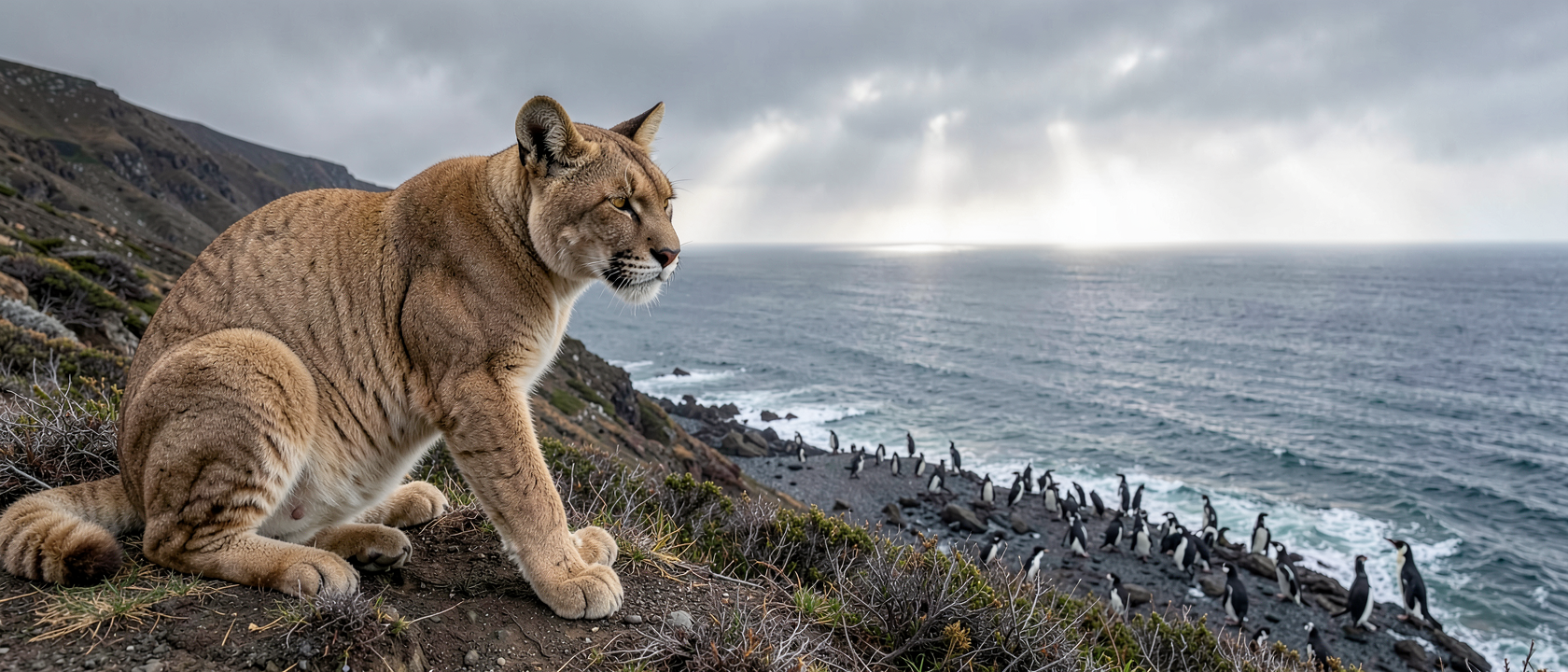
A Crowd at the Colony
Fourteen pumas (Puma concolor) wore GPS collars in Monte León National Park, on the Patagonian coast of Argentina’s Santa Cruz Province, for a study that ended up complicating everything textbooks say about the species. Nine of those pumas hunted Magellanic penguins (Spheniscus magellanicus) from a mainland colony of roughly 40,000 breeding pairs. Five stuck to other prey. Mitchell Serota, who ran the fieldwork as a doctoral student at UC Berkeley, and his co-authors published the results on December 17, 2025, in Proceedings of the Royal Society B, drawing on field seasons from 2019 to 2023.
The nine penguin-eating pumas met each other 254 times over the study. The five that ignored penguins met each other four times. Same species, same park, same years of tracking; one group crossed paths constantly, the other almost never did. Local puma density in the park came out more than double the highest concentration ever recorded in Argentina.
Following the Buffet, Not Each Other
The overlap has a shape, and it traces the coastline. During the penguins’ breeding season, when tens of thousands of birds crowd a stretch of beach about 1.2 miles (2 km) long, the penguin-hunting pumas barely left it. Once the birds moved offshore for the summer, those same cats’ home ranges roughly doubled, stretching back into the drier interior where prey is thinner and more spread out.
Most of the 254 encounters happened within 0.6 miles (1 km) of the colony, and penguin-hunting pumas turned out to be nearly five times more likely to run into another puma inside that radius than non-hunters were. None of this required the cats to look for company. They were all tracking one fixed, seasonal buffet, and the buffet is what put them within sight of each other.
When Rivalry Stops Paying Its Way
Defending a territory is not free. Patrolling it, marking it, occasionally fighting for it, all of that draws on the same energy budget a puma needs for hunting. The paper’s authors reach for the resource dispersion hypothesis to explain what they saw: when food is abundant, concentrated, and reliably in the same place, an animal gains less from defending it than it would spend trying. Forty thousand breeding pairs is more penguin than one puma, or several, could realistically fence off as private property.
Under that arithmetic, tolerance gets cheaper than territoriality. The researchers are careful to frame this as a shift in payoff, not in personality: the same cost-benefit calculation pumas already run is simply landing on a different answer, because one input, an unusually rich and stationary food source, has changed. Solitary living was never a fixed trait of the species. It was the cheapest option under the food conditions pumas usually meet.
Solitary Isn’t a Law, It’s a Default
The standard description of Puma concolor is a strictly solitary cat that avoids other adults outside of mating and holds an exclusive range. It also comes with a second assumption: that pumas prefer to hunt grazing mammals like guanacos, not birds the size of a penguin. Monte León’s penguin-hunters break both descriptions without acquiring new biology. Hand the same cats a concentrated enough meal, and they cluster at densities that would be unthinkable anywhere else pumas have been counted in Argentina, trading 254 encounters where a comparable group of non-hunters logged four.
The textbook picture was not wrong about how pumas usually behave. It was only ever tested under ordinary conditions, where prey is scattered enough that avoiding rivals pays, and where the prey on offer is a mammal rather than a seabird. Give pumas a food source big enough to break that logic, and the solitary cat stops being a law of the species and turns out to have been a default setting all along.
“A Couple of Individuals,” Until the Cameras Disagreed
Before the GPS data came back, the working assumption on the research team was that penguin-hunting was an oddity, a couple of unusual pumas with a taste for seabird rather than anything widespread. Camera traps along the colony beach argued otherwise: the same stretch of shore turning up detection after detection of different cats, arriving in numbers nobody had planned to find. In one striking case, a single collared puma traveled dozens of kilometers (some tens of miles) outside Monte León to visit an entirely separate penguin colony, a case Serota’s team offers as a sense of how strong the pull of penguins can be for one individual cat, not as a pattern measured across the population.
What Serota’s Team Still Doesn’t Know
The paper is upfront about its gaps. Nobody yet knows how many penguins an individual puma kills, which makes it hard to judge what this predation means for the colony’s numbers long-term, even though penguin counts at Monte León currently look stable or growing. It is also unclear whether a smaller or newer colony, without 40,000 pairs to absorb the pressure, would hold up the same way, or whether the puma density recorded here is a lasting feature of the park or a temporary spike. Serota’s team lists a next step as examining whether the penguin habit is changing how these same pumas hunt guanacos, their more traditional prey. None of the three questions has an answer yet.