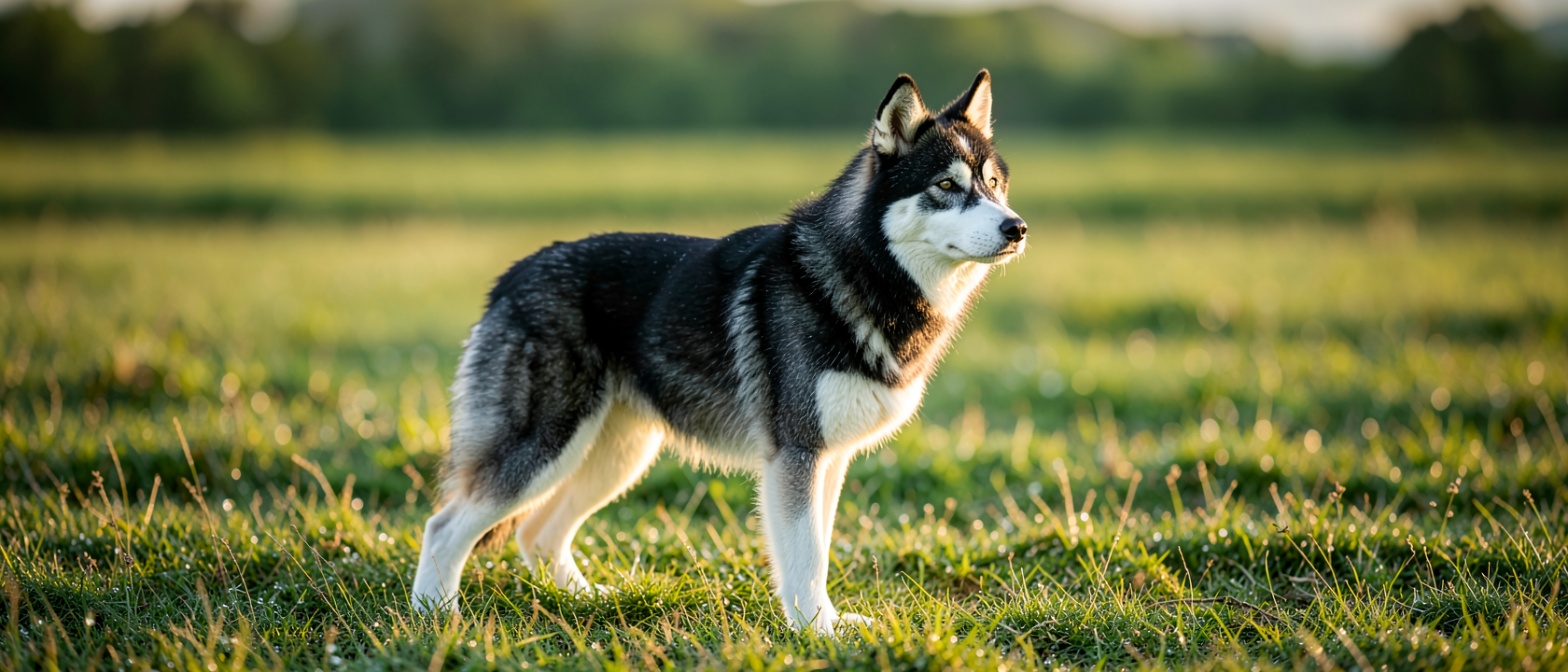
The Chihuahua has more brain to spare than the Siberian husky, and it’s worse at its job
In domestic dogs (Canis lupus familiaris), the breeds people trust with the hardest work have the smallest brains for their size, not the biggest. Ana Balcarcel and colleagues at the University of Montpellier measured 1,682 adult dog skulls from 172 breeds held at the Natural History Museum Bern, in Switzerland, comparing brain volume against body size, a measure the paper calls relative endocranial volume. Working breeds, Siberian huskies, Great Pyrenees, rottweilers, came out with the smallest ratios in the whole sample. Companion breeds, Chihuahuas, Pomeranians, Yorkshire terriers, had the largest. The team also pulled scores for 14 behavioral traits from the Canine Behavioral Assessment and Research Questionnaire, a standardized evaluation used across breeds. The small-brained working dogs scored higher on trainability. The big-brained lapdogs scored higher on fear, aggression, and separation anxiety. The study ran in Biology Letters on November 13, 2024.
It’s not a smaller brain. It’s a differently built one.
Size alone doesn’t explain the reversal. Balcarcel’s team also found that bigger dogs and smaller dogs differ in the composition of their brain tissue itself, not just in how much of it there is. A Chihuahua’s brain isn’t a scaled-up copy of a Siberian husky’s, and a husky’s isn’t a shrunken copy of a Chihuahua’s. That points to working breeds packing complex cognitive load into a more efficiently organized brain rather than a bigger one. Earlier research already showed working breeds outperform other dogs on executive function, meaning behavioral control and short-term memory. As Balcarcel put it, breeding hasn’t only changed dogs’ body sizes and proportions, it has changed their brains “in a significant way.”
Nobody was breeding Chihuahuas to take orders
A wild animal is shaped by whatever keeps it alive long enough to reproduce. A dog is shaped by a job description someone wrote for it. Balcarcel described this as “evolution under human hands,” a directed kind of artificial selection rather than a natural one. A sled team has no use for a Siberian husky that won’t take direction, so generation after generation, working lines were bred for trainability and executive function, the exact trait the skull data now shows tracking with a smaller relative brain. Toy breeds were never bred for obedience. They were bred for affection, for attention-seeking, for how they looked in someone’s lap. Nothing was selecting fearfulness or aggression out of that gene pool, because nothing needed it gone. That’s the reversal hiding behind every clip of a small dog losing its mind at the doorbell: the dog isn’t badly wired. It was optimized for a job that never included following orders.
Bigger brain, smarter animal, except here
Across wild mammals, this rule holds up well: a bigger brain relative to body size tracks with more complex cognition and better survival odds, standard zoology. Domestic dogs break it more than once. Dogs already carry brains that are, on average, 20% smaller relative to body size than their closest wild relative, the gray wolf (Canis lupus), and still perform a wide range of cognitive skills on par with wolves. A separate neuroanatomy study out of the Natural History Museum Bern found that dogs show up to four times more variation in brain shape than wolves do, with reshuffled sensory regions, and that “ancient” breeds like the Siberian husky kept a more wolf-like brain structure than “modern” breeds like the German shepherd. Then, inside the dog side of the comparison, Balcarcel’s own skull study found the reversal that opened this piece: the smallest relative brains sit in the breeds rated most trainable. Multiple separate datasets, all pointing away from the same assumption.
What nobody’s measured yet: the shape of the thing
Balcarcel’s team measured brain size and, in broad terms, tissue composition. They have not yet measured brain shape within this same behavioral dataset, and shape is the more likely candidate for explaining specific breed talents rather than trainability in general. The neocortex, the folded outer layer tied to higher-order processing, is the structure most likely to vary in ways that map onto particular jobs, from scent work to herding to guarding. Connecting that shape variation, across the 172 breeds in the collection, to the fear, aggression, and trainability scores already on record is described as the next step. It hasn’t happened yet. Which fold of tissue explains why one breed is built to take a command and another is built to guard a lap is, for now, a genuinely open question. Even the idea that a bigger relative brain directly causes a toy breed’s fear or clinginess is still just the researchers’ working hypothesis, not a proven mechanism, the correlation is solid, the causal arrow isn’t.