
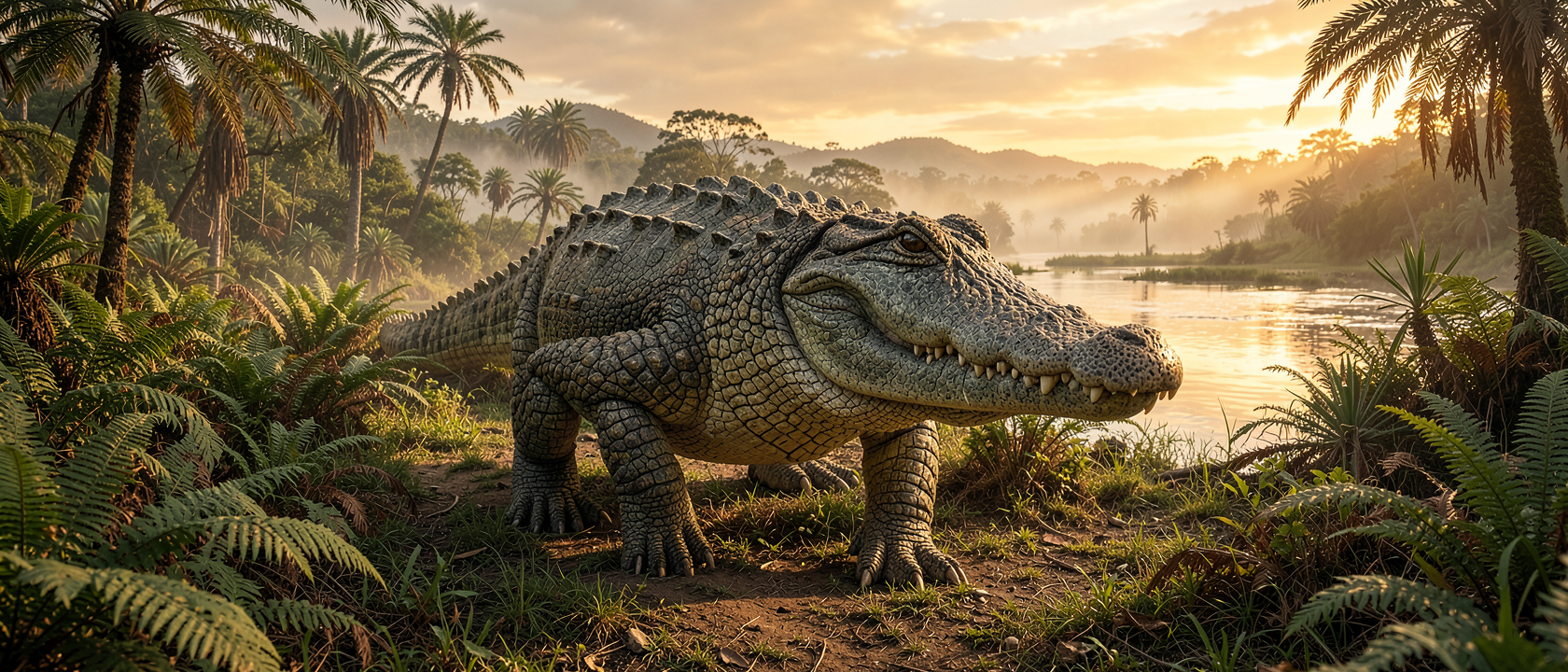
An 11.5-Foot Predator From the End of the Cretaceous
Picture the last days of the dinosaurs and you probably picture a dinosaur in charge. In one Patagonian river system, that job belonged to something else. Kostensuchus atrox weighed about 550 pounds (250 kilograms) and measured up to 11.5 feet (3.5 meters) long, roughly the length of a small car. It lived about 70 million years ago in the Chorrillo Formation of southern Patagonia, Argentina, during the Maastrichtian, the final stretch of the Cretaceous period before the asteroid impact that ended the dinosaurs’ run. Its skeleton places it among the peirosaurid crocodyliforms, an extinct lineage related to today’s crocodiles and alligators, a branch of the family tree with no dinosaurs in it at all. And the evidence from its jaws points to an animal that ate medium-sized dinosaurs for a living, the same animals most people assume were running the show.
A Skull Built to Crush Bone
The specimen is unusual for how complete it is: a skull, jaws, and multiple body bones preserved together, instead of scattered fragments pieced together from different animals. The skull is wide and heavily reinforced, and the teeth are shaped for gripping and crushing rather than slicing, the kind of build an animal needs to hold onto prey that is still fighting. Fernando Novas, of the Museo Argentino de Ciencias Naturales “Bernardino Rivadavia,” and colleagues described the fossil in a paper published in PLOS One on August 27, 2025. Based on the jaw and tooth shape, the team classified Kostensuchus atrox as a hypercarnivore, meaning more than 70% of its diet was meat, and concluded its skull was built to take down prey far larger than the fish, turtles, and small reptiles that most crocodile relatives of its size go after.
The Most Complete Peirosaurid Ever Found
This skeleton is the first crocodyliform fossil ever recovered from the Chorrillo Formation, and among peirosaurids generally, it is one of the most complete known. It also ranks as the second-largest predator identified from that formation so far, trailing only Maip, a giant megaraptorid theropod dinosaur that shared the same river system. The find is also the southernmost confirmed record of peirosaurid crocodyliforms, showing the lineage ranged farther south than earlier fossils had suggested. The Chorrillo Formation preserved a temperate, humid world of rivers and lagoons, and the same rock layers have produced fish, frogs, turtles, snakes, plesiosaurs, insects, fossil plants, and even a Cretaceous relative of the platypus. That gives researchers a fairly complete picture of the food web, which is what makes the ranking meaningful rather than a guess built from a lone tooth.
Apex Status Wasn’t Reserved for Dinosaurs
The common assumption about any Late Cretaceous scene is that a dinosaur sits at the top of the food chain by default, with everything else playing a supporting role. The evidence on Kostensuchus atrox argues against that default: a peirosaurid crocodyliform, confirmed as the Chorrillo Formation’s second-largest predator, with a jaw built for hunting dinosaurs rather than avoiding them. Nothing about this find makes the Chorrillo Formation’s dinosaurs look small; the formation’s largest predator, Maip, was a dinosaur and still bigger. What the fossil shows is that in this one river and lagoon system, 70 million years ago, the apex tier included an animal outside the dinosaur family tree. This fossil complicates the assumption that dinosaurs were automatically the scariest thing around.
What the Single Fossil Still Can’t Tell Us
Several questions stay open. The paper does not identify which dinosaur species ended up as prey, only that the jaw and body size were suited to medium-sized dinosaurs. Nothing is known yet about its behavior or how it reproduced. Novas has also proposed that peirosaurid crocodyliforms lived in temperate environments as well as the warmer, drier regions of Brazil and northern Patagonia where they had previously turned up, though that broader range is his interpretation of a single data point, not a settled fact. Whether Kostensuchus atrox actively hunted or scavenged is, by the researchers’ own account, an inference from anatomy rather than a direct observation. Every one of these questions rests on one specimen: no second Kostensuchus atrox fossil has been confirmed, so there is no way yet to know how this particular animal compared to others of its kind, or how old it was when it died.
The Name Behind the Teeth
The genus name borrows from two sources: Kosten, the harsh wind of Patagonia in the Tehuelche language, and Souchos, the crocodile-headed god of Egyptian mythology, with atrox meaning fierce. It is a fitting name for an animal defined, for now, by a single skeleton: one crocodile relative, pulled from one riverbank in Patagonia, quietly rewriting who got to be the apex predator 70 million years ago.