
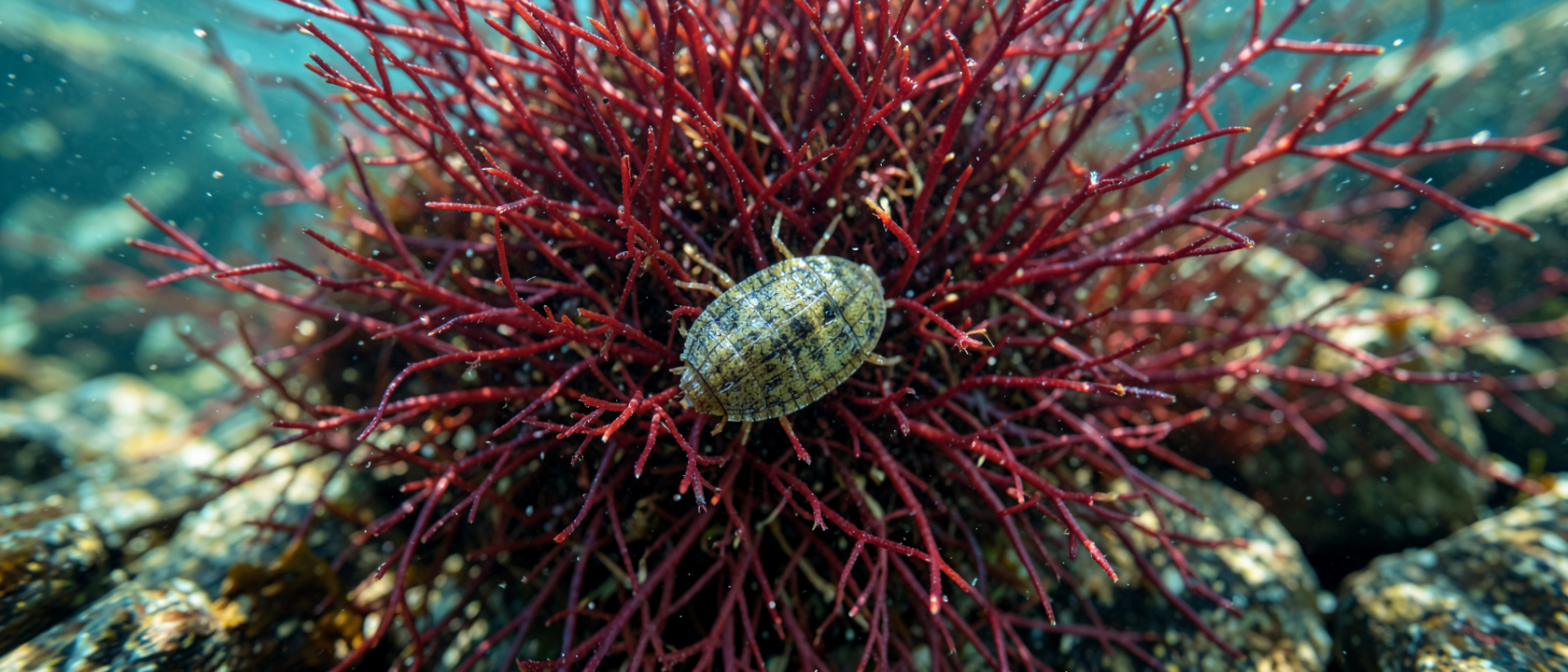
The Bug That Pollinates Seaweed
Before there were flowers, before there were bees, something in the ocean may already have been carrying sex cells from plant to plant. A small marine crustacean does exactly that today, and it took until 2022 for anyone to prove it. The crustacean is Idotea balthica, a flattened isopod that spends its whole life tucked inside the branching fronds of the red alga Gracilaria gracilis, the alga’s permanent resident rather than an occasional visitor. A team led by CNRS researcher Myriam Valero, working with the Roscoff Marine Station’s Evolutionary Biology and Ecology of Algae unit, Sorbonne University, Pontificia Universidad Católica de Chile, and Universidad Austral de Chile, published the finding in Science on July 29, 2022. What they established: Idotea balthica physically transports the male reproductive cells of G. gracilis from male algae to female algae, fertilizing the seaweed directly. It is the first documented case of an animal fertilizing a seaweed, and it means pollination, animal-delivered sex cells moving between plants, is no longer something only flowers get to claim.
How a Woodlouse of the Sea Delivers Sperm
Male G. gracilis algae grow reproductive structures on their surface that release spermatia, the alga’s equivalent of sperm, wrapped in a sticky mucilage coating. Unlike the mobile sperm of many organisms, these spermatia have no flagella, the whip-like tails that let cells swim, so they cannot travel through the water on their own, according to Valero; they need a ride. As an Idotea balthica swims and crawls through the thicket of fronds where it already lives, the sticky spermatia stick to its cuticle, the hard outer shell covering its body. The isopod carries on with its day, and when it brushes against the surface of a female thallus, the algal body, the spermatia transfer off its shell and onto the plant, triggering fertilization. Nothing about this looks deliberate on the isopod’s side. It is accidental cargo on a moving body, but mechanically it is doing exactly what a bee does with pollen: carrying sticky cells from one sex to the other because its own life happens to run through both.
The Alga Pays for the Ride
Gracilaria gracilis houses and feeds the animal that fertilizes it. Its dense, branching structure gives Idotea balthica shelter from currents and wave action that a soft-bodied animal this size would struggle to find on open rock. The alga also feeds its tenants: a biofilm of small organisms grows across its surface, and the isopods graze it. The isopod gets housing and food; the alga gets its spermatia delivered. Researchers who studied this behavior describe it as a mutualism, a relationship in which both species gain. That is why the behavior looks like an evolved trait rather than a lucky one-time accident: an isopod living inside a well-fertilized, thriving patch of Gracilaria gets more shelter and more food than one living on a sparse, poorly fertilized patch, giving both species a reason to keep showing up for each other.
Pollination Was Supposed to Be a Flower’s Trick
Marine biologists assumed red algae fertilized the plain way: male cells released into the water, carried by current alone to a female plant, no animal involved. That assumption made sense on paper, since spermatia in red algae lack flagella and were long thought incapable of the kind of active partnership insects have with flowers. The Science paper contradicts it directly: an animal, Idotea balthica, is doing part of that work. A second assumption falls with it.
Animal-mediated fertilization was treated as a land invention, something that arrived with flowering plants and their insect pollinators roughly 140 million years ago. Red algae are far older than that, having arisen more than 800 million years ago. If a crustacean is ferrying sperm between fronds of Gracilaria gracilis, animals moving sex cells between plants did not start with bees and flowers. It may be a strategy the ocean had running hundreds of millions of years before land plants existed to borrow it.
What Nobody Has Measured Yet
The 2022 study leaves real gaps, and the research team says so plainly. Fertilization success in Gracilaria gracilis could come mostly from isopods carrying spermatia, or mostly from ordinary water currents doing what they always did, and nobody has separated the two yet. It is also unclear whether Idotea balthica triggers spermatia release from male algae or just happens to brush past structures that are already shedding them on their own schedule. Whether the isopod can tell a male thallus from a female one, or is simply wandering through its habitat with no sense of which sex it is touching, is an open question too. Researchers also aren’t sure how these seaweeds managed to reproduce before this relationship evolved in the first place. No one has yet tested whether the same partnership exists between other marine animals and other algae.