
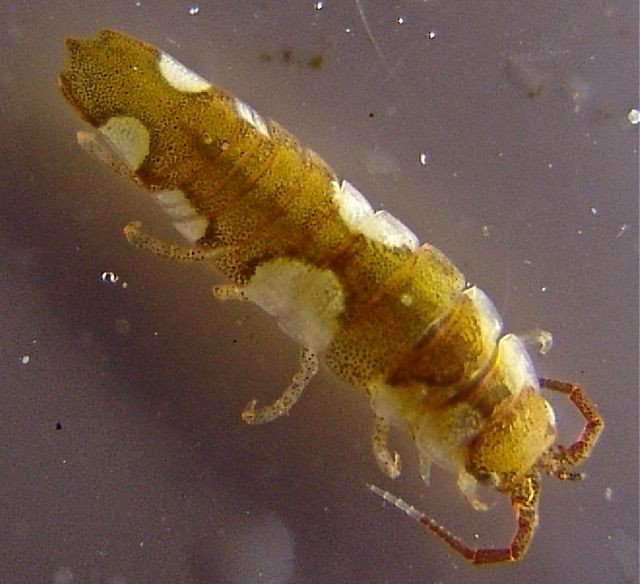
Idotea balthica, the Baltic Isopod, is a small marine crustacean belonging to the order Isopoda and the family Idoteidae, found across a range stretching from northern Norway and the Gulfs of Bothnia and Finland south to the Black Sea, and also along the north-west coast of North America. Males reach up to about 22 mm in length and females about 15 mm. Its body structure, colour polymorphism, and wide depth tolerance between 1 and 200 m have made it the subject of ecological study in northern European waters. As a malacostracan crustacean, it shares its class with crabs, shrimps, and lobsters, despite superficially resembling an insect.
Key facts
- Scientific name: Idotea balthica
- Kingdom: Animalia
- Phylum: Arthropoda
- Class: Malacostraca
- Order: Isopoda
- Family: Idoteidae
- Genus: Idotea
- Taxonomic rank: species
Body plan and size
The body of Idotea balthica is divided into three recognizable regions. The thorax consists of seven distinct sections called somites. Behind the thorax sits a short abdomen of two somites, and the body ends in a tail-piece called the pleotelson, whose posterior edge carries three processes, with the middle one being the longest.
Sexual dimorphism in length is pronounced: males measure up to about 22 mm while females reach about 15 mm. Beyond size, comparisons between Massachusetts and Baltic Sea populations found that males from Massachusetts showed darker coloration than their Baltic counterparts, while females from Massachusetts tended to have shorter body lengths. These differences were detected alongside a greater preference in Massachusetts specimens for the alga Chondrus crispus rather than the species’ more typical food source.
Colour polymorphism and camouflage
Coloration in Idotea balthica runs from green to brownish-tan, with wide variation across individuals. The species displays colour polymorphism with named phenotype morphs: bilineata, lineata, and flavafusca forms, as well as several combined forms. Pronounced differences in the composition of these morphs have been observed between populations, suggesting that local selection pressures shape which morph predominates in a given place.
The selective agent behind that variation is predation. Idotea balthica lives on the brown alga Fucus vesiculosus, which is frequently colonized by the white bryozoan Electra crustulenta. An experiment found that predation risk for each colour morph was strongly dependent on background coloration: a morph that blends with bare brown Fucus stands out sharply against white Electra patches, and vice versa, so the local ratio of brown alga to white bryozoan cover influences which phenotype fares best in each microhabitat.
Habitat, range, and diet
The species prefers hard substrates covered with algae and occupies depths between 1 and 200 m. Its geographic range is wide: it extends from northern Norway and the Gulfs of Bothnia and Finland in the north, south through the Baltic Sea to the Black Sea, and appears separately along the north-west coast of North America.
Its diet includes decaying vegetation, especially Fucus vesiculosus. The Massachusetts population studied showed a greater affinity for Chondrus crispus compared with Baltic specimens, suggesting that diet breadth or preference can shift between geographically separated populations even within a single species.
Taxonomy and historical subspecies
Idotea balthica sits within the phylum Arthropoda, class Malacostraca, order Isopoda, family Idoteidae, genus Idotea. Three names that were once applied as subspecies are now treated as synonyms of the single species: Idotea balthica basteri (Audouin, 1826), Idotea balthica stagnea (Tinturier-Hamelin, 1960), and Idotea balthica tricuspidata (Desmarest, 1823).
The species superficially resembles an insect, a resemblance that has sometimes led to misidentification by non-specialists. As a malacostracan crustacean, it shares its class with crabs, shrimps, and lobsters, not with any insect group.
Population comparisons across the Atlantic
Research comparing Massachusetts specimens with Baltic Sea populations found that the two groups resembled each other in most measurable respects. The key recorded differences were darker male coloration in Massachusetts, shorter female body length in Massachusetts, and a stronger preference for Chondrus crispus over Fucus vesiculosus in Massachusetts individuals.
Data sources
Where it appears
- The Isopod That Pollinates Seaweed, Long Before Bees Existed November 25, 2026
Data updated: 2026-11-04