
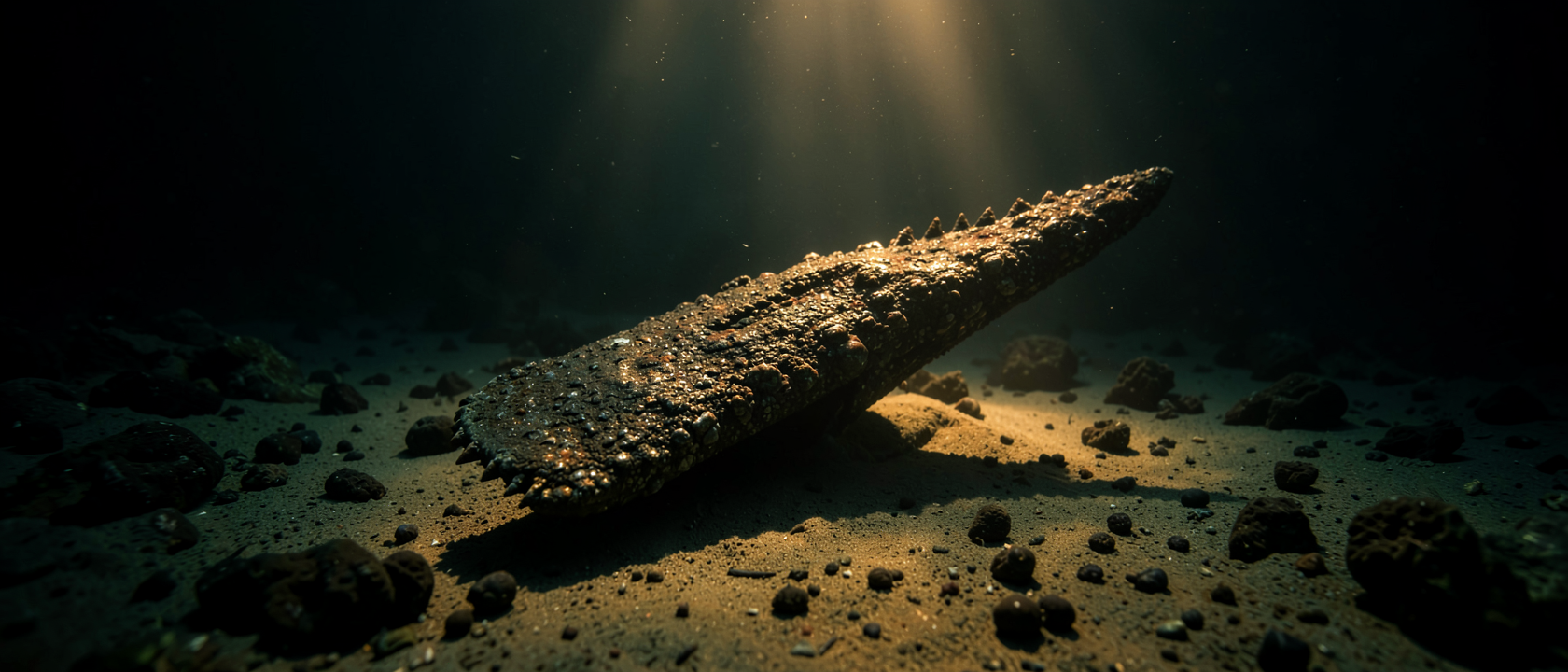
The Shark Tooth at the Heart of the Nodule
Millions of years after a megalodon shed a tooth into open water, that tooth is still doing work. During the 2026 Cook Islands ROV Exploration cruise, NOAA Ocean Exploration piloted the remotely operated vehicle Deep Discoverer across the seafloor of the southwestern Cook Islands Exclusive Economic Zone. Nearby dives on the same cruise logged depths of 3.1 miles (4,950 meters) near a feature called B1 Seamount and 3.5 miles (5,600 meters) on an abyssal plain farther west. On dive after dive, the ROV came back with polymetallic nodules: dense, dark lumps about the size of a potato, scattered across the sediment.
Cracking several of them open did not reveal an ordinary basalt pebble at the center. Instead there was a fossil tooth, serrated and dark with a metallic crust, several measuring over 3 inches (7 centimeters) long and one reaching 5 inches (13 centimeters), the largest of the expedition known as EX2605. Based on their size, NOAA reports the teeth likely belonged to Otodus megalodon, the largest shark and the largest fish ever to swim, an animal that shed teeth by the thousand across its lifetime in the Neogene, the epochs running from roughly 23 million to 2.6 million years ago. Seven of those discarded teeth turned up this way, each one sitting at the core of its own nodule.
The Precipitation Engine
Nothing crystallizes out of seawater for free. Dissolved metal ions need a hard, stable surface to grab onto before they can stack into a mineral layer, and a sediment plain with no rock outcrop rarely offers one. A fallen megalodon tooth did. Its enamel and the calcium phosphate beneath it resist dissolving even below the carbonate compensation depth, the depth at which shells and bone would normally break down in the corrosive deep-ocean chemistry, so the tooth stayed intact while softer material around it did not. NOAA describes this as the standard route by which these nodules grow: dissolved iron and manganese, carried in bottom water and in the water trapped between sediment grains, precipitate directly onto that hard surface, ring by ring, at a pace measured in millimeters per million years. Given enough time, the ferromanganese layers close completely over the tooth’s serrations, and a fossil ends up looking, from the outside, like an ordinary lump of ore.
The Ocean’s Black Box Recorder
While that shell was forming, the tooth itself kept recording. Exposed apatite, the mineral that makes up tooth enamel, absorbs trace metals and rare earth elements directly from the bottom currents drifting over it, neodymium among them. Every deep ocean water mass carries its own chemical fingerprint, shaped by which continents and rivers fed it over geologic time, and NOAA’s description of this process holds that the ratio of neodymium isotopes locked into the fossil becomes a lasting note on which water mass was passing overhead, and when. A tooth that sat still on this seafloor for a few million years picked up a line of chemistry for every current that moved across it, long after the shark that shed it was gone.
Extinction Timing and Ocean Depths
Movies keep sending Otodus megalodon back into the ocean to hide in a trench, waiting. The nodules pulled from the Cook Islands seafloor argue against that plot more directly than any commentary could. A tooth sealed inside a polymetallic nodule has not moved in millions of years; that stillness is the entire mechanism by which the metal layers built up around it undisturbed. A 2018 reanalysis of the fossil record placed the species’ last confirmed appearance at 3.6 million years ago, a full million years earlier than the extinction date long quoted in popular accounts, after researchers found that fossils dated younger than that were either misdated or belonged to other species entirely. Seven teeth, each locked motionless inside its own metal shell, point the same direction: stillness for millions of years is exactly what turns a tooth into a nodule, and it is the opposite of a living population still out hunting somewhere in the dark.
The Unread Geochemical Pages
All seven teeth are now in hand; their chemistry is not. NOAA’s plan is to run high-precision analysis on the neodymium and other rare earth elements layered through the tooth roots and their metal coating, work that has not been completed. Until that mass spectrometry comes back, nobody can say which water masses moved across this patch of the southwestern Pacific, or when the currents feeding it shifted. The exact age of these seven teeth is also still unknown; NOAA has confirmed only that the nodules took millions of years to form, not where any single tooth falls within that span.
Telepresence on Dive 09
One of those teeth came up with an audience. During Dive 09 of the 2026 Cook Islands ROV Exploration, Cook Islands Prime Minister Mark Brown joined the mission through a live telepresence link to the ship’s control room, watching the feed alongside the ROV pilots as they surveyed his country’s seabed. Brown helped direct Deep Discoverer’s manipulator arm toward a dark, mineralized nodule, and the arm lifted a 5-inch megalodon tooth out of the silt thousands of meters below. Elsewhere on the cruise, the crew kept things just as hands-on: co-coordinator Matt Dornback posed with two of the recovered teeth on deck, and co-coordinator Gretchen Spencer introduced one to the support ROV Seirios before both specimens went into storage for analysis.