
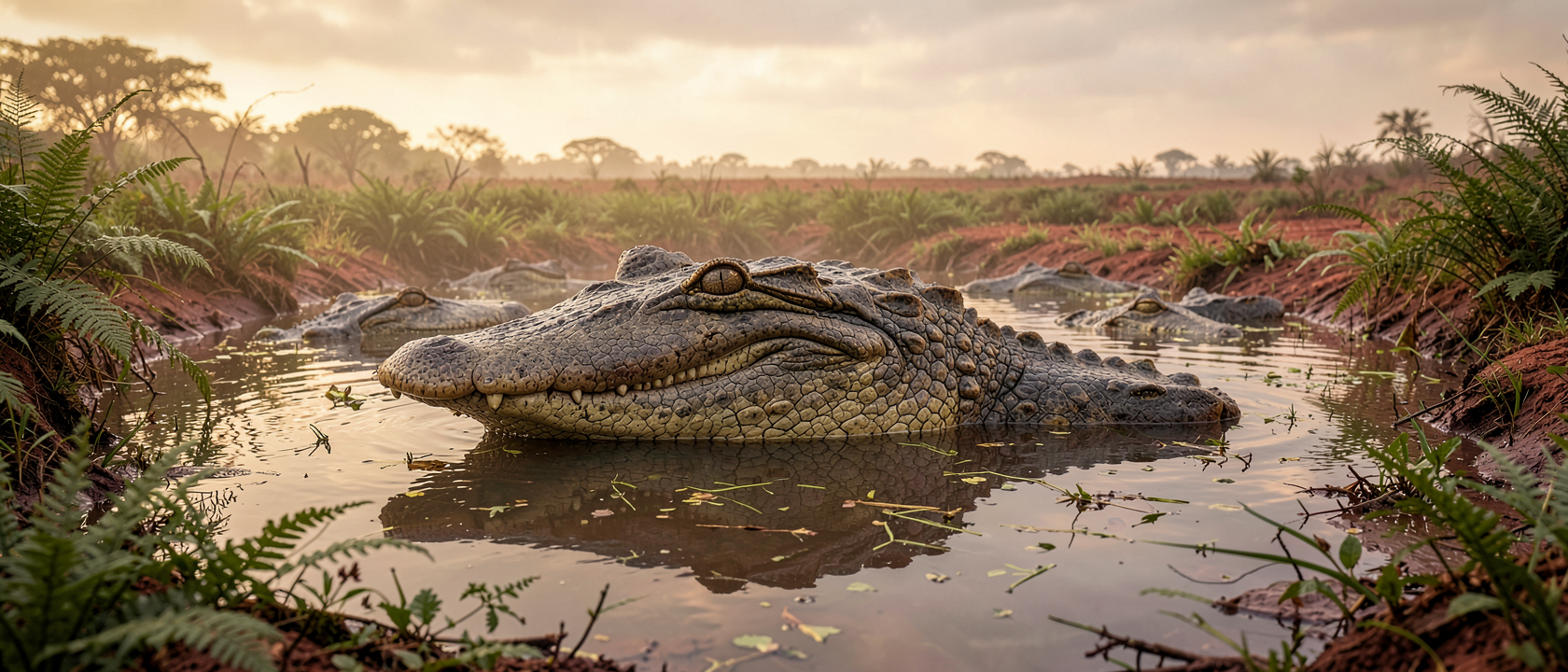
Nineteen Giant Amphibians, One Grave, No Explanation
At least 19 individual Buettnererpeton bakeri, an alligator-sized amphibian that patrolled floodplains some 230 million years ago, turned up together in a single layer of Wyoming rock. The site is called Nobby Knob, near Dubois, Wyoming, inside the Popo Agie Formation. Aaron Kufner, a geologist at the University of Wisconsin-Madison, led four excavations there between 2014 and 2019, and the team counted duplicate skeletal elements, among them the interclavicle, a bone from the chest, and matching right-side limb bones, so no single animal got counted twice, arriving at a minimum of 19. That single haul nearly doubles every previously known specimen of the species. The study, published April 2, 2025, in PLOS One, calls Buettnererpeton bakeri the oldest known North American metoposaurid, a group of temnospondyl amphibians and early relatives of today’s salamanders, frogs, and toads. As Kufner put it in a press release, the site is a snapshot of a single population, not a jumble of bones gathered up over time from different places.
How the Floodplain Buried Them Gently
The obvious explanation for a bone bed this size is the usual one: moving water carrying skeletons in from elsewhere and dropping them together piece by piece, month after month. Nobby Knob kills that explanation. The bones show none of the wear a journey downstream would leave, and the rock around them is fine-grained ancient soil laid down in thin, repeated layers, the kind that settles over calm, still water during repeated floods rather than a scouring current. That calm is almost certainly why even delicate bones survived at all, and why portions of several skeletons remain articulated, meaning the bones are still arranged roughly as they sat in life. Study co-authors Dave Lovelace and Aaron Kufner, both geoscientists at the University of Wisconsin-Madison, told Popular Science that this kind of articulation is nearly absent from other North American metoposaurid bone beds and had never before been documented for Buettnererpeton at all. The same layers also hold fossilized plants, bivalves, and coprolites, which is to say fossilized droppings, filling out the picture of a quiet, shallow wetland rather than a busy channel.
Why They Were All There Together
Since nothing here drifted in on a current, the mix of sizes in the bone bed, from juveniles to full-grown adults, points to a group that died together rather than bones that arrived one at a time over years. The study lays out two possibilities and the authors don’t pick a winner: the animals may have gathered as a breeding colony, or they may have been trapped as a shared pool shrank around them during a dry spell. Separate from the question of how they died, the depth at which Buettnererpeton bakeri fossils sit in the Popo Agie Formation matters on its own. The species is consistently found below the lowest known layer containing the related metoposaurid Anaschisma browni, which makes Buettnererpeton the older of the two lineages and gives researchers a marker they can use to date other metoposaurid sites across Wyoming, Colorado, and Utah.
Was This Normal, or a Fluke?
Nobody knows yet whether die-offs like the one at Nobby Knob were a routine hazard of metoposaurid life, with seasonal pools failing again and again across the Popo Agie Formation, or whether this one site simply happened to catch a single, unrepeated event and fossilize it unusually well. The researchers wrote in their study that judging how common this kind of die-off was among temnospondyls is difficult, because most of their bone beds were transported from the actual place of death, erasing the evidence needed to compare one event to another. No second snapshot site has turned up yet to settle it either way.
What a Bone Bed Actually Tells You
Here’s the part worth carrying into the next fossil headline you scroll past: a mass grave doesn’t automatically mean a mass accident, and a pile of bones in one place doesn’t automatically mean they died in one place. Most big bone beds are more like a river’s lost-and-found than a crime scene, built up over years by water moving remains from somewhere else. Nobby Knob is the rarer kind, a site where the stillness of the rock itself proves the animals were never transported at all, which is exactly why the researchers can call it a real population rather than an accumulation. Knowing the difference is the kind of thing that separates a person who finds fossils interesting from one who actually understands what they’re looking at.
Last One at the Puddle
Here is the joke version, and strictly the joke version: nineteen alligator-sized amphibians lined up at the same shrinking puddle, each one convinced it would be the last to need a drink. None of them were right.