
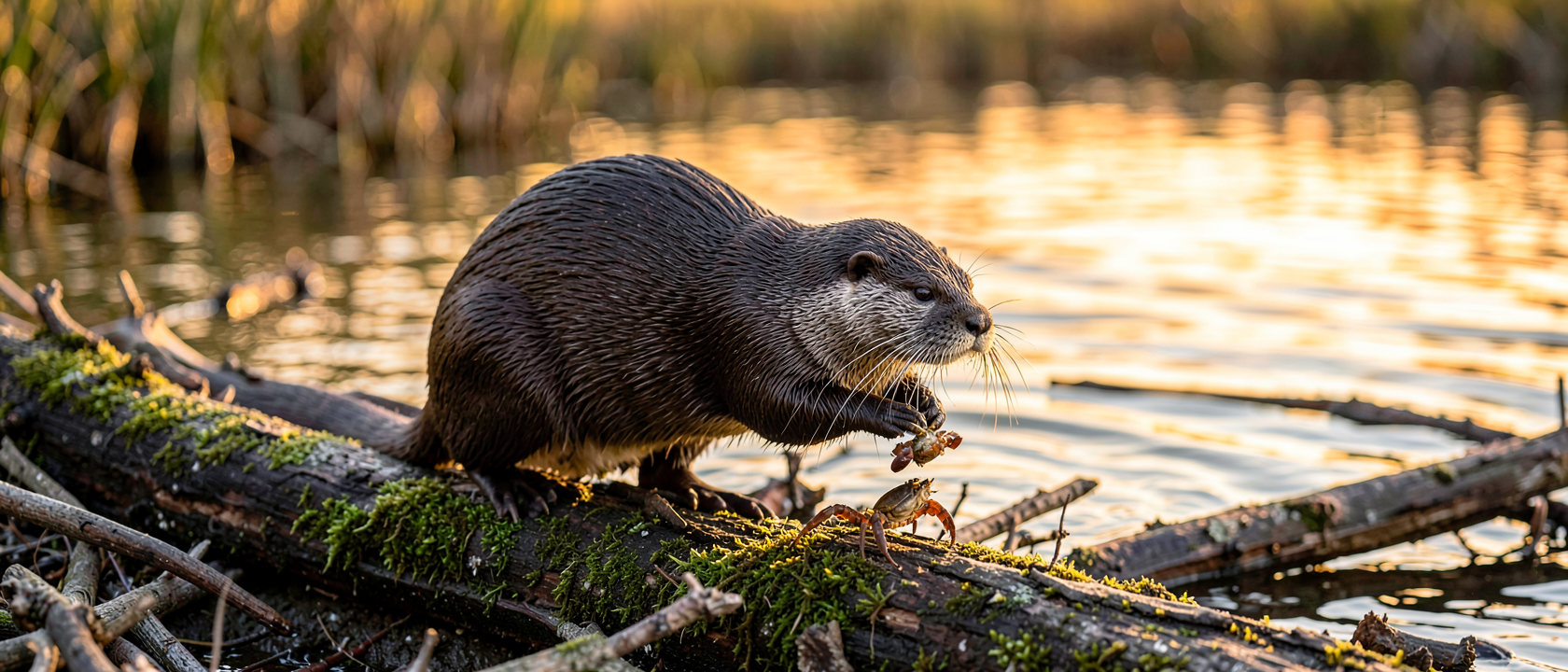
The Otter Latrine Does More Than One Job
North American river otters (Lontra canadensis) do not keep a separate dining room. A team led by graduate researcher Calli Wise, with co-author Katrina Lohan, spent 11 months collecting an average of 28 scat samples from each of 18 active otter latrines along 7.5 miles (12 km) of shoreline on the Rhode River, a subestuary of Chesapeake Bay, working out of the Smithsonian Environmental Research Center (SERC) in Edgewater, Maryland. Their results, published August 14, 2025 in Frontiers in Mammal Science, describe otters eating, scent-marking, socializing, and defecating at the exact same spots. An otter finishing a crab at a latrine stands on the same ground where it reads every other otter’s scent message and leaves its own. Most latrines sat close to the water’s edge, among driftwood and debris, though a few turned up on docks and boardwalks the otters had claimed for themselves. The whole project traces back to one odd pile of scat spotted on a SERC dock, later confirmed by wildlife cameras to belong to a river otter.
The Scat Told a Specific Story
DNA metabarcoding, a method that identifies species from genetic fragments inside a mixed sample, combined with microscopy on the collected scat, showed that finfish and crabs made up 93% of everything the otters had eaten. The otters also took amphibians, worms, and the occasional bird, along with two invasive species, common carp and southern white river crayfish. Riding along inside that prey, the analysis turned up parasites from six taxonomic classes, most of them trematodes, the parasitic flatworms known as flukes. A smaller group, roundworms and single-celled apicomplexans, are known to infect mammals directly, suggesting these had gotten into the otters themselves rather than arriving as passengers in a meal.
Slower Prey, Easier Catches
A fish or crab fighting off a trematode infection burns energy it needs for escape, which can leave it slower and easier for a hunting otter to catch. That energy drain can be the difference that lets the otter close the gap. The fluke inside a crab’s gill ends up acting like a quiet accomplice to the otter’s hunt, present long before the otter ever arrives on the scene.
The Parasite as an Unpaid Hunting Partner
For the otter, this works out as a payoff: a fish or crab population riddled with parasites can still serve as a reliable food source, because sick, slow prey is the prey an otter can catch again and again. Lohan noted that because so many of the parasites in the scat were infecting the otters’ prey rather than the otters, the otters may be culling the sickest individuals straight out of those fish and crab populations just by eating them. She went further, raising a genuinely open possibility: river otters, like other top predators, might not find enough to eat without parasite-weakened prey available to catch. That pattern is what lets the parasite work like part of the otter’s hunting equipment, present in the prey before the otter ever shows up.
Parasites That Earn Their Keep
The common assumption treats a parasite as pure liability, something any animal would do better without. This study complicates that assumption directly. Most of the parasites recovered from the otter scat were infecting the otters’ prey rather than the otters themselves, and the otters appear to have paid no real price for eating infected fish and crabs. None of the parasites identified are known to infect humans, though some are close relatives of species that cause human illnesses such as cystoisosporiasis. The myth this finding undercuts is the idea that a parasite is only ever a cost, never a contributor to how a predator gets fed.
Open Questions About an Elusive Animal
River otters are mostly nocturnal and rarely seen, and some basic facts about the Chesapeake Bay population remain missing entirely. There is no population estimate for river otters in the region, not even a rough one. Researchers also do not yet know whether otters moving into urban and suburban waterways could work as disease sentinels, animals whose infections would flag contamination or health risks before anyone tests the water directly. Lohan has pointed out that otters are mammals too, and some of the parasites that infect them could, in principle, infect people as well, though this particular study found none that do. The population count and the sentinel question both remain open, not answered by this study.