
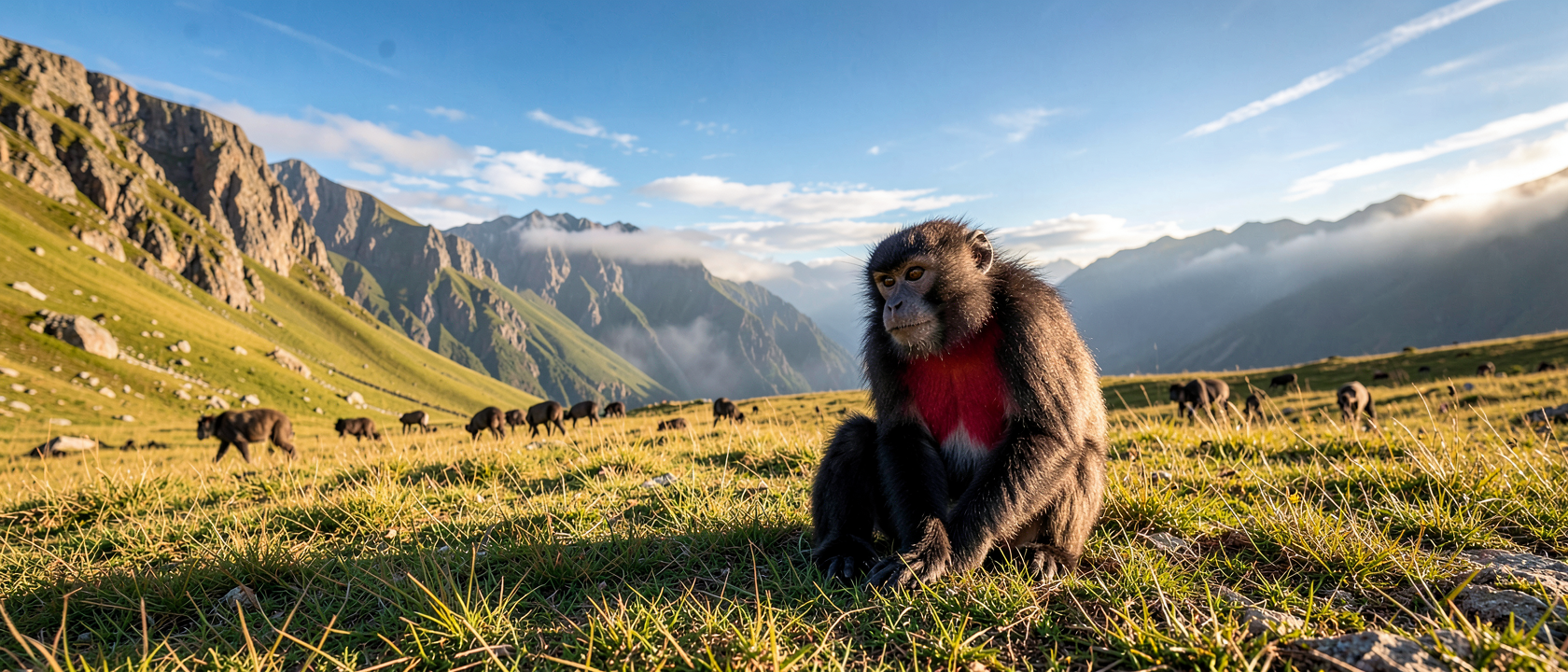
A Mutation Every Single Gelada Carries, and Does Nothing With
Every gelada tested carries two amino acid changes in its hemoglobin, changes found in no other primate, and those changes turn out to do nothing to help the animal breathe thin air. That’s the finding from a paper published March 25, 2022 by Noah Snyder-Mackler and Kenneth Chiou, researchers at Arizona State University, who led a team that assembled the first reference genome for the gelada (Theropithecus gelada), built from DNA of a single wild adult female sampled in Ethiopia’s Simien Mountains. When they sequenced 70 more geladas, wild and captive, and compared the results, those two substitutions turned up in the alpha chain of hemoglobin, the protein inside red blood cells that grabs and carries oxygen. Every one of the 70 animals had both changes. Not a majority, not a cluster of high-altitude herds: all of them. The researchers flagged that kind of universal spread as a likely fixation signature, the pattern left behind when a mutation gets locked into an entire species because it did something important enough for natural selection to keep.
The Lab Test That Found Nothing
So the team ran the standard check: P50, a measurement of the oxygen pressure needed to get hemoglobin half-saturated. A lower P50 means hemoglobin holds oxygen more tightly, which is exactly what you’d expect from blood tuned for thin air. Gelada hemoglobin, carrying its two unique substitutions, came back statistically indistinguishable from human hemoglobin and from baboon hemoglobin. No tighter grip on oxygen, no looser one either. The team also checked the other obvious lever: blood hemoglobin concentration, the “more oxygen-carriers per liter” trick that lets lowland humans acclimatize when they move to altitude. Geladas living above 9,843 feet (3,000 m) showed no elevation in hemoglobin concentration compared with lowland baboons, with humans, or even with geladas born and raised in zoos at sea level. Two mechanisms, two flat results.
The Myth This Kills
That result kills a specific assumption, one that shows up constantly in animal-adaptation writing: find a mutation unique to a species and present in every individual, and you’ve found the adaptation. Geladas break that logic on its own terms. The mutation is universal, and it is also functionally inert, a conclusion reached by direct lab testing, not inferred from how rare or widespread it looked in the genome. Universal does not mean functional. The hemoglobin story that the genome seemed to be telling turned out to be a dead end, confirmed rather than assumed.
If Not Blood, Then What: The Chest Clue
If the blood chemistry wasn’t doing the work, the body’s architecture might be. The same study measured chest circumference and found that high-altitude geladas have significantly larger chests, relative to body size, than hamadryas baboons living at low elevation in Ethiopia. A bigger chest cavity could mean more room for lung tissue, and more surface area for oxygen to cross into the bloodstream. The paper draws a comparison worth naming directly: larger chest dimensions are already documented in human populations native to the Andes, a separate and well-studied case of high-altitude adaptation in our own species. The blood was a dead end. The container holding it might not be.
A Genome-Wide Hunt, Mostly Down a Different Road
The hemoglobin and chest findings came out of a much wider search. Scanning more than 20,000 protein-coding genes in the gelada genome, the team flagged 103 genes carrying the genetic signature of positive selection. Four of those genes sit in pathways the body uses to sense and respond to low oxygen: ITGA2, NOTCH4, FERMT1, and MLPH. Here’s the number that actually matters: of those 103 candidates, only three, FRAS1, HMBS, and TNRC18, overlap with genes already known from human highland populations, Tibetans, highland Ethiopians, Nepalese Sherpas, and Bajau free divers who routinely dive to extreme depths. A hundred and three candidates, and the overwhelming majority have no match in the human altitude playbook. Evolution did not reach for the same toolkit twice.
What Nobody Measured
Two questions the study leaves standing. First, nobody measured gelada lungs. A larger chest circumference is consistent with more lung volume, but it is an inference, not a measurement, and whether the lungs inside that chest are actually bigger has not been tested. Second, nobody knows if that bigger chest is written into gelada genetics or if it is simply what a chest grows into after a lifetime of breathing thin air. Settling that would mean comparing wild high-altitude geladas against geladas born and raised in captivity at low elevation, data the study did not have.
Maybe Two Species Wearing One Name
The genome turned up something the researchers weren’t even hunting for. The 70 sequenced geladas split cleanly into a northern population, centered in the Simien Mountains, and a central population, centered in the Guassa Community Conservation Area, separated for up to roughly 500,000 years, with deep genetic divergence between them. A large chromosomal fission, one chromosome splitting into two, shows up at high frequency in the northern population and is essentially absent from the central one. That category of chromosomal rearrangement is the same kind of change that makes mules infertile despite horses and donkeys being close enough relatives to interbreed at all. Whether this means northern and central geladas are quietly becoming two separate species, rather than one species with two addresses, is a question the paper leaves open.