
Twelve Cats, Ten Trials, One Third of a Bowl
A research team led by animal behavior scientist Masao Miyazaki at Iwate University in Japan fasted twelve healthy domestic cats for 16 hours, then gave each one 0.7 ounces (20 grams) of dry food and ten minutes to eat it. The cats were mixed-breed and intact, six males and six females, ages three to fifteen. The findings were published in the journal Physiology & Behavior in 2026.
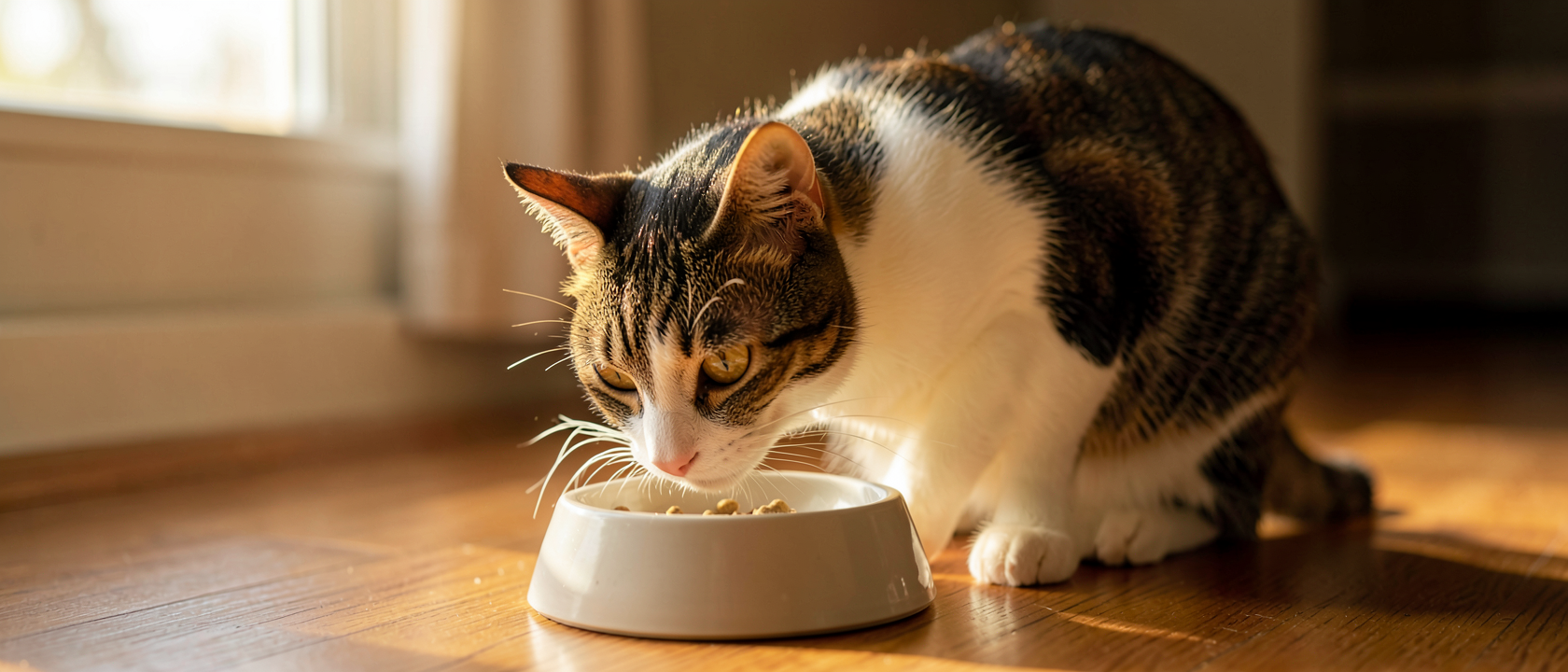
Across ten separate trials, only four of the twelve cats ever finished that small portion. Most stopped after eating roughly a third of what was in the bowl, despite having gone 16 hours without food. It happened repeatedly: a hungry cat, offered food, walking away while the bowl was still mostly full.
What Actually Predicted How Much They Ate
The researchers measured the volatile organic compounds, the airborne molecules that carry scent, in six different cat foods labeled A through F. Each had a distinct odor profile, but a stronger smell did not mean a more eagerly eaten food. Odor intensity did not predict palatability at all.
Repetition did. In the feeding trials, cats ran through six cycles of ten minutes with food followed by ten minutes with an empty bowl. Given the same food cycle after cycle, they ate progressively less of it. Given six different foods in sequence, that drop-off nearly disappeared. In one version of the test, cats got the same food for five cycles straight and a different food on the sixth, and intake rose again on that sixth cycle regardless of whether the new food was more or less palatable than the one before it.
A two-compartment bowl made the point cleanly. It let the researchers change a food’s smell without changing the food itself. Same food, altered scent: the cats ate more. Nothing on the plate was different. Only what it smelled like had changed.
A Solitary Hunter’s Stomach
Miyazaki’s team calls this olfactory habituation: a smell loses its pull on behavior the longer it’s the only smell around, and a fresh scent can switch feeding motivation back on. They compare it to sensory-specific satiety in humans, the reason there’s still room for dessert after a full dinner. “These findings suggest that cats do not stop eating simply because they are full,” Miyazaki said. “Sensory novelty, especially olfactory novelty, can reactivate feeding motivation in cats.”
They tie this to where the house cat comes from. Felis catus descends from the African wildcat, Felis lybica, a solitary hunter that caught small prey many times across a day rather than eating one large meal, unlike a pack of dogs splitting and finishing a single carcass together. A nose that loses interest in one smell within minutes works, in that light, as a built-in cue to go find the next small catch instead of sitting at one bowl until it’s empty. As the study puts it, feline feeding behavior looks like a balance between internal energy needs and the sensory environment in front of the cat, not something decided by hunger alone.
What a Second Compartment Proved
The usual reading of a half-eaten bowl is that the cat has had enough, a full stomach and nothing more to it. The two-compartment bowl experiment contradicts that directly. Nothing about the food changed between one feeding and the next: not the ingredients, not the amount, not the time since the last bite. Only the scent drifting off it changed, and that alone was enough to get a cat eating again. A full stomach doesn’t start caring what something smells like partway through a meal, but a nose that’s already habituated to it clearly does.
Two Unanswered Questions and a Bomb-Sniffing Detail
The paper doesn’t identify what’s happening at the level of neurons, which circuits stop firing when a smell goes stale, or how a new scent flips them back on. That’s not something this study addresses. The sample was also narrow by design: twelve intact cats from one research colony. Whether the same pattern holds for neutered cats, for kittens, or for cats outside that group is simply not established here.
One detail in the discussion, drawn from earlier research rather than from this experiment, notes that dogs appear to habituate to smells more slowly than cats do. That gap has been proposed as part of why scent-detection work, sniffing out explosives among other things, tends to go to dogs rather than cats. Not a myth, not yet settled either. Just a nose with more patience.
Garfield Never Had This Problem
Garfield eats one giant tray of lasagna, with enthusiasm, panel after panel, for decades. The joke only works because real cats don’t behave that way. The twelve cats in the Iwate University trials were losing interest in their own food within ten minutes, long before any tray would have been empty. A cat built like the ones in this study would have quit by the second helping, nose first, and lasagna isn’t the kind of meal a cat’s diet is built around to begin with. A full bowl left half-touched isn’t a mystery, and it isn’t the food’s fault either: a cat’s nose simply moved on before its stomach did.