
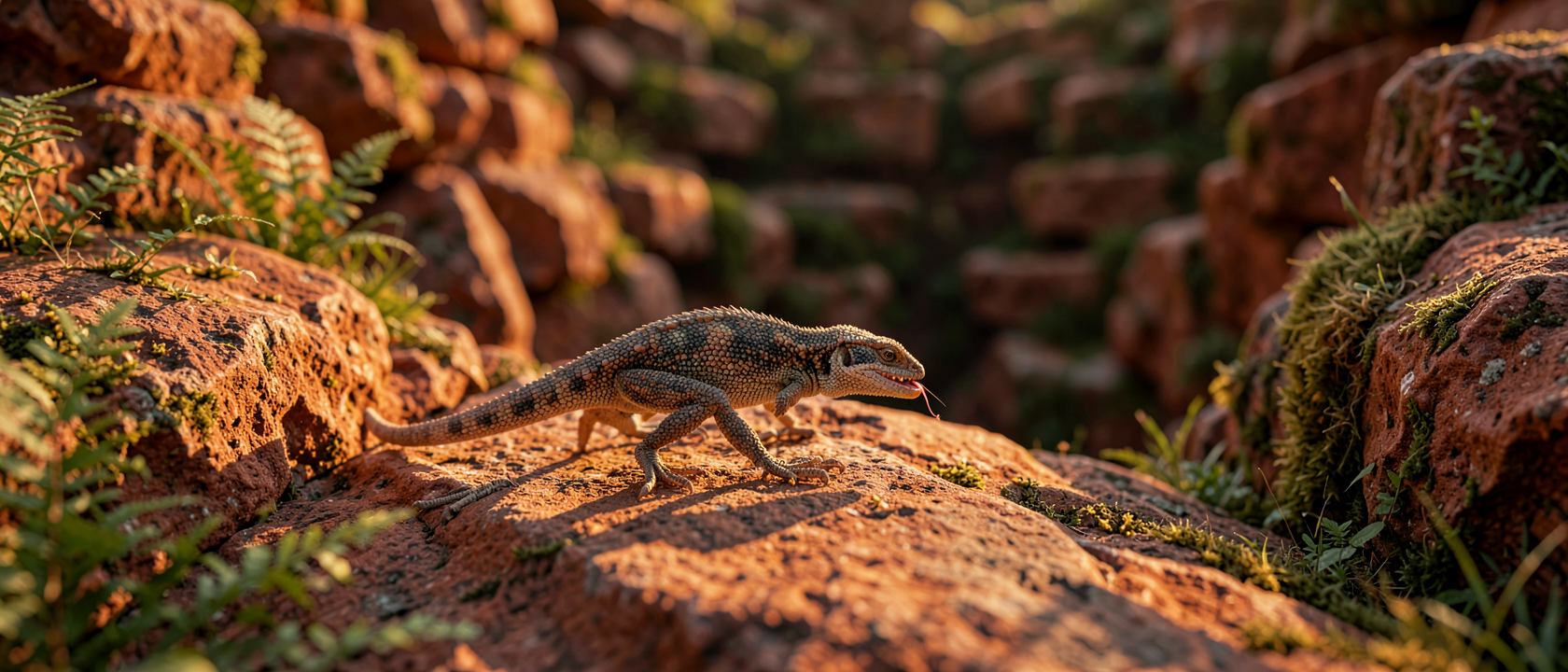
The Oldest Lizard Was in a Drawer, Not a Cliff Face
Cryptovaranoides microlanius is the oldest confirmed lizard on record, dated to at least 202 million years old, right at the close of the Triassic. That reconfirmation pushes the known origin of Squamata, the group that contains every living lizard and snake, back by roughly 35 million years from the previous oldest confirmed fossil. University of Bristol researchers Michael Benton and David Whiteside stand behind the call, published after a rival team tried to strip the animal of its lizard credentials entirely. Nothing new was dug up here: an animal that has sat in a museum collection for decades just had its address on the family tree nailed down, again. The animal itself was modest: an adult reached about 9.8 inches (25 centimeters) long, built with sharp, cutting teeth, likely hunting in limestone crevices near what is now Bristol, in South Gloucestershire, England.
How You Tell a Lizard From a Croc’s Cousin by Its Jaw
The Bristol team did not settle this by eyeballing a drawing. They ran X-rays and CT scans, computed tomography scans that build a 3D image from cross-sections, on the fossil, then coded hundreds of specific anatomical traits across Cryptovaranoides, living lizards, fossil lizards, and archosauromorphs, the reptile branch that leads to crocodiles and dinosaurs, into a phylogenetic analysis: a method that tests which family tree placement the combined evidence actually supports. The result came out precise rather than vague. Three features tie the animal to Lepidosauria, the superorder that contains Squamata; ten more land it within Pan-Squamata, the broader branch leading toward true squamates; two specific traits in the skull and jaw then place it inside Squamata itself; and four further traits, in the teeth and limb bones, pull it into Anguimorpha, the suborder that includes today’s monitor lizards, beaded lizards, and Komodo dragons. The traits in question are things like how a tooth sits in its socket, the shape of the jaw joint, and how certain bones in the wrist and ankle meet. This is forensic reading of bone, not a guess from silhouette.
A Yale Team Tried to Evict It From the Lizard Family
In 2023, Yale researcher Chase Brownstein published a reanalysis of the same type material and reached the opposite conclusion: not a lizard, but an archosauromorph, closer kin to crocodiles and dinosaurs than to monitors and geckos. If that held, the 202-million-year-old specimen would stop being the oldest lizard, and the confirmed age of Squamata would snap back to where it stood before 2022. The Bristol team’s answer was not a shrug and a restatement. Whiteside, Sofia Chambi-Trowell, and Benton argue that Brownstein’s analysis misread specific limb and skull features, the same bones the new CT scans and X-rays were brought back out to re-examine. Chambi-Trowell, a co-author on the rebuttal, said in December 2024 that having the CT images and renewed access to the fossil let the team check Brownstein’s claims point by point, and that most of the concerns raised turned out to be wrong. What is actually being fought over is bigger than one skeleton: which branch of the reptile tree gets to claim 202 million years of history, and whether the whole dated starting point for lizards and snakes as a group moves with it.
They Published Every Scan So You Could Check Their Work
Rather than simply asserting the lizard classification and moving on, the Bristol team released the full CT scans and photographs behind the new paper. That turns a claim of being right into something any outside researcher can check bone by bone. The stakes of that openness show up in the fossil’s own record: the same physical skeleton was classified as a lizard in 2022, reclassified as an archosauromorph in 2023, and classified as a lizard again in 2024, with no new material found in between, only new readings of the same bones. One place the uncertainty still shows directly: in broader squamate family trees, Cryptovaranoides’ specific position inside Anguimorpha, rather than a more basal spot within Pan-Squamata, is still marked with a question mark. The fossil has already changed classification twice without a single new bone being found. That is where the science stands: not settled, only rechecked twice so far.
Seventy Years in a Drawer Before Anyone Looked
The skeleton came out of Late Triassic fissure-fill deposits, cracks in ancient limestone that filled with sediment and trapped small animals, in a quarry near Bristol, England, long before anyone described it in print. It then sat in a collection, unexamined, for close to 70 years before Whiteside, Chambi-Trowell, and Benton finally studied it properly and described the species in 2022. The holotype, the single physical specimen the whole species is defined by, is a juvenile with a skull just 0.55 inches (14 millimeters) long. It is cataloged as NHMUK PV R36822 and now lives at the Natural History Museum in London. Nobody opened that drawer for close to seven decades, and the animal inside it may have been rewriting the start date of lizard evolution the entire time. The genus name, Cryptovaranoides, means roughly “hidden lizard.” The species name, microlanius, comes from the Greek for small and the Latin for butcher, a nod to teeth built for cutting prey. Neither name was picked to describe the fossil’s own biography. It fits anyway.