
The Count
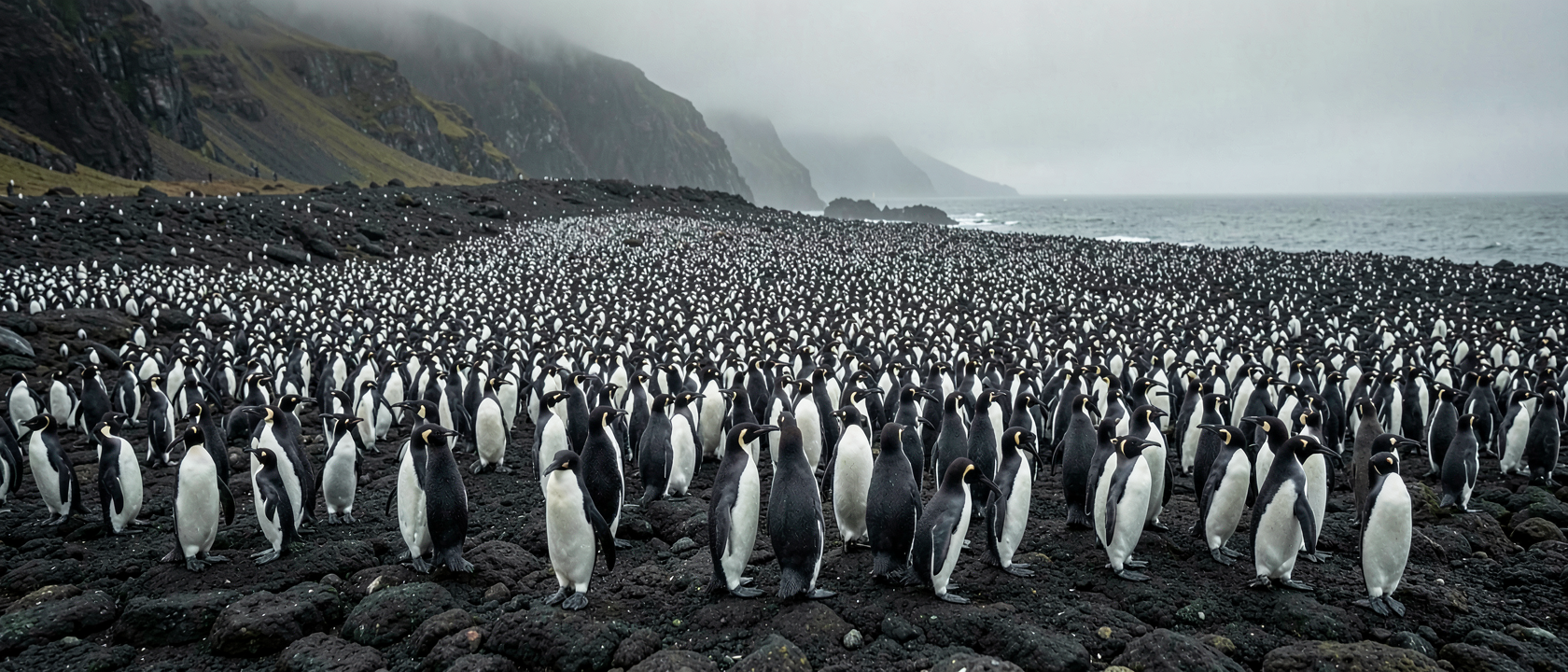
Zavodovski Island, a smoking volcanic speck in the South Sandwich Islands that once held the largest penguin colony on Earth, has lost 63% of its chinstrap penguin (Pygoscelis antarcticus) breeding pairs in roughly fifteen years. British Antarctic Survey researchers led by Norman Ratcliffe combined drone imagery, satellite surveys, and ground counts to re-census the island, publishing the results in Current Biology on October 7, 2026.
In 2011, the island held about 543,000 breeding pairs, well over half a million nests packed onto one patch of ash and rock. By 2025, that number had fallen to roughly 201,000. The colony’s area shrank at a steady 9.5% per year the entire time, a pattern the study’s authors call a “remarkably constant log-linear decline,” meaning the percentage lost held steady year after year rather than spiking once and recovering. Ratcliffe put the annual population drop at around 7%, two to three times the rate measured elsewhere in the region.
Ratcliffe compared the scale of the loss to a country losing 60% of its population in the same span. The island has now shed more than a quarter of all its penguins, and it has lost its title: the world’s largest penguin colony is now the Adélie penguin colony at Cape Adare, in the Ross Sea, which held 504,332 breeding pairs in 2018, more than 3,100 miles (5,000 km) away. The scale of the drop is large enough that researchers say the global conservation status of chinstrap penguins, currently Least Concern under the IUCN (International Union for Conservation of Nature) system, may need reconsidering.
Why Krill Decide Everything
Chinstrap penguins eat almost nothing but Antarctic krill (Euphausia superba). Not a preference. Close to the whole diet. Ratcliffe’s team tracked Zavodovski’s chinstraps foraging in the cooler water northwest of the island, exactly where krill should be plentiful.
Here’s the chain. The Southern Ocean absorbs roughly three-quarters of all the heat the world’s oceans have gained from global warming. In the Weddell Sea, deep water is warming up to five times faster than the global average at comparable depths. That heat melts sea ice. Sea ice provides shelter, and the algae growing on its underside feeds juvenile krill. Strip the ice, and the krill nursery goes with it. Shrink the krill, and a single-food-source predator has nothing to fall back on. Ratcliffe’s explanation for where the krill went is blunt: warming water pushed them south, into the Weddell Sea, out of the chinstraps’ reach.
An Island Changing Species
The same warming reshaping the krill supply is reshaping Zavodovski itself, nudging it from maritime Antarctic conditions toward a sub-Antarctic climate: less ice, more bare rock, warmer water. That shift is bad news for chinstraps and good news for their neighbors.
Macaroni penguins (Eudyptes chrysolophus) on the same island grew their population by 28% between 2011 and 2016 and have held steady since. They nest on bare rock instead of needing ice nearby. They stay close to their colonies year-round rather than ranging far to feed. And when krill runs short, they can switch to fish. Chinstraps can’t. Researchers describe this as the largest community shift recorded among Antarctic penguins at a single site: one species’ collapsing habitat becoming another species’ opening.
The Myth: “They’ll Just Move South”
The obvious assumption is that a cold-water specialist in trouble simply swims south, toward colder water where the krill still are. The study’s own observations say that is not how it works for this bird.
Chinstrap penguins show strong site fidelity: adults return to the same breeding ground, generation after generation, regardless of what has happened to the food supply nearby. Researcher Peter Fretwell notes that relocation is unlikely, partly because there are few islands far enough south and cold enough for chinstraps to start new colonies. The krill have moved. The penguins, by both instinct and geography, mostly haven’t. A species can’t out-swim a warming ocean just because somewhere colder exists on a map, if there’s nowhere colder it can actually build a nest.
What’s Still Unknown
Researchers ruled out two of the obvious competing explanations. There’s no shortage of nesting room on Zavodovski, so competition between the two penguin species for space doesn’t explain the decline. And Mount Curry, the island’s volcano, erupted in March 2016, but the decline had already been underway for years beforehand and continued at the same steady pace afterward.
What’s left open: whether industrial krill fishing happening elsewhere in the Southern Ocean, carried toward Zavodovski by ocean currents, is piling onto a shortage already caused by melting ice. Fishing is banned inside the island’s own marine protected area, but an indirect effect arriving from far away hasn’t been ruled out. The researchers present it as a real possibility, not a confirmed cause.
Acrid Point, Stench Point, and a 15-Day Boat Ride
Six British Antarctic Survey researchers camped on Zavodovski from December 10 to 16, 2023, after a boat trip that took 15 days to reach one of the more remote points on the planet, more than 1,200 miles (2,000 km) from the nearest permanent human settlement.
They describe an island thick with volcanic gas and the reek of guano. The map had already made the point for them, decades before anyone ran a drone survey: Acrid Point, Stench Point, Reek Point, Pungent Point, and Noxious Bluff are all real names on real charts, sitting around a colony that was, until recently, the largest gathering of penguins on Earth.