
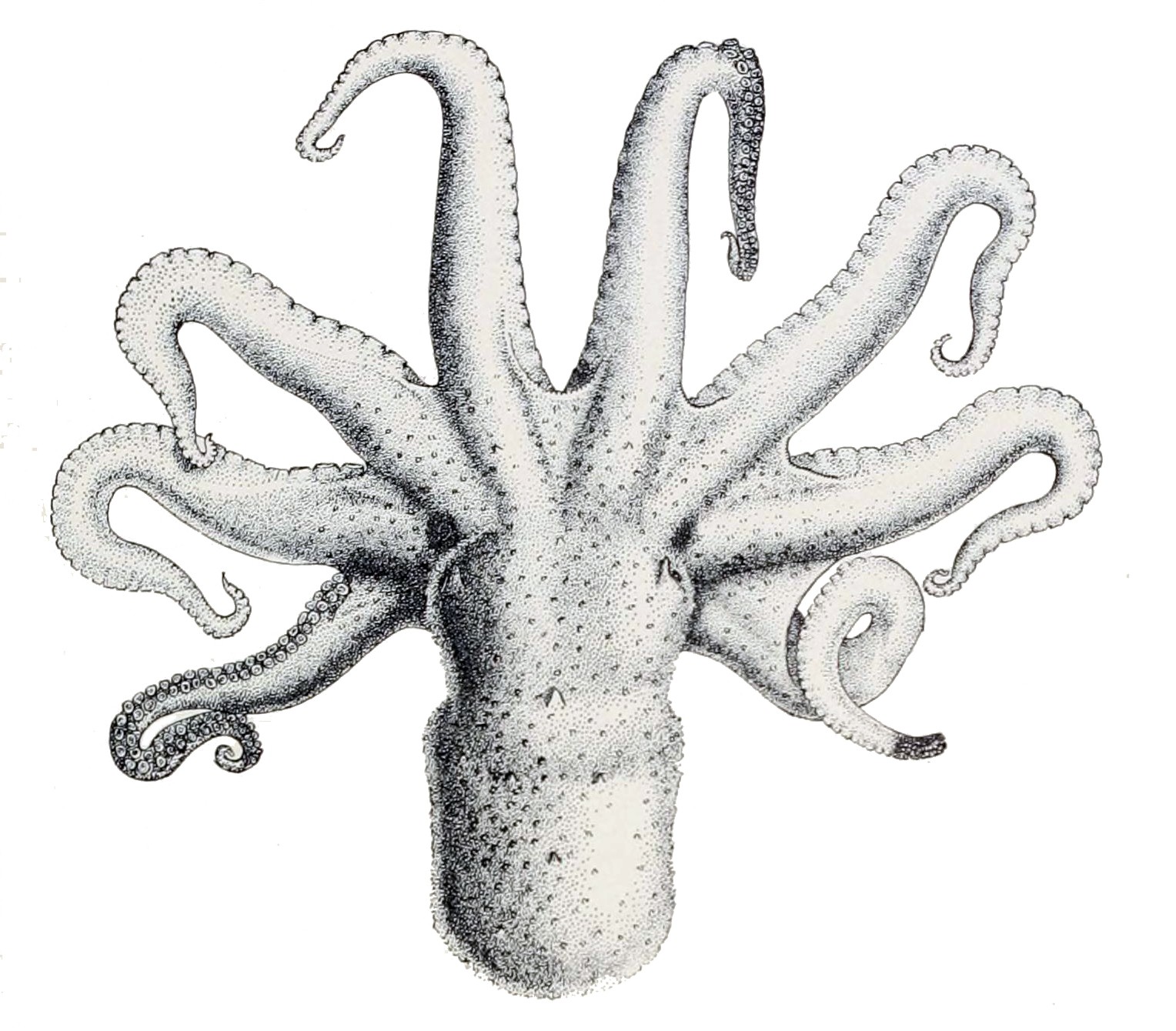
Octopus bimaculatus, the California two-spot octopus, is a cephalopod mollusc of the family Octopodidae that lives throughout the kelp forests of Southern California and extends into Mexican waters. First described scientifically by Addison Emery Verrill in 1883, the species reaches a maximum total length of 61 cm, with arms four or five times the length of the mantle. Its common name refers to the two iridescent blue ocelli, false eyespots, positioned beneath its real eyes, which serve as one of its most recognisable features. A 2026 whole-genome resequencing study placed the species alongside its sibling Octopus bimaculoides and found that the two diverged from a common ancestor roughly one million years ago.
Key facts
- Scientific name: Octopus bimaculatus
- Kingdom: Animalia
- Phylum: Mollusca
- Class: Cephalopoda
- Order: Octopoda
- Family: Octopodidae
- Genus: Octopus
- Taxonomic rank: species
Physical description and the ocelli
O. bimaculatus reaches a maximum total length of 61 cm, with arms that run four or five times the length of the mantle. The species belongs to a genus of seventy-three species within the family Octopodidae, which itself comprises twenty-three genera.
The two blue-ringed ocelli beneath the real eyes are the character that gives the species its names in every language. When the animal is alarmed or agitated, these false eyespots turn bright blue and display a broken chain-link pattern. That detail separates O. bimaculatus from its sibling species O. bimaculoides, whose ocelli show a solid chain-like pattern rather than the spikey pattern of O. bimaculatus. The difference is subtle enough that the two have historically been confused, but it is consistent.
Chromatophores in the skin allow rapid changes in both colour and texture, used while hunting prey and while concealing the body from predators. Visual communication with other cephalopods is documented for the species.
Behaviour and reproduction
The species is primarily nocturnal. It leaves its den after dark to hunt and to mate, returning before light. This pattern is shared with most octopuses, but O. bimaculatus is recorded as a ubiquitous presence in Southern California kelp forests, meaning the ecological consequence of its nightly forays runs through one of the coast’s most productive nearshore habitats.
Reproduction is gonochoric: each individual is strictly male or female for life. Fertilisation is internal. The male uses a modified arm called the hectocotylus, inserting it beneath the female’s mantle to deliver sperm packets called spermatophores. The female then broods her eggs in her den, and those eggs take anywhere from 150 to 210 days to hatch. If the mother survives to the end of that period, she finally leaves the den once hatching is complete.
Parasites
O. bimaculatus hosts ectoparasitic flagellates and ciliate protozoans that live on its gills.
Discovery and naming
Addison Emery Verrill formally described the species in 1883 in a paper titled “Descriptions of two species of Octopus from California,” published in the Bulletin of the Museum of Comparative Zoology. The species epithet bimaculatus comes from New Latin and means simply “twice-spotted,” a name that records nothing beyond the animal’s most visible marking. The species is also called Verrill’s Two-Spot Octopus, and in Mexico it carries the vernacular name Pulpo Manchado.
Genomics and population history
A 2026 whole-genome resequencing study analysed O. bimaculatus alongside its sympatric sibling O. bimaculoides and found that the two split from a common ancestor approximately one million years ago. Despite their similar morphologies, the population histories of the two species have diverged substantially. O. bimaculatus has maintained a large and relatively stable effective population size throughout its inferred demographic history, in contrast to its sibling.
The same 2026 study found that O. bimaculatus carries substantially higher nucleotide diversity than O. bimaculoides. Genes in genomic regions shared between both species were enriched for compound eye development functions.
Fisheries and legal status in California
No directed commercial fishery targets O. bimaculatus in California. The species is prohibited from take for the marine aquaria pet trade in that state. Recreational take is permitted statewide by hook and line or by hand. The species is caught incidentally in traps and nets and can be sold, but it is not hunted by humans as a primary food source.
Did you know
- The two blue-ringed false eyespots beneath its real eyes can trick predators and prey alike into mistaking the glowing marks for actual eyes. (montereybayaquarium.org)
- The eggs of O. bimaculatus take anywhere from 150 to 210 days to hatch before the mother, if she survives, finally leaves the den. (mexican-marine-life.org)
- A 2026 genomic study estimated that O. bimaculatus split from its nearly identical sibling species, O. bimaculoides, only about one million years ago, despite the two now differing sharply in life history and population trends. (pmc.ncbi.nlm.nih.gov)
- The species name honors nothing but its own appearance: “bimaculatus” is New Latin simply for “twice-spotted”. (mexican-marine-life.org)
- In Mexico, Octopus bimaculatus goes by the local name “Pulpo Manchado”. (mexican-marine-life.org)
Data sources
- GBIF
- Wikidata
- marinespecies.wildlife.ca.gov
- mexican-marine-life.org
- animaldiversity.org
- pmc.ncbi.nlm.nih.gov
- marinespecies.org
- biorxiv.org
Where it appears
- This Octopus Gene Is Older Than Bones November 18, 2026
Data updated: 2026-11-10