
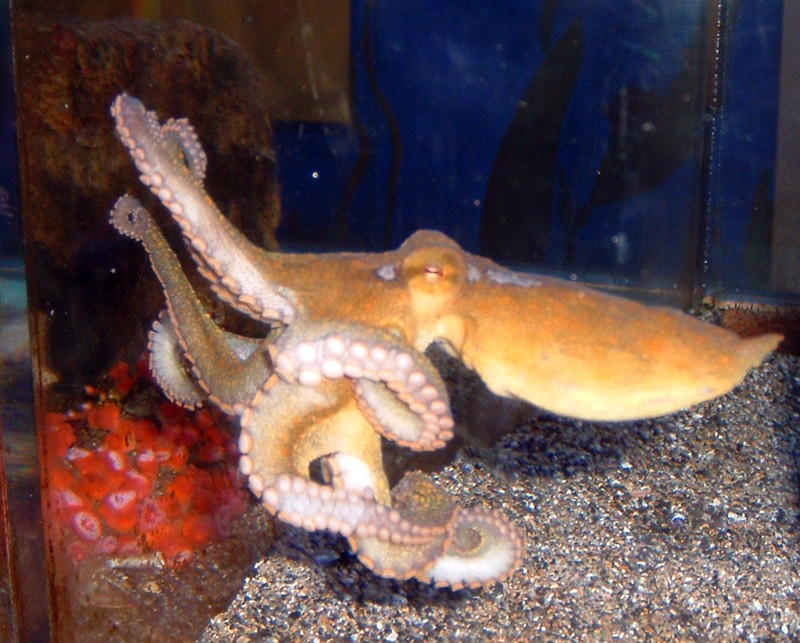
Octopus bimaculoides, known widely as the bimac or California two-spot octopus, is a cephalopod mollusc found along the Pacific coast of California and Baja California. Its most recognisable feature is a pair of iridescent blue false eyespots, called ocelli, one beneath each true eye, which it uses to deter predators and mislead prey. With a total length reaching up to 3 feet (1 meter) and a weight between 4.4 and 8.8 lb (2 to 4 kg), it is a medium-sized octopus that has become one of the most studied cephalopods in the world. In 2015, it became the first cephalopod to have its genome fully sequenced, opening a sustained period of molecular and neurobiological research that continues to yield results.
Key facts
- Scientific name: Octopus bimaculoides
- Kingdom: Animalia
- Phylum: Mollusca
- Class: Cephalopoda
- Order: Octopoda
- Family: Octopodidae
- Genus: Octopus
- Taxonomic rank: species
Physical description
The bimac carries arm lengths of 18 to 23 inches (46 to 58 cm) and a mantle length of 5.9 to 8 inches (15 to 20 cm). Its skin is not heavily textured compared to many other octopus species, but it has well-developed crypsis: the ability to change colour and pattern to match the surrounding substrate. This camouflage capacity operates alongside the two permanent blue ocelli, which are fixed in position and serve a different function entirely. The name bimaculoides comes from the Latin for ‘two-spotted’, a direct reference to those ocelli.
The ocelli are iridescent rather than pigmented, which means their colour shifts with the angle of light. The ocelli present a conspicuous signal that may startle or confuse a predator at close range, complementing rather than duplicating the effect of camouflage. Adult moray eels are recorded predators; they attack by ripping off the octopus’s arms. Scorpionfish and humans are also listed among its predators. When an arm is lost, the bimac can regenerate it.
Habitat and diet
Rocky reefs and canyon ledges define the bimac’s preferred habitat along the southern California coast. The species is nocturnal, conducting most of its hunting after dark. Its recorded prey includes limpets, black abalone, snails, clams, hermit crabs, and small fishes, a list that spans several phyla and reflects opportunistic foraging across the benthic community.
Water quality has measurable consequences for the population. Pollution can impair the octopus’s immune system, and population levels fluctuate with water quality conditions. There is no directed commercial fishery for the species in California, and collection for the marine aquaria pet trade is prohibited. Management falls under the California Department of Fish and Wildlife through general invertebrate regulations.
Reproduction and maternal behaviour
The bimac reaches sexual maturity at around 1 to 2 years of age. After mating, the female anchors her eggs to the substrate using mucal secretions and tends the clutch through four distinct behavioural stages as the embryos develop. In the first brooding stage, she guards the den, strokes the eggs with her suckers, and blows water over them with her funnel to maintain oxygenation.
The optic gland, which is the functional counterpart of the vertebrate pituitary gland, governs what happens next. It drives a programmatic maternal decline across the four brooding stages that ends in the mother’s death once the eggs hatch. This link between the optic gland and senescence has been a focus of research into the hormonal control of ageing in invertebrates.
Skin photoreception
A University of California at Santa Barbara study found that the skin of Octopus bimaculoides can sense light independently of the central nervous system. Photoreceptors distributed across the skin respond to light even when the optic nerves are not involved, which raises questions about how distributed sensory processing functions in an animal whose nervous system is already unusually decentralised for an invertebrate. How this peripheral light sensing influences behaviour has not yet been fully characterised in cephalopod neurobiology.
Genome sequencing and molecular biology
In 2015, Octopus bimaculoides became the first cephalopod to have its genome fully sequenced. The published genome study found no evidence for the whole-genome duplications that had been proposed as a possible explanation for cephalopod complexity. Instead, the genome revealed expansions in two specific gene families: protocadherins, which are involved in neuronal connectivity, and C2H2 zinc-finger transcription factors. Large-scale genome rearrangements associated with octopus-specific transposable elements were also identified.
Over 45 percent of the Octopus bimaculoides genome is composed of repetitive elements, an unusually high proportion. Divergence time estimates, based on single-copy orthologous genes, place the split between Octopus bimaculoides and the related species Octopus minor at approximately 43 million years ago.
A chromosome-level genome assembly identified a genetic sex determination system with a Z0 karyotype in females and ZZ in males, with chromosome 17 carrying the Z sex chromosome. This Z0/ZZ system is rare among cephalopods and had not previously been characterised at the chromosomal level for this species.
Research model
The bimac is easy to raise in the laboratory from egg to adult, a practical quality that has made it one of the most common species used to study octopus genomics, development, and evolution. A study characterising play behaviour in the species noted that it is growing in relevance as a model organism in biomedical research. For that study, researchers at Michigan State University received wild-caught bimacs shipped overnight from the California coast via Aquatic Research Consultants, allowing controlled captive observations that would not be possible with more fragile or slow-maturing species.
Did you know
- The species name bimaculoides literally means ‘two-spotted,’ referring to the iridescent blue ocelli. Cabrillo National Monument uses this reference directly in the common name it applies to the species. (nps.gov)
- Moray eels attack the bimac by ripping off its arms. The octopus can regenerate those lost limbs, a capacity that places it simultaneously in the roles of prey and effective survivor within the same encounter. (nps.gov)
- For a study of play behaviour, researchers at Michigan State University received wild-caught bimacs that had been shipped overnight from the California coast through a supplier called Aquatic Research Consultants. (ncbi.nlm.nih.gov)
- The optic gland, the functional analogue of the vertebrate pituitary gland, controls a four-stage maternal decline in brooding females. The process ends with the mother’s death after her eggs hatch. (pmc.ncbi.nlm.nih.gov)
- A chromosome-level genome assembly identified chromosome 17 as the Z sex chromosome in Octopus bimaculoides, part of a Z0/ZZ genetic sex determination system that is rare among cephalopods. (biorxiv.org)
Data sources
- GBIF
- Wikidata
- nps.gov
- dimensions.com
- cma.recreation.parks.lacity.gov
- aquariumofpacific.org
- ncbi.nlm.nih.gov
- pmc.ncbi.nlm.nih.gov
- californiacurated.com
- mbl.edu
- nature.com
- biorxiv.org
- marinespecies.wildlife.ca.gov
Where it appears
- This Octopus Gene Is Older Than Bones November 18, 2026
Data updated: 2026-11-09