
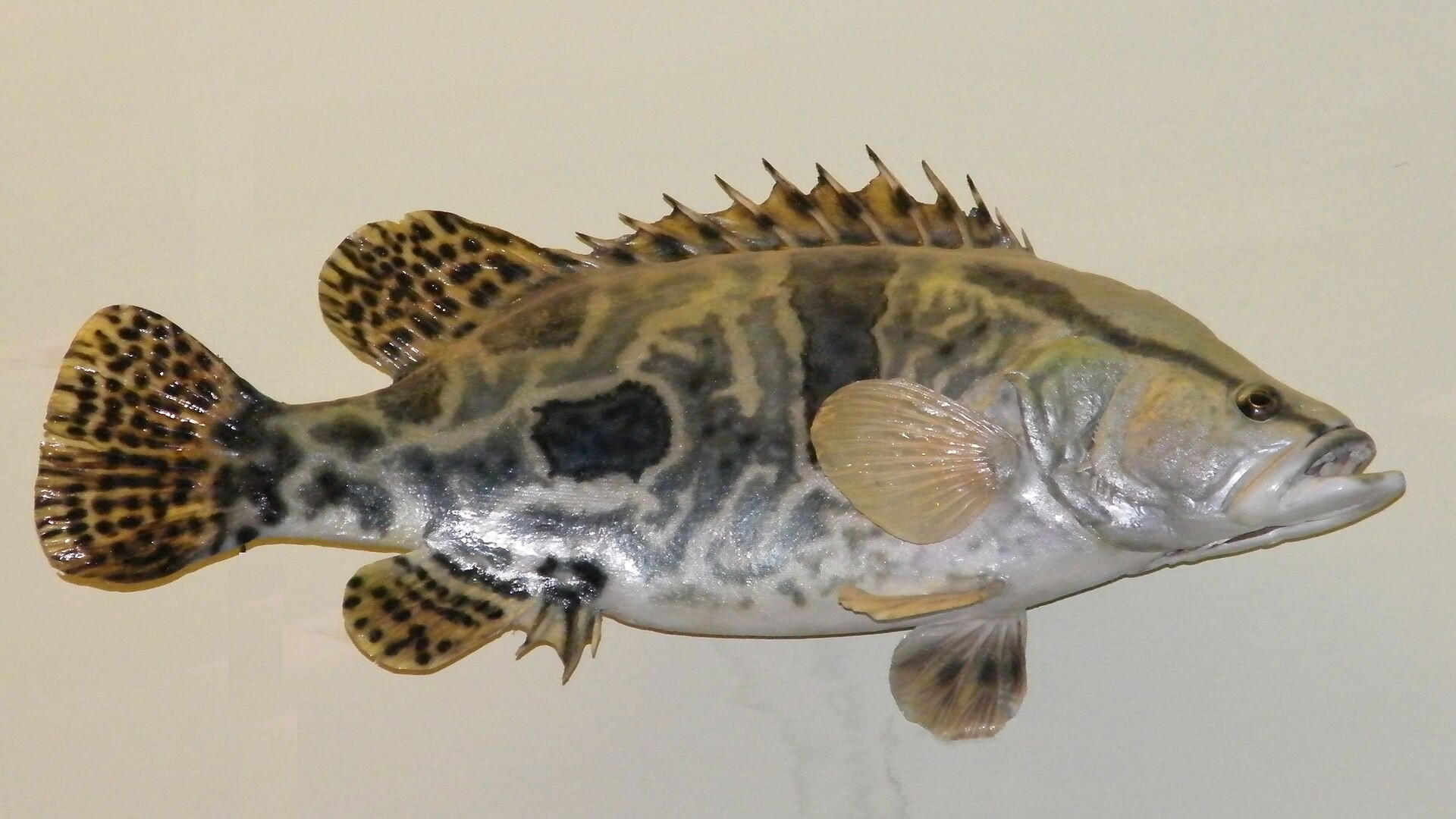
The Aucha perch (Siniperca chuatsi) is a large freshwater fish in the family Percichthyidae, native to the Amur River basin and distributed across China, North Korea, South Korea, and parts of Russia. It reaches a maximum reported length of 70 cm and a weight of around 8 kg, making it one of the largest predators in its range. Its trophic level is estimated at 4.5, placing it among the apex consumers of the river systems it occupies. In China, its combination of commercial value and strict predatory biology has shaped both centuries of aquaculture practice and an expanding body of genomic research.
Key facts
- Scientific name: Siniperca chuatsi
- Kingdom: Animalia
- Phylum: Chordata
- Order: Perciformes
- Family: Percichthyidae
- Genus: Siniperca
- Taxonomic rank: species
Size, build and predatory biology
Adults can reach 70 cm in total length and approximately 8 kg. The species is a benthic fish, spending its time near the riverbed, and it feeds on live fish throughout its entire life cycle. Larvae begin as predators immediately after hatching, with no recorded shift to plankton or invertebrate prey at any life stage.
The Aucha perch is an obligate predator: it feeds almost exclusively on live fish and can swallow prey up to two-thirds of its own body length. Its hunting method is a slow, deliberate stalk during which the fish adopts its darkest coloration, followed by a strike of great speed.
The species’ trophic level is estimated at 4.5 based on the composition of its diet. Generation time is estimated at 7.4 years based on growth studies.
Sensory systems and vision
Feeding in the Aucha perch depends on a network of sense organs: eyes, the lateral line, the mouth, and olfactory organs. Research published in a genome study found that the fish recognises prey using vision. Genome analysis found six opsin genes in the species, specifically two RH1, one RH2, one SWS2, and one LWS. Two sites in the transmembrane domains, L98 and T219, were identified as potentially important for light absorption.
Genome, toxins and gill raker evolution
A genome analysis predicted 155 toxin proteins in the Aucha perch, including two copies each of SNTX-alpha and SNTX-beta, which were described as capable of forming active functional toxins.
A separate study published in Communications Biology traced the species’ inability to filter-feed on zooplankton to reduced expression of eda and edar genes. BMP4 signaling was found to inhibit edar expression via the Xvent-1 site, resulting in fewer gill rakers. The researchers proposed that this molecular pathway promoted the evolution of exclusively predatory feeding in the lineage.
Range and introduced populations
The native range of Siniperca chuatsi covers the Amur River basin, mainland China, North Korea, South Korea, and Russia. The species has been reported as introduced to Taiwan, though the details of that introduction are undocumented. The U.S. Fish and Wildlife Service classifies the species’ invasion history as Data Deficient.
Aquaculture and economic importance
The Aucha perch has been raised in Chinese aquaculture for approximately 200 years, one of the longer documented histories for a freshwater food fish in the region. According to the 2023 China Fishery Statistical Yearbook, total aquaculture production in China reached 401,500 tons in 2022, an increase of 27,500 tons over 2021 and an annual growth rate of 7.36 percent.
The scale of production makes the species an economically significant aquaculture animal for China, though its strict requirement for live prey has historically complicated commercial rearing.
Taxonomic history
The species was first described in 1855 by Stepan Ivanovich Basilewsky, a Russian missionary-physician, from rivers near Tientsin. The lectotype specimen, catalogued as ZIN 2336, measures 262 mm and was collected from rivers at Tientsin, Hopei Province, China. The species is placed in the genus Siniperca, order Perciformes, family Percichthyidae.
Did you know
- Despite its popularity as food, the Aucha perch has been kept and bred in Chinese aquaculture for around 200 years. (aquariumglaser.de)
- The Aucha perch’s genome revealed 155 predicted toxin proteins, an unusual trait for a food fish. (ncbi.nlm.nih.gov)
- Aucha perch larvae are so strictly predatory that, lacking live prey, they will resort to cannibalizing their own siblings soon after hatching. (grokipedia.com)
- The fish can swallow prey up to two-thirds its own body length in a single lightning-fast strike. (aquariumglaser.de)
- The species was scientifically described by Stepan Ivanovich Basilewsky, a Russian missionary-physician, who first recorded it in 1855 from rivers near Tientsin. (researcharchive.calacademy.org)
Data sources
- GBIF
- Wikidata
- aquariumglaser.de
- fishbase.se
- frontiersin.org
- ncbi.nlm.nih.gov
- pmc.ncbi.nlm.nih.gov
- nature.com
- researcharchive.calacademy.org
- baike.baidu.com
- fws.gov
Where it appears
- Female Mandarin Fish Turn Male After a Plasmid Bath, No Needle Involved November 16, 2026
Data updated: 2026-11-07