
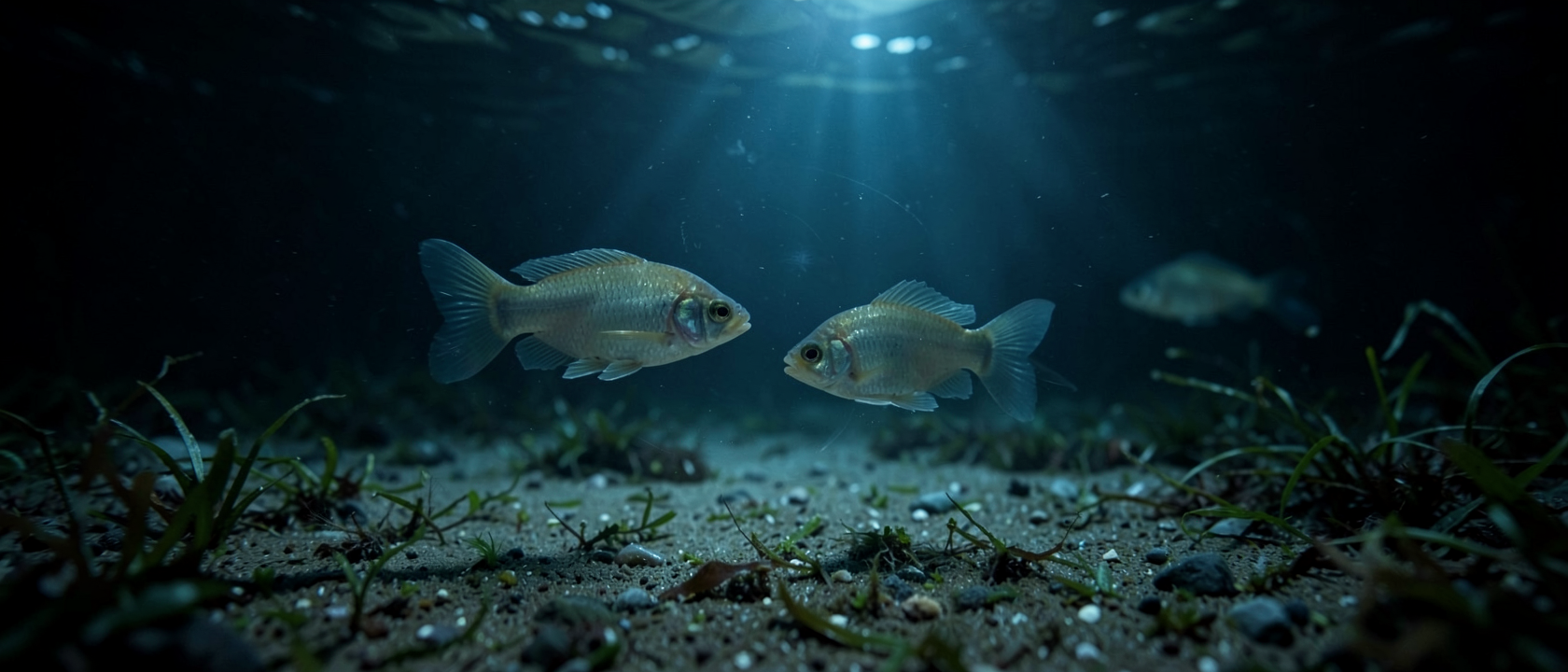
Two Hours of Nothing, Then Midnight
For the first two hours after sunset, the river went nowhere. Cameras set up over the water in Gifu City, Gifu Prefecture, caught wild Japanese medaka (Oryzias latipes) sitting almost motionless, barely finning against the current. Then, close to midnight, the same stretch of water turned into a chase.
The footage comes from a study led by Dr. Yuki Kondo and Professor Satoshi Awata of Osaka Metropolitan University’s Graduate School of Science, with co-authors Kotori Okamoto, Yuto Kitamukai, and Yasunori Koya, published in PLOS ONE in 2025. The team filmed the river from 9 p.m. to 5 a.m. during the medaka breeding season, when sunset fell around 7 p.m. and sunrise around 5 a.m. and found the real spawning clock was centered on midnight, not the dawn window everyone expected.
The Night, Hour by Hour
Between 9 p.m. and 11 p.m. activity across the river stayed low. “Staying,” the researchers’ term for sitting with little or no movement, hit its highest rate of the whole night between 9 p.m. and 10 p.m. Most fish were essentially parked.
Then the clock flipped. Around midnight, spawning began. Females carrying fertilized eggs, a visible cluster of two to 20 eggs stuck to the underside of the abdomen after mating, started turning up in the footage from 12 a.m. onward, a clear sign that mating was already underway in total darkness.
“Individual swimming,” the researchers’ measure of active movement, climbed fast after midnight and peaked between 1 a.m. and 3 a.m. Male courtship behavior peaked hardest of all between 2 a.m. and 3 a.m.: “following,” where a male trails and chases a chosen female, and “quick circles,” a rapid rotating display performed right in front of her. A related follow-up study from Kondo’s team lays out the fuller sequence: the male chases, circles rapidly, wraps his dorsal fin and anal fin, the fins on his back and underside, around the female, she releases her eggs, he releases sperm, and he swims off. All of it happens hours before any hint of daylight.
Why the Dark Might Suit Them
Nobody has proven why medaka wait for the middle of the night to spawn, and the paper settles on neither of the two leading guesses.
One is predation. A male doing rapid circles in front of a female, chasing her across open water while flashing breeding colors, is a loud, visible event. In daylight, that’s exactly the kind of display a sharp-eyed predator can spot from a distance. In darkness, it mostly can’t.
The other is the river itself. Water temperature drops after sunset, current shifts, and insect activity changes overnight, cues that simply don’t exist in a lab tank under a fixed light cycle and still water. Maybe it’s tied to the river’s nightly rhythm rather than to safety at all. Nobody has shown which explanation holds, or whether it’s both.
The Myth the River Killed
Medaka are one of the most studied fish on the planet, a staple lab animal in genetics research for decades. That long relationship produced a textbook assumption: medaka spawn near dawn, roughly an hour before or after sunrise, based on laboratory experiments run under tank conditions.
The river footage contradicts that outright. Spawning in the wild starts around midnight, hours before any lab-predicted dawn window, and courtship is already peaking by 2 to 3 a.m. long before the tank-based schedule said anything should be happening. A follow-up semi-outdoor study by the same team returned consistent results, reinforcing that medaka begin reproducing in full darkness, not at first light.
The lab data weren’t fabricated or sloppy. They just measured the wrong clock. Tanks under artificial lighting had been quietly running one of biology’s favorite model organisms on a schedule nobody had checked against the actual river, because nobody had put a camera over the water at 2 a.m. before.
What the Three Nights Don’t Tell Us
The published analysis of spawning timing drew on three nights of footage, part of a four-night recording run from July 25 to 28, 2023. The paper doesn’t report how many individual fish were tracked, so there’s no way yet to know whether midnight spawning is the norm for the whole population or a pattern driven by a handful of especially active fish.
It’s also unclear why the shift to darkness happens at all, whether it holds in other rivers, other seasons, or other medaka populations across Japan, and exactly when female ovulation occurs relative to courtship, a detail a follow-up study flagged as still unresolved. Medaka are presumed to start courting around midnight and spawn shortly after the female ovulates, but the precise trigger hasn’t been pinned down.
What’s settled is that wild medaka run on a different schedule than the one decades of lab research assumed. What’s still missing is the rest of the clock.