
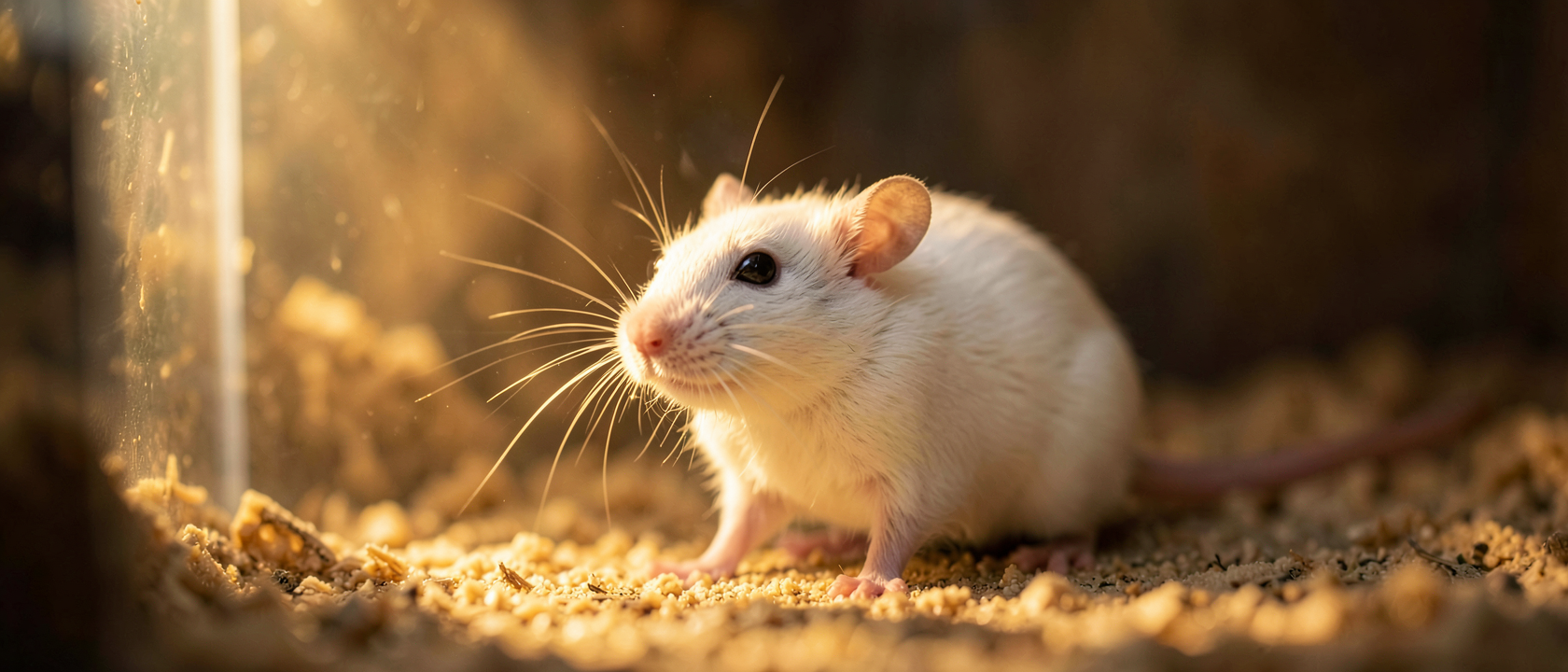
Thirsty lab mice at Columbia University’s Zuckerman Institute faced two holes with identical odds of a water reward. One gave nothing extra. The other released a scent that told them, ahead of time, whether water was actually coming. The scent couldn’t be eaten or drunk and did nothing for them physically. Most mice picked it anyway, and kept picking it even after researchers rearranged the payoffs so that choosing the informative hole meant collecting less water overall.
A hole that tells you nothing except what’s next
The study, “Representations of the Intrinsic Value of Information in Mouse Orbitofrontal Cortex,” was led by Jennifer J. Bussell with Ryan P. Badman, Christian D. Márton, Ethan S. Bromberg-Martin, L.F. Abbott, Kanaka Rajan, and Richard Axel, and published in Nature Neuroscience on July 30, 2026. The two holes gave mice the same statistical shot at water. One carried no cue at all. The other released an odor that reliably forecast the outcome, win or lose, before the mouse found out the hard way. The scent had zero caloric value and no sensory payoff of its own. It was pure foreknowledge, and most mice paid for it anyway.
A second price tag inside the brain
While mice ran the task, the researchers recorded large populations of neurons in the orbitofrontal cortex, a region just above and behind the eyes that is central to how animals weigh and compare choices. About 20 percent of those neurons fired differently depending on whether the mouse was expecting information, a signal distinct from the cells already known to track plain reward size. By comparing brain activity across trials promising a large water reward against trials promising a small one, Bussell separated two parallel tallies: an extrinsic ledger for how much water is coming, and an intrinsic ledger for whether the mouse will get to know it’s coming. The two populations overlap, but they are not the same cells doing the same job. The brain appears to be pricing the water and pricing the knowledge about the water as two separate line items, and the size of the information signal scaled with how long the mouse had to carry that knowledge before the reward arrived.
Waiting is the expensive part
When the researchers stretched the delay between the cue and the water, forcing mice to sit with the suspense longer, the mice leaned even harder toward the informative hole. That pattern points toward an answer to the obvious question: what is any of this actually for? The preference doesn’t look like it’s about using the information to do anything, since there is nothing to do with it. It looks more like the resolution of uncertainty is worth something on its own, independent of whatever the uncertainty was about. That is the researchers’ reading of the pattern, not a confirmed mechanism, but it’s a tidy one: a mouse appears willing to spend real water just to stop not knowing.
The myth: only tangible rewards count
Aristotle opened the Metaphysics with the claim that all people desire to know by nature. Mid-twentieth-century researchers tested something narrower on rats and pigeons, building choice tasks around food, water, and shocks, the tangible currencies that behavioral economics assumed were the only things an animal brain would actually pay for. Ethan Bromberg-Martin, a co-author on the Columbia study, had already shown in earlier work that certain brain regions treat information somewhat like a food reward, even when it can’t be eaten or drunk. The new finding pushes that further into territory long reserved for sugar concentrations and water volumes. A decision-making region of the mouse brain assigns standalone value to pure knowledge, not knowledge that pays off later, just knowledge. The standing assumption that only consumable rewards move the needle doesn’t survive this result.
What nobody knows yet
Why a mouse brain, or a human one, bothers computing a price tag for information with no practical use is still unresolved. The team lays out competing possibilities without picking one: it could be an evolutionary leftover from a time when information really was survival-relevant and got wired in as valuable by default; it could reflect a genuine reward-like pleasure in discovery itself; or it could be the brain paying to eliminate the discomfort of simply not knowing, rather than seeking any thrill at all. None of these is confirmed. Ben Hayden, a professor of neurosurgery at Baylor College of Medicine who was not involved in the study but has run similar work in primates, has said mice are actually the better model for this kind of circuitry, arguing you can do much better neuroscience with a mouse than with a monkey when the question is how a brain decides to seek out information at all.
Bussell, an associate research scientist in Richard Axel’s lab, has said that getting to be curious about the world is one of life’s great pleasures, and that she wants to understand how that plays out in the brain, for how children learn as much as for how adults navigate a world full of information and misinformation. Her next step is tracing where this signal goes beyond the orbitofrontal cortex, into regions like the medial prefrontal cortex and the insula, both involved in weighing internal states and decisions, to map how far the appetite for knowing actually reaches.