
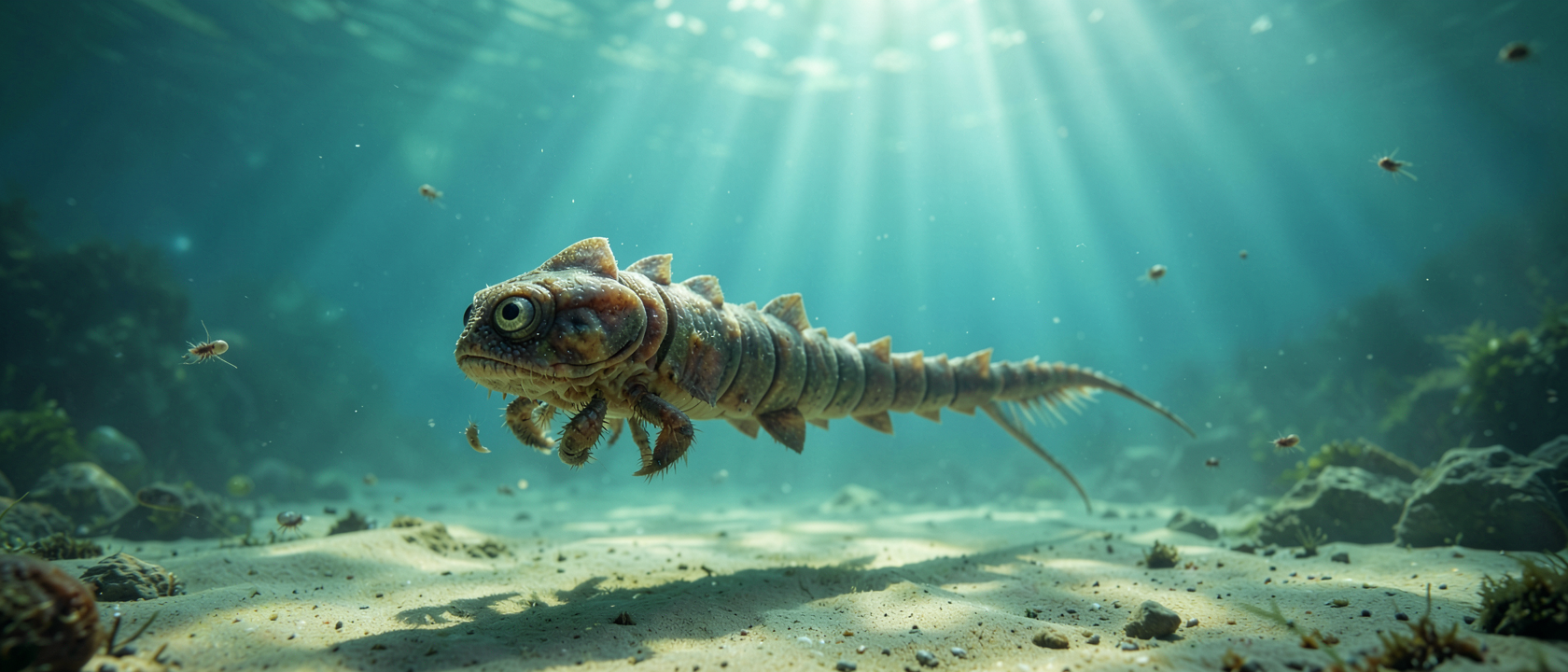
A predator small enough to lie across your index finger patrolled the seafloor of what is now British Columbia with a third eye mounted between its two large compound ones, and a tail segment so crammed with gills that nothing like it has turned up in any other fossil from its own family.
A sea moth gets a name
Paleontologists Joseph Moysiuk and Jean-Bernard Caron described the new species in a paper published May 14, 2025 in Royal Society Open Science. They named it Mosura fentoni, the only species in the genus Mosura, built from sixty specimens collected between 1990 and 2022 at Burgess Shale sites in British Columbia, including one previously unpublished fossil originally gathered by Charles Walcott, the paleontologist who discovered the Burgess Shale itself. Field collectors had nicknamed the animal the “sea-moth” for its silhouette, and the genus name runs with it: Mosura honors Mothra, the moth-shaped monster of Japanese film. The species belongs to Radiodonta, an extinct lineage of arthropods that split off before the ancestor of every living jointed-legged animal, identifiable by compound eyes paired with only a single set of jointed limbs. The group’s most famous member, Anomalocaris canadensis, grew to 3.3 feet (1 meter) and shared these Cambrian waters, dated to roughly 506 million years ago, in the Wuliuan stage. Mosura itself ran a modest 0.6 to 2.4 inches (1.5 to 6.1 centimeters), genuinely finger-sized beside its giant relative.
Three eyes and a tail built like a gill farm
Mosura carried the standard radiodont parts: paired swimming flaps down its sides, hook-lined feeding appendages, a circular tooth-ringed mouth shaped like a pencil sharpener, large compound eyes, and that single pair of jointed limbs. What it added was a third eye, oval and median, sitting squarely between the two big ones. Its trunk ran to 26 segments, the highest count reported for any radiodont despite Mosura being among the smallest ones known. At the rear, instead of more swimming flaps, it carried 16 tightly packed segments lined with gills, a dense abdomen-like region documented in no other radiodont fossil.
Why hunt with a third eye and breathe through your tail
Moysiuk and Caron propose the median eye worked less like a backup pair of eyes and more like an instrument: a fast orientation tool, the kind modern dragonflies use to lock onto a target mid-chase, rather than a general-purpose image former. Paired with a body built for small, shrimp-like prey rather than the larger animals Anomalocaris went after, that eye may have let Mosura hunt the same waters as its giant relative without competing with it directly. The crowded gill segments raise a separate question about lifestyle: more gill surface moves more oxygen, which fits either an unusually active animal or one living somewhere short on oxygen to begin with. Either way, something the size of a finger had already split its body into a hunting end and a breathing end, long before anything with a backbone tried the same arrangement.
The myth this fossil buries
The dark “tonguelette” structures inside radiodont fossils had been read by earlier researchers as remnants of nerve tissue, gut, or appendages. Moysiuk and Caron reinterpret them instead as lacunae, the open cavities of a circulatory system that pumps hemolymph (the arthropod equivalent of blood) out through arteries and lets it drain back through body spaces rather than veins, a pattern that matches other Cambrian arthropod fossils. That correction sits on top of a bigger one: radiodonts were never one animal wearing different costumes, a uniform body plan long assumed across the group. Mosura’s record trunk segment count and its gill-packed tail, absent from every other described radiodont, are the evidence that this group experimented with its own anatomy far more than the textbook picture allowed.
What nobody has settled yet
The median eye’s actual job is still a proposal, not a demonstrated function; the dragonfly comparison fits the behavior but has not been tested against it. The gill-packed tail sits in the same place: whether it points to an active hunting style or a response to thin oxygen in Cambrian seas remains an open question the researchers have flagged for further work, not one they have closed.
Mosura’s one regret
Mosura never got to fight Godzilla. Tokyo did not exist yet, and neither did much else, but half a billion years before either of them appeared on a screen, it was already running strike missions on shrimp-sized prey with a third eye for aim and a tail built like a gill farm for stamina. No studio budget required. The original had better specs.