
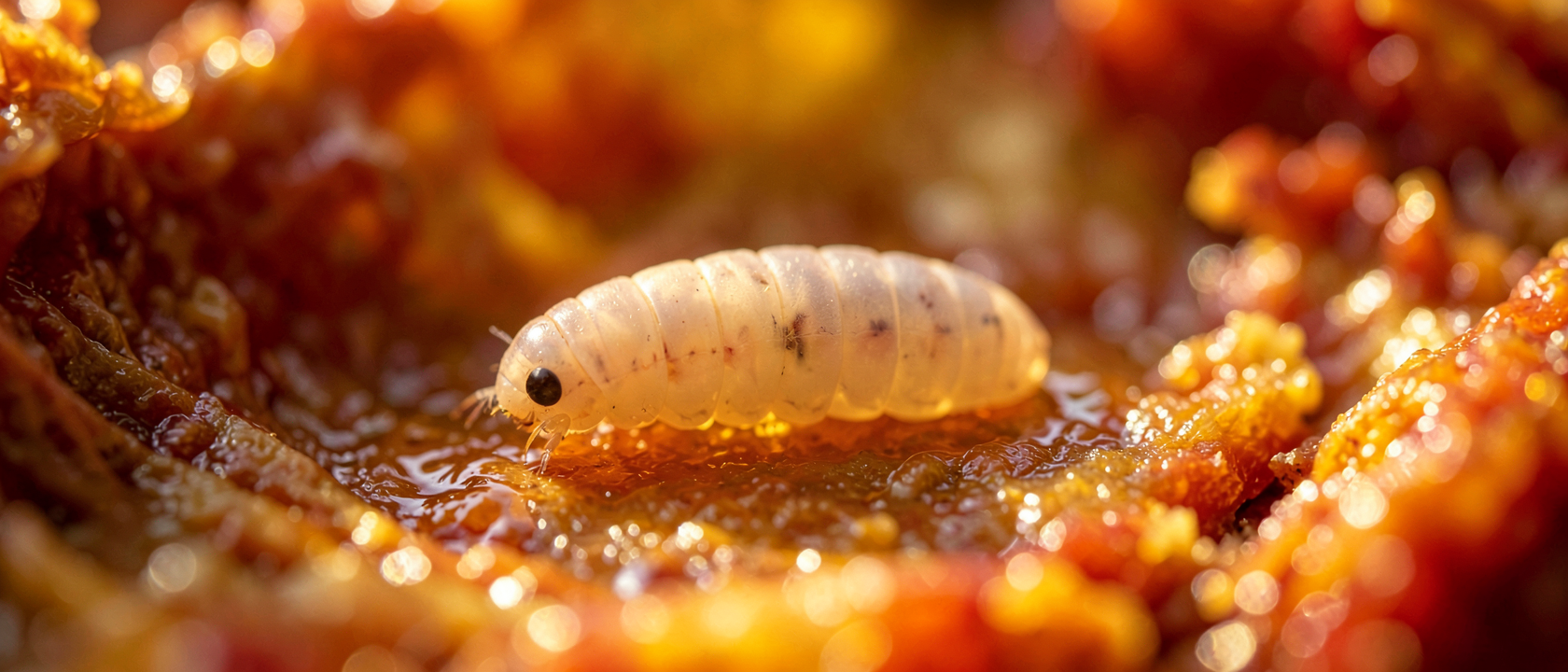
No Skeleton, Still a Calcium Bank
Fruit fly larvae have no bone and no cartilage anywhere in their bodies, and they still run a hormone-controlled calcium system that works on the same logic vertebrates use to manage theirs. A team at the University of Tsukuba, led by Okamoto, Niwa, and Kohsaka, published the finding in Nature in 2025. The animal in question is the common lab fly, Drosophila melanogaster, and specifically its larvae: soft, legless, cream-colored maggots a few millimeters long, with nothing resembling a skeleton to store minerals in. They keep an emergency calcium stash anyway.
How Capa Pulls Calcium From a Tube
The hormone is a small protein called Capa, released by a specific set of neurons in the larva’s cranial nervous system, the cluster of nerves near the head end. Capa travels through the body and acts on the apical surface of the Malpighian tubules, the organs that do a kidney’s job in an insect: filtering waste and fluid out of the body cavity. Inside the tubules, in a cavity called the lumen, calcium sits stored in solid form as what the researchers call “pearl-like calcium granules,” or PCGs. When Capa reaches the tubule, those granules dissolve, and the calcium they were holding moves out into the haemolymph, the fluid that does a blood supply’s job in an insect. The neuron fires, the hormone travels to the tubule, and the granule dissolves, releasing calcium into circulation within the larva’s body.
Why a Boneless Larva Needs a Calcium Reserve
This is not a cosmetic side detail. Larvae engineered to lack Capa had measurably lower calcium levels in their haemolymph, and the consequences showed up fast: weaker muscle contractions and noticeably reduced movement compared to normal larvae. The same Capa-deficient larvae also developed into elongated pupae, the resting stage before adulthood, matching the shape seen in larvae raised on a calcium-free diet. A fly that cannot release its stored calcium is a fly that struggles to crawl properly and pupates abnormally. The researchers draw the comparison directly: this is functionally the same job parathyroid hormone does in vertebrates, pulling calcium out of bone when the diet is not supplying enough. The storage container is different, but the withdrawal system and the cost of a failed withdrawal are strikingly similar.
The Myth This Kills
Physiology has long treated hormone-driven calcium regulation as something that needs a skeleton to draw from, bone being the textbook calcium reservoir in every vertebrate biology course. This study is presented as the first clear evidence of a complete, analogous system, a hormone, a dedicated mineral stockpile, and a release trigger, running in an animal that has no bone at all. The granules inside the Malpighian tubules are not a stripped-down, consolation-prize version of a skeleton. They do exactly what bone does for a vertebrate: hold calcium in reserve until a hormone says to release it.
What Nobody Knows Yet
This system has so far been shown in one species, under laboratory conditions, with no stated information on whether other insects or other boneless invertebrates run anything similar. How widespread or conserved these pearl-like calcium granules are across animal lineages is untested. The researchers note that the discovery could eventually inform understanding of human disorders of calcium metabolism, but they have not explored any specific mechanism or disease link. That connection is a door left open, not a claim already made.