
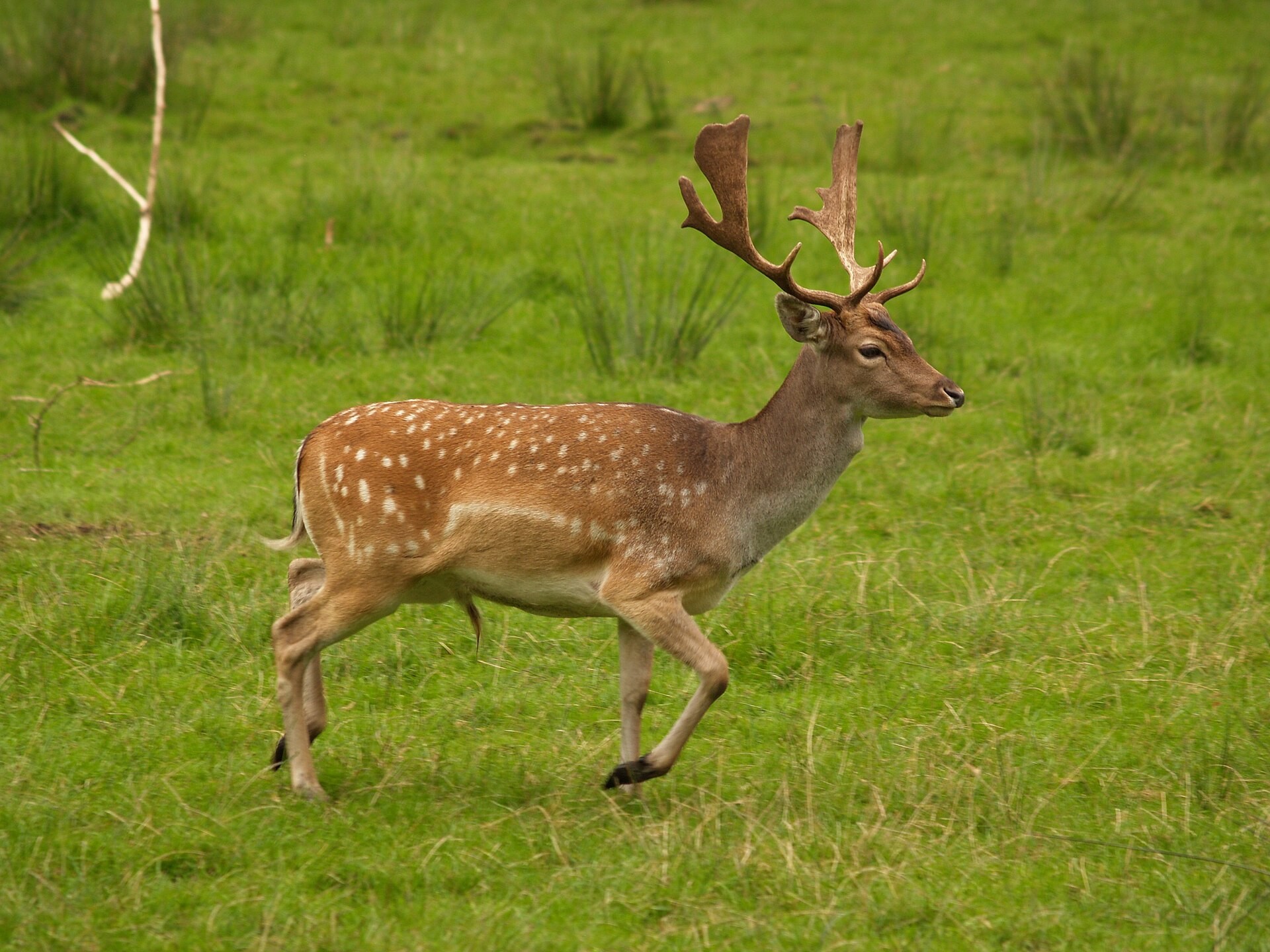
Dama dama, the fallow deer, is a mid-sized ruminant in the family Cervidae, native to western Eurasia and now established on every inhabited continent. Among roughly 50 recognized deer species, it is the most widely kept in the world, present in forests, grasslands, shrublands, pastures, plantations, and agricultural land alike. Bucks weigh 70–100 kg and stand 85–95 cm at the shoulder; does are lighter at 40–50 kg and 75–85 cm. The species carries a distinction held by no other deer: it forms true leks, a mating arena system otherwise associated with birds such as grouse.
Key facts
- Scientific name: Dama dama
- Kingdom: Animalia
- Phylum: Chordata
- Class: Mammalia
- Order: Artiodactyla
- Family: Cervidae
- Genus: Dama
- Taxonomic rank: species
- Mass: 5 kg
- Gestation period: 220.5 days
Physical description
Adult bucks measure 140–160 cm in body length and weigh 70–100 kg; does are 130–150 cm long and weigh 40–50 kg. Males grow palmate, multi-point antlers ranging from 50 to 70 cm in length. The antlers are shed each April and regrown, with velvet cleared by August. From the age of 3–4 years, the palmate sections can measure 8–25 cm in width.
Dama dama has the most variable coat coloration of any deer species, with four recognized morphs: common (spotted fawn), menil (paler and spotted), melanistic (black), and white. The common morph shifts seasonally: reddish-brown with white spots in summer, and a dull grey-brown with indistinct or absent spots in winter. The white morph is not albinism. It results from a mutation in the MC1R gene causing a leucine-to-proline amino acid substitution; melanocytes remain fully functional. No other European deer species combines this four-morph system with the same seasonal coat shift.
Diet and digestion
Fallow deer are ruminants with a four-chambered stomach that ferments food using bacteria. Grasses dominate the diet, contributing over 60% of intake between March and September. The remainder is made up of herbs, broadleaved browse, bramble, holly, ivy, and heather. In winter, the diet shifts toward bark, fungi, nuts, and berries.
Mating system and reproduction
The fallow deer rut peaks in October in the Northern Hemisphere. During this period bucks groan loudly, perform parallel walks with rivals, and fight for rutting positions. A buck may stop eating entirely and lose 9–23 kg of body weight, a figure that can represent more than 20% of total mass.
The species exhibits three distinct mating strategies depending on population density and tradition. In most populations bucks defend a fixed rutting stand, forming what are recognized as true leks: aggregations of two to five males on a traditional territory of roughly 100–150 m² that holds no food or other resource. Females visit and select mates there. In other populations bucks herd females into harems; in low-density areas they simply seek out receptive individuals. The lek system is unique among deer.
Does give birth to a single fawn in June or July after a gestation of 229 days. The fawn weighs 4–5 kg at birth, is mobile from a young age, and joins the social group within a week. Males generally live 8–10 years in the wild, though individuals can reach 16 years; females live 12–16 years according to the Mammal Society.
Vocalizations
Fallow deer use six types of vocalization: barking (an alarm call produced by females), bleating (during birth or with young), mewing (associated with submission), peeping, groaning (produced by rutting bucks), and at least one additional category. The groaning of rutting bucks is one of the more audible signs of the October rut.
Distribution and introduction history
Fallow deer have been introduced to all inhabited continents and are the most widely kept deer species in the world. The range of habitats they occupy — from closed-canopy forest to open agricultural land — partly explains how successfully they establish outside their native range.
A 2024 study by Durham University and the University of Exeter, published simultaneously in PNAS and Scientific Reports, used ancient and modern DNA alongside zooarchaeological evidence to reconstruct a 10,000-year biocultural history of fallow deer. The analysis revealed two genetically distinct post-glacial European populations separated by the Bosphorus, clarifying that human-assisted movement of the species began long before the commonly cited periods.
Strontium isotope analysis of jaw bones excavated at Fishbourne Roman Palace in Sussex confirmed that at least one individual had been born in southern Europe before living in England. That finding pushed the confirmed presence of fallow deer in Britain back by roughly 1,000 years beyond the Norman introduction that had previously been credited. Charles Darwin collected feral fallow deer specimens on Barbuda in the 1800s, documenting wild island populations decades before modern researchers began reconstructing their origin history.
Texas holds over 10,000 fallow deer, about one-third of which live outside confinement, mostly on the Edwards Plateau. That population is among the largest free-ranging introduced populations in the Americas.
Status in the United Kingdom
In the UK, fallow deer are protected under the Deer Act 1991. The population is estimated at approximately 100,000 individuals: roughly 95,000 in England, 4,000 in Scotland, and 1,000 in Wales. Numbers are locally abundant and increasing.
Disease and livestock interaction
Fallow deer are a known reservoir host for Mycobacterium bovis, the bacterium responsible for bovine tuberculosis. Their gregarious herding behavior and regular use of cattle pastures place them among the highest-risk deer species for transmitting the disease to livestock.
Farming and commercial use
Fallow deer are farmed in many countries for venison and antler velvet. They account for approximately 20% of deer farmed in the UK. In Australia and New Zealand, European and Mesopotamian fallow deer have been crossed to produce larger-bodied farmed stock.
Did you know
- Fallow deer are the only deer species known to form true leks — a mating arena behavior more associated with birds such as grouse — making their reproductive system unique among the approximately 50 recognized deer species worldwide. (pubs.usgs.gov)
- Naturalist Charles Darwin collected feral fallow deer specimens on Barbuda in the 1800s, documenting wild populations on the island decades before modern scientists began analyzing their origins. (blog.nature.org)
- During the rut, a male fallow buck may stop eating entirely and lose as much as 9–23 kg of body weight, potentially over 20% of his mass, while competing for and defending a rutting stand. (depts.ttu.edu)
- Strontium isotope analysis of fallow deer jaw bones excavated at Fishbourne Roman Palace in Sussex confirmed that at least one individual had been born in southern Europe before living out its days in England, pushing the confirmed presence of fallow deer in Britain back by roughly 1,000 years beyond the previously credited Norman introduction. (shootinguk.co.uk)
- The fallow deer coat changes seasonally: in summer it is reddish-brown with white spots ideal for woodland camouflage, while in winter it becomes a dull grey-brown with indistinct or absent spots — a dual seasonal strategy shared by no other European deer species with the same four distinct color morphs. (depts.ttu.edu)
- Texas alone holds over 10,000 fallow deer, about one-third of which live outside confinement, mostly on the Edwards Plateau — making it one of the largest free-ranging introduced populations in the Americas. (depts.ttu.edu)
Data sources
- GBIF
- Wikidata
- animaldiversity.org
- jungledragon.com
- depts.ttu.edu
- iucngisd.org
- wildlifeonline.me.uk
- bds.org.uk
- pubs.usgs.gov
- countryfile.com
- gwct.org.uk
- nature.com
Data updated: 2026-10-31