
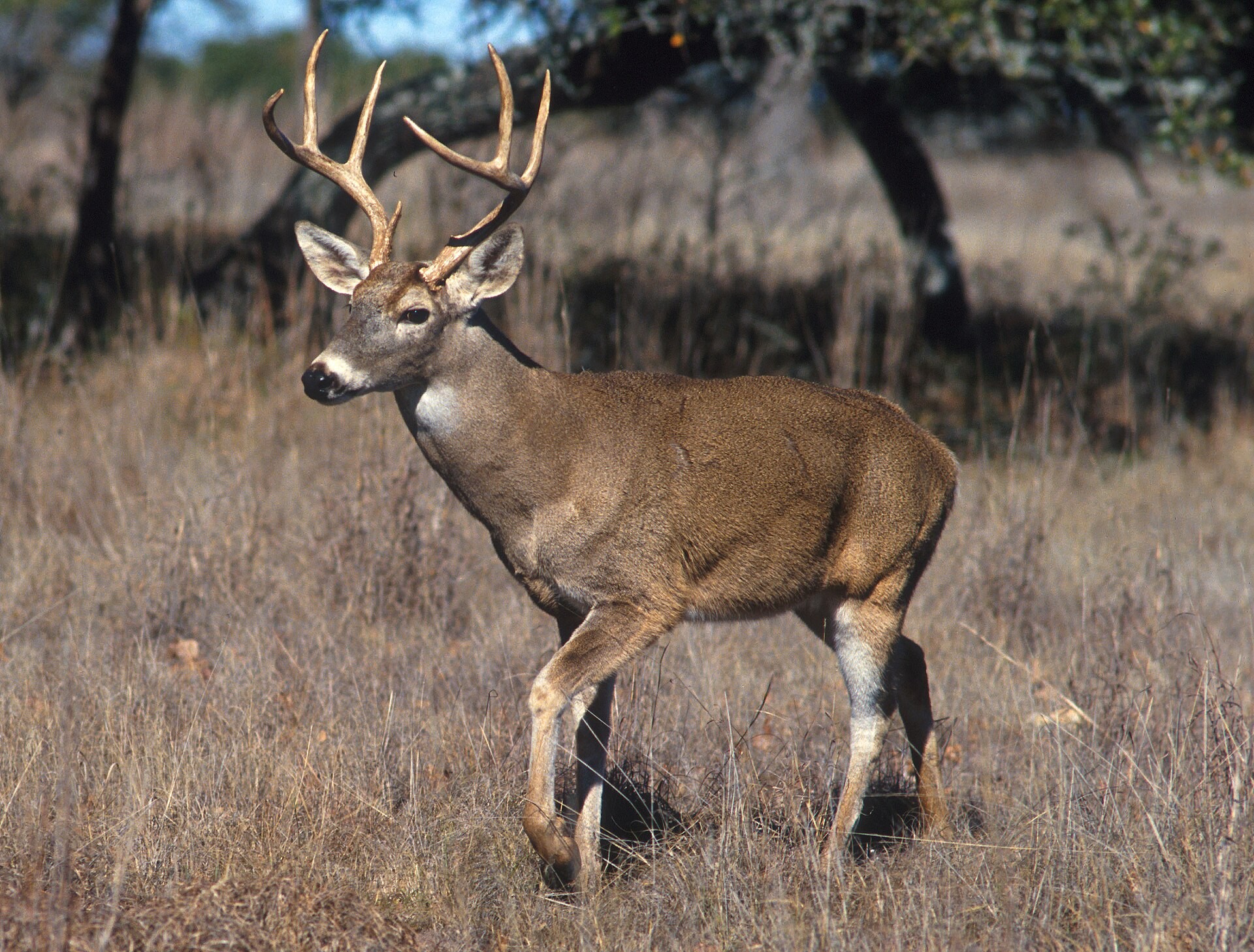
The white-tailed deer, Odocoileus virginianus, is a ruminant mammal of the family Cervidae whose range stretches from southern Canada through the entire mainland United States (excepting two or three western states), through Central America, and south to Bolivia and northern Brazil. Thirty-eight subspecies are recognized across that range, from the diminutive Key deer of Florida, where mature bucks may weigh 60 pounds, to northern subspecies in Minnesota where bucks can reach 300 pounds. First formally described in 1780 by Eberhard August Wilhelm von Zimmermann under the name Dama virginiana, the species has since become the state mammal or state animal of at least eleven U.S. states. Its populations carry growing veterinary and public-health significance: a 2025 study recorded an average 17 percent annual decline in deer density across a high-prevalence chronic wasting disease study area in Arkansas from 2021 to 2024.
Key facts
- Scientific name: Odocoileus virginianus
- Kingdom: Animalia
- Phylum: Chordata
- Class: Mammalia
- Order: Artiodactyla
- Family: Cervidae
- Genus: Odocoileus
- Taxonomic rank: species
- Gestation period: 205 days
Taxonomy and closest relative
Zimmermann’s 1780 description, published in his Geographische Geschichte des Menschen und der vierfüßigen Tiere, fixed the type locality to Virginia, United States. The species sits within the order Artiodactyla and the family Cervidae, in the genus Odocoileus. That genus contains only two species: Odocoileus virginianus itself and the mule deer, Odocoileus hemionus, making the mule deer the white-tailed deer’s sole congener. Both species are endemic to North America. Where their ranges overlap, they hybridize in the wild, a phenomenon supported by published genetic evidence.
Thirty-eight subspecies are formally recognized: 17 in the United States and Canada, 13 in Mexico and Central America, and 8 in South America. The species is assessed as Least Concern on the IUCN Red List, with a stable population trend as of the most recent assessment.
Body size, coat, and physical adaptations
Body size in this species conforms to Bergmann’s rule: individuals grow larger at higher latitudes. The Key deer subspecies of Florida represents one extreme, with mature bucks potentially weighing 60 pounds; Minnesota’s northern subspecies represents the other, with bucks reaching 300 pounds. Coat hairs are hollow, a structural feature that improves insulation in cold weather. By late autumn, a deer may accumulate a fat layer that comprises 10 to 25 percent of its total body weight, functioning as an energy reserve through winter months when food availability drops.
Fawns are born with reddish-brown coats covered in white spots and weigh between 1.5 and 2.5 kg at birth. The spots disappear by their first winter. Gestation lasts 205 days.
The species has more rods in the eye than humans do, sharpening vision at dawn and dusk. It has fewer cones, which means it cannot distinguish red or orange colors.
White-tailed deer carry multiple scent-gland systems: glands between both halves of each hoof on all four feet, metatarsal glands on the outside of each hind leg, and a larger tarsal gland on the inside of each hind leg at the hock. Secretions from the tarsal gland become especially strong during the rutting season.
Habitat and range
The species occupies a wide variety of terrestrial habitats. The northern end of its range includes the dense forests of Maine; the southern end includes the deep sawgrass swamps of Florida. Across this span, white-tailed deer consistently favor areas that combine dense thickets with open edges, because those edges supply the most accessible food.
Despite heavy snow in northern parts of the range, the species does not migrate to a separate winter range. Instead, deer yard up within their own territories during severe winter conditions. Outside the mating season, females and males live separately, with bucks forming small bachelor herds, typically three or four individuals.
Activity patterns and feeding
White-tailed deer are crepuscular. They feed mainly from before dawn until several hours afterward and again from late afternoon until dusk, remaining largely inactive during most daylight hours. This pattern aligns with their superior rod-based low-light vision.
The species is a ruminant with a four-chambered stomach. This digestive architecture allows a deer to consume large amounts of food rapidly, storing it for later chewing and digestion, a significant advantage when feeding in exposed areas where lingering increases predation risk.
Behavior: alarm signals and the rut
When alarmed, a white-tailed deer stomps its hooves, produces a snorting vocalization, and raises its white-tipped tail. This tail-raising behavior, called flagging, functions as a visual warning to nearby deer.
The mating season, known as the rut, is triggered by decreasing photoperiod rather than temperature or calendar date alone. In early autumn, bucks shed the velvet from their antlers. Does are receptive for only about 24 to 72 hours per estrous cycle during the rut, creating intense competition among bucks during a compressed window.
Disease: chronic wasting disease
Chronic wasting disease (CWD) is a fatal contagious prion disease that affects white-tailed deer. A 2025 study conducted in Arkansas recorded an average 17 percent annual decline in deer density across a high-prevalence CWD study area from 2021 to 2024, providing direct quantitative evidence that the disease can drive population-level decline.
A separate 2025 study published in Scientific Reports provided the first evidence of vertical transmission of CWD: infectious prions were identified in multiple fetal and maternal-fetal reproductive tissues from naturally exposed free-ranging does, establishing that the pathogen can be passed from a doe to her fetus in utero. The mechanism and frequency of vertical transmission remain active research questions.
White-tailed deer and human health
A surveillance study conducted in Ontario, Canada during November and December 2021 sampled 300 white-tailed deer and identified a highly divergent lineage of SARS-CoV-2, designated B.1.641, circulating in the population. The study also provided evidence of deer-to-human transmission of that lineage, establishing white-tailed deer as a documented reservoir from which novel viral variants can re-enter human populations.
Cultural and civic status
The white-tailed deer is the state mammal or state animal of at least eleven U.S. states, including New Hampshire, Pennsylvania, Arkansas, Georgia, Illinois, Mississippi, Nebraska, Ohio, and South Carolina.
Did you know
- Antlers shed by white-tailed deer bucks in late winter are rapidly consumed in the wild because other animals chew on them for their high calcium content. (fossilrim.org)
- White-tailed deer can store so much body fat by late autumn that the fat layer comprises 10 to 25 percent of their total body weight, serving as an essential energy reserve through winter when food is scarce. (maine.gov)
Data sources
- GBIF
- Wikidata
- animaldiversity.org
- depts.ttu.edu
- mammaldiversity.org
- wildadirondacks.org
- naturemappingfoundation.org
- cosleyzoo.org
- maine.gov
- nps.gov
- naturesmart.com
- ncbi.nlm.nih.gov
- deerassociation.com
- journals.plos.org
- nature.com
- nhpbs.org
Data updated: 2026-10-31