
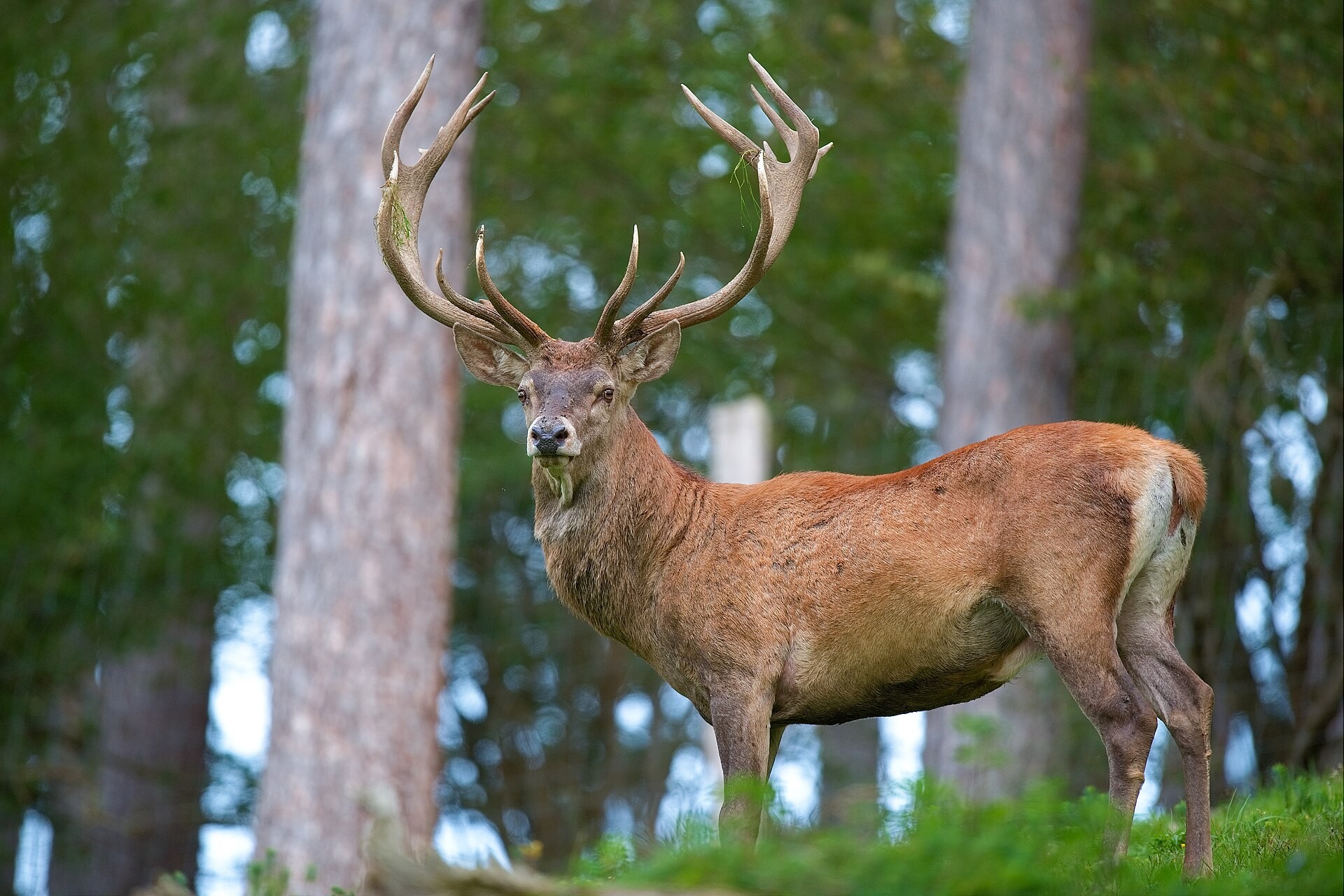
The Barbary red deer, Cervus elaphus barbarus, is the only deer subspecies native to Africa, clinging to the dense oak and cork forests of northwestern Algeria and Tunisia. Formally described by naturalist Edward Turner Bennett in 1833, with Tunisia recorded as the type locality, it is smaller and lighter than its European relatives, with adult males weighing between 80 and 110 kilograms and standing roughly 114 cm at the shoulder. By 1962, the entire known wild population had collapsed to as few as seven individuals, making it one of the most dramatic near-extinctions in North African mammal history. Conservation measures in Tunisia and Algeria have since allowed numbers to recover, though the subspecies remains vulnerable to habitat loss, poaching, and emerging disease.
Key facts
- Scientific name: Cervus elaphus
- Kingdom: Animalia
- Phylum: Chordata
- Class: Mammalia
- Order: Artiodactyla
- Family: Cervidae
- Genus: Cervus
- Taxonomic rank: species
- Gestation period: 234.5 days
Physical characteristics
The Barbary stag is noticeably smaller than typical European red deer. Males reach 130–140 cm (51–55 inches) in body length, while females measure 90–100 cm (35–39 inches). Shoulder height in adult males averages approximately 114 cm (45 inches). Body weight ranges from 80 to 110 kilograms (180 to 240 pounds), with males heavier than females.
Antler size reflects the subspecies’ compact proportions. The Rowland Ward record for a Barbary red deer antler stands at 100.02 cm (39 3/8 inches), a measurement that is considerably shorter than the antlers recorded for larger European red deer subspecies.
Taxonomy and description
The subspecies was formally described and named by the naturalist Edward Turner Bennett in 1833. The original type locality was recorded as Tunisia. It belongs to the species Cervus elaphus, within the family Cervidae, order Artiodactyla, class Mammalia, phylum Chordata, and kingdom Animalia. Its gestation period is 234.5 days.
Habitat and range
The Barbary stag thrives in dense, humid forested areas, particularly oak and cork forests near the Algerian-Tunisian border. Its range spans Algeria, Tunisia, and historically Morocco. The subspecies became extinct in Morocco by 1932, and populations in Tunisia dwindled to as few as seven individuals by 1962 before protective measures were introduced.
El Feidja National Park in northwestern Tunisia is the core protected stronghold for the subspecies. The park covers a total area of 2,632 hectares, of which 417 hectares form a fully protected fenced zone dedicated to the preservation of Barbary deer.
Behaviour and reproduction
The Barbary stag is polygynous. During the autumn rut, dominant stags assemble harems and roar loudly, day and night, to attract females and challenge rival males. This pattern is consistent with the broader reproductive biology documented across Cervus elaphus subspecies.
Gestation lasts 234.5 days. Maximum recorded longevity for red deer in captivity is 31.5 years, while average lifespan in the wild is approximately 10–11 years.
Threats and conservation status
Primary threats to the Barbary stag include habitat degradation from logging, agriculture, and urbanization, as well as poaching. Predation by the critically endangered Barbary leopard may also still occur, though the leopard’s own rarity makes the frequency of such interactions uncertain.
In 2021 and 2022, Epizootic Hemorrhagic Disease Virus serotype 8 (EHDV-8), transmitted by Culicoides midges, was identified in Barbary deer carcasses found in the El Feidja national reserve in northwestern Tunisia. The outbreak killed at least seven animals in a single incident. This represented a newly documented disease threat to the subspecies, demonstrating that even fenced protected populations face risks from vector-borne pathogens.
Cultural and historical record
The Barbary stag carries regional symbolic weight beyond its ecological role. It is the emblem species of El Feidja National Park in Tunisia and the official symbol of El Tarf Province in Algeria.
Ancient Roman hunting mosaics from Carthage, in modern-day Tunisia and dating to the late 5th or 6th century CE, depict horsemen roping stags. These images provide some of the earliest cultural records of deer hunting within the subspecies’ native range, predating Bennett’s formal scientific description by more than a millennium.
Did you know
- In Tunisia in 1962, the entire known wild population of the Barbary stag had collapsed to as few as seven individuals before conservation and protection measures enabled the subspecies to recover. (grokipedia.com)
- The Barbary stag is the emblem species of El Feidja National Park in Tunisia and is also the official symbol of El Tarf Province in Algeria, reflecting its deep cultural significance in the region. (tunza.eco-generation.org)
- Ancient Roman hunting mosaics from Carthage in modern-day Tunisia, dating to the late 5th or 6th century CE, depict horsemen roping stags, providing some of the earliest cultural records of deer hunting in the subspecies’ native range. (worldhistory.org)
- An Epizootic Hemorrhagic Disease Virus (EHDV-8) outbreak identified in 2021–2022 in Tunisia killed at least seven Barbary deer in the El Feidja reserve in a single incident, highlighting the vulnerability of this small population to emerging infectious diseases. (ncbi.nlm.nih.gov)
- The Rowland Ward record measurement for a Barbary red deer antler stands at 100.02 cm (39 3/8 inches), which is considerably shorter than the antlers of larger European red deer subspecies. (wild-about-you.com)
Data sources
- GBIF
- Wikidata
- mammaldiversity.org
- storyteller.travel
- wild-about-you.com
- wildlifeonline.me.uk
- genomics.senescence.info
- grokipedia.com
- ncbi.nlm.nih.gov
- medomed.org
Data updated: 2026-10-31