
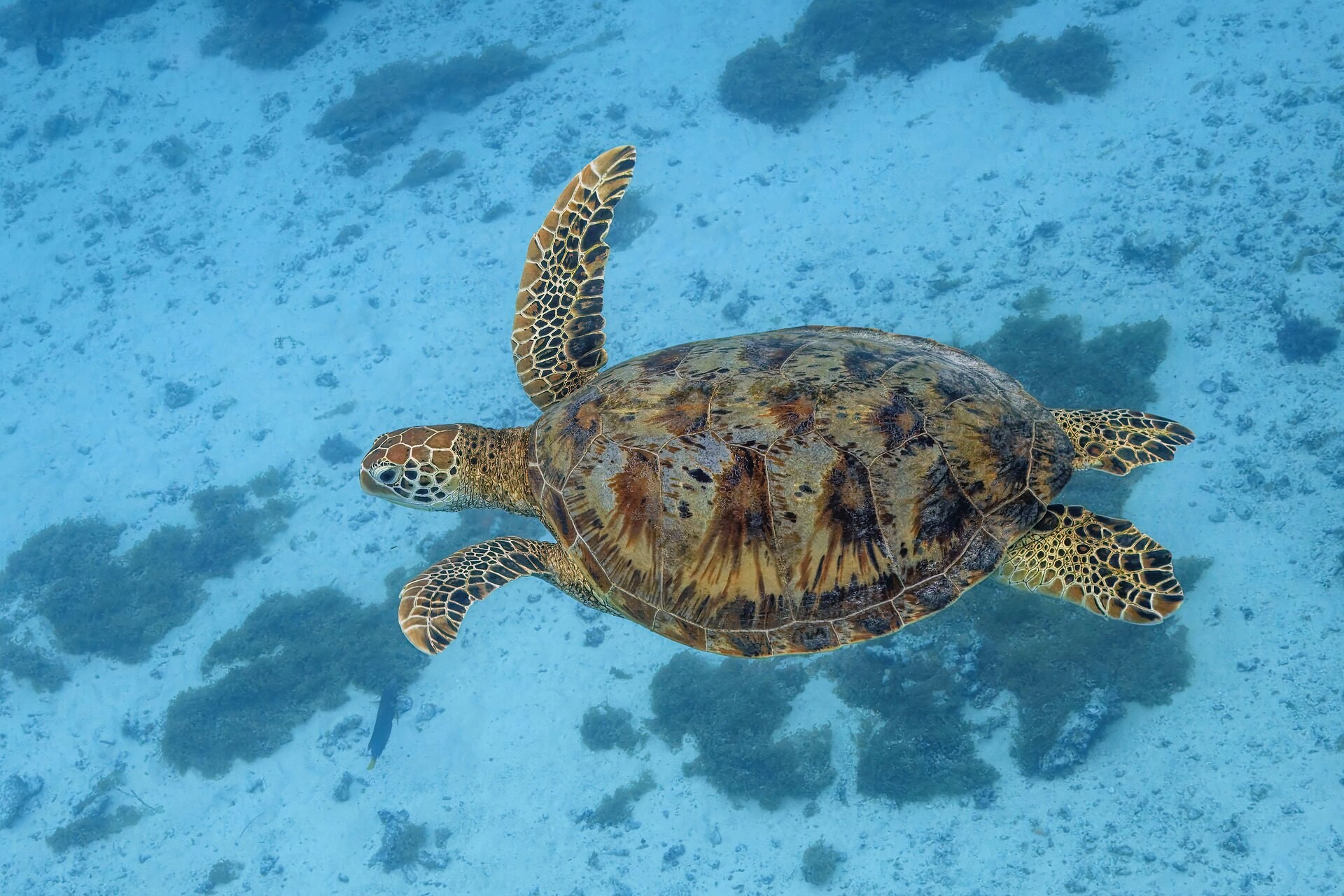
Chelonia mydas, the green turtle, is a large sea turtle distributed across tropical and subtropical waters roughly between 30 degrees north and 30 degrees south, and it is the only fully herbivorous sea turtle species alive. Adults average about 136 kg in weight and approximately 1 m in carapace length, placing them among the largest hard-shelled reptiles on Earth. The species carries outsized ecological weight: by grazing on seagrass beds, green turtles function as megaherbivore ecosystem engineers, maintaining seagrass health and cycling nutrients back into the broader marine community. In 2025, the IUCN moved Chelonia mydas from Endangered to Least Concern after population data showed a global increase of over 28% since the 1970s, the outcome of more than four decades of international protection.
Key facts
- Scientific name: Chelonia mydas
- Kingdom: Animalia
- Phylum: Chordata
- Class: Testudines
- Family: Cheloniidae
- Genus: Chelonia
- Taxonomic rank: species
Identification and appearance
The adult carapace is smooth and keelless, ranging in colour from light to dark brown with dark mottling; the plastron is whitish to light yellow. One feature separates Chelonia mydas from every other sea turtle: a single pair of prefrontal scales located in front of the eyes. All other sea turtle species carry multiple pairs. Hatchlings look nothing like adults: their carapace is black and their plastron white, and they measure about 50 mm in length while weighing approximately 25 g.
The common name ‘green turtle’ is a persistent source of confusion. The shell is not green. The name comes from the greenish hue of the fat beneath the skin, a colour produced by the animal’s herbivorous diet. The Eastern Pacific subspecies, Chelonia mydas agassizii, sometimes called the ‘black turtle,’ tends to be darker overall and follows a more carnivorous diet than Atlantic populations, consuming mollusks, algae, and other invertebrates.
Diet and feeding ecology
Adult green turtles are the only sea turtle species that feed primarily on seagrasses and algae, making them unique among the seven living sea turtle species. Juveniles, however, begin life as omnivores. Before transitioning to an entirely plant-based diet, young green turtles consume small marine invertebrates including hydrozoans, bryozoans, and the eggs of sea hares (Aplysia).
The ecological consequences of that adult diet extend well beyond individual turtles. Green turtles graze seagrass beds in a way that keeps the grass short, dense, and photosynthetically active. Nutrients from their digested seagrass cycle back into the system, supporting other marine plants and animals. When green turtles disappear from an area, the seagrass suffers: the seagrass die-offs in Florida Bay and the Gulf of Mexico during the 1980s were directly linked to what researchers have described as the ‘ecological extinction’ of green turtles in those regions.
Habitat and migration
Green turtles use three distinct habitat types across their lives. Nesting females come ashore on beaches; juveniles occupy open-ocean convergence zones; adults settle into coastal benthic feeding areas, where seagrass and algae are available. The species nests in over 80 countries, more broadly distributed than any other of the seven sea turtle species.
Between those habitats, green turtles undertake some of the longest migrations recorded for any reptile, with documented distances exceeding 1,615 miles (2,600 kilometres) between feeding sites and nesting grounds. Male green turtles never come ashore voluntarily; they spend their entire lives at sea. Females return to land only to nest.
Navigation over those distances is guided in part by the Earth’s magnetic field. Laboratory and field experiments demonstrated that juvenile green turtles use geomagnetic information as a navigational map, allowing them to locate specific target areas during open-ocean crossings. A separate experiment displaced green turtles 100 km from their nesting site and attached a strong magnet to their heads; those individuals were impaired in returning home, confirming that geomagnetic cues are essential for fine-scale navigation near the nesting beach as well.
Reproduction and life history
Female green turtles lay between 1 and 9 clutches per nesting season, averaging around 3 clutches, with each clutch containing 75 to 200 eggs. Incubation takes approximately 45 to 75 days. Sexual maturity arrives very late and varies enormously depending on population: estimates range from 16 years in captivity to 50 years in Hawaiian populations.
Temperature during incubation determines hatchling sex. Research at the northern Great Barrier Reef documented a hatchling sex ratio of 99% female, attributed to warming sand temperatures linked to climate change. That figure represents an extreme case, but the mechanism applies across all populations: warmer sand produces more females, and the long-term trend toward warmer conditions carries direct consequences for future population structure.
Survival from egg to adulthood is estimated at roughly 1 in 1,000 hatchlings. Predation, disorientation, and ocean conditions account for most of that attrition before a turtle reaches reproductive age.
Taxonomy and scientific history
Carl Linnaeus formally described the species in 1758 in the tenth edition of Systema Naturae, naming it Testudo mydas from shells collected on Ascension Island in the South Atlantic. Those shells were later identified as belonging to the loggerhead sea turtle (Caretta caretta), not to Chelonia mydas; even so, the description of C. mydas was ruled valid under taxonomic rules. The genus Chelonia was first applied by Brongniart in 1800.
The Eastern Pacific subspecies Chelonia mydas agassizii is the only formally recognised subspecies. Its darker colouration and broader diet distinguish it from Atlantic and Indo-Pacific populations, though the degree of genetic differentiation between populations continues to be investigated.
Disease
Fibropapillomatosis is the most prevalent wildlife disease documented in green turtles, producing external and internal tumours. The suspected viral agent is Chelonid herpesvirus 5, and disease frequency correlates with degraded coastal marine habitats. Fibropapillomatosis was first described in 1938 in a captive green turtle at the New York Aquarium, then remained at low prevalence for decades before cases expanded rapidly worldwide during the 1980s. Whether Chelonid herpesvirus 5 is the sole or primary cause, and why the disease became so much more common, remain open questions.
Conservation status and legal protection
The historical worldwide decline of the green turtle was driven primarily by the long-term harvest of eggs, juveniles, and adults from nesting beaches and feeding grounds. Adults were particularly sought for green turtle soup, prepared from their body fat, a practice that persisted across many centuries and in many cultures.
Protection began in 1978 when the species was first listed under the U.S. Endangered Species Act. International trade in specimens or products is effectively banned under CITES Appendix I, which covers the green turtle throughout its entire range. The IUCN listed the species as Endangered in 1982; in 2025, after more than four decades on that list, it reclassified Chelonia mydas as Least Concern on the basis of a documented global population increase of over 28% since the 1970s.
Cultural significance
In Hawaiian tradition, the giant turtle goddess Kauila could transform into a human girl to protect children at the shoreline. Turtle shells are used in ceremonial rattles by Chumash, Tongva, and Comcaac coastal communities, representing independent cultural relationships with the species that predate any scientific classification.
Did you know
- It is estimated that only about 1 in 1,000 green sea turtle hatchlings survive to reach adulthood, making the stretch from egg to reproductive age one of the most perilous life journeys among reptiles. (cms.int)
- The green turtle has nesting sites in over 80 countries, giving it the most widely dispersed nesting distribution of any of the seven sea turtle species on Earth. (seaturtlestatus.org)
- Green turtles displaced 100 km from their nesting site in the open ocean were impaired in returning home when carrying a strong magnet glued to their head, demonstrating that geomagnetic cues are essential for fine-scale navigation near the nesting beach. (journals.plos.org)
- Fibropapillomatosis was first described in 1938 in a captive green turtle at the New York Aquarium, but remained at low prevalence until cases expanded rapidly worldwide during the 1980s. (frontiersin.org)
- The seagrass die-offs in Florida Bay and the Gulf of Mexico during the 1980s were directly linked to what scientists call the ‘ecological extinction’ of green turtles in those areas, illustrating the species’ role as a seagrass ecosystem engineer. (dresseldivers.com)
- Linnaeus formally described the green turtle in 1758 from shells collected on Ascension Island in the remote South Atlantic Ocean, though those shells were later identified as actually belonging to the loggerhead sea turtle (Caretta caretta); the description of C. mydas was nevertheless ruled valid under taxonomic rules. (virginiaherpetologicalsociety.com)
Data sources
- GBIF
- Wikidata
- fws.gov
- nps.gov
- seamap.env.duke.edu
- fisheries.noaa.gov
- cms.int
- oceanservice.noaa.gov
- animaldiversity.org
- kids.nationalgeographic.com
- burkemuseum.org
- journals.plos.org
- virginiaherpetologicalsociety.com
- oceanicsociety.org
- boem.gov
- aquariumofpacific.org
- accessscience.com
Data updated: 2026-10-31