
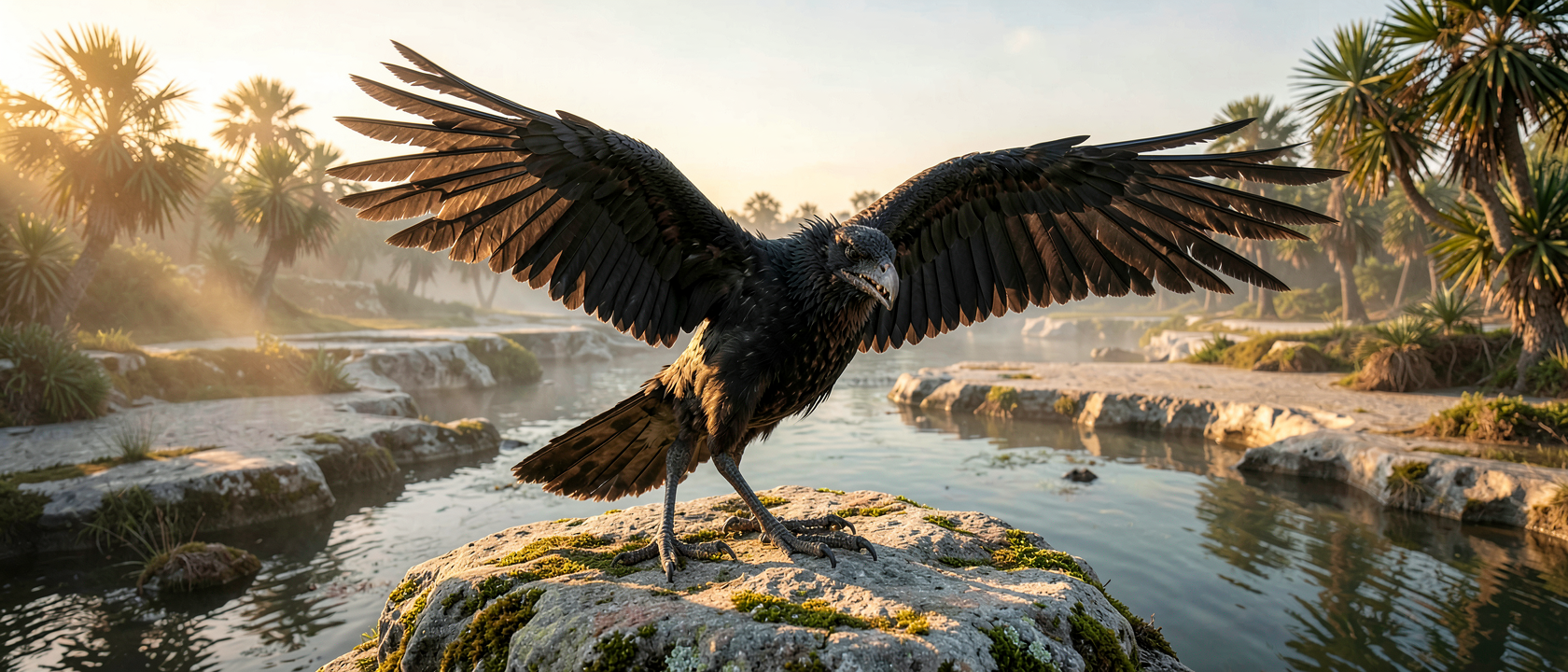
The Dinosaur With a Dragon’s Mouth
A 150-million-year-old Archaeopteryx fossil just revealed something no specimen of its kind has shown before: the soft-tissue outline of tooth-like bumps lining the roof of its mouth, a tiny bone that points to a flexible tongue, and a cluster of unusually nerve-dense openings near the tip of its jaw. Jingmai O’Connor of the Field Museum in Chicago and her colleagues describe all three in a study published February 2, 2026, in the journal The Innovation, working from the “Chicago Archaeopteryx,” a specimen first scientifically described in 2025.
Archaeopteryx itself is the animal most people half-remember from a textbook: a Late Jurassic dinosaur from the Solnhofen Limestone of southern Germany, roughly the size of a Eurasian magpie, with the largest individuals possibly reaching raven size. It carried flight feathers and a wishbone on a body that still kept sharp teeth, three clawed fingers, and a long bony tail, with a toothed jaw rather than a true beak. The mouth parts in the new paper aren’t flight equipment. They’re feeding equipment, and they’re the oldest of their kind ever recovered.
What a Mouth Like That Is For
Each structure has a job, and researchers know the jobs because living birds still use versions of this kit. Oral papillae, the tooth-like bumps on the roof of the mouth, work like built-in grip studs: they steer slippery, struggling prey backward down the throat instead of letting it slide out sideways. A mobile tongue changes the whole feeding strategy, letting an animal reach into its own mouth and reposition food instead of just swallowing whatever landed in the jaw. The nerve-rich openings at the jaw tip are proposed as an early version of what’s called a bill-tip organ in modern birds, a sensory structure that works something like fingertips, feeling out food before committing to a bite.
The study’s case rests on absence as much as presence. These features turn up in nonflying dinosaurs not at all, and in living birds constantly. Archaeopteryx, on the evidence of this one specimen, had a working version of all three.
A Mouth Built to Pay for Flight
O’Connor’s team frames this as an economics problem before it’s a biology one. Powered flight is expensive, even the short, bursty flapping flight that a 2018 study concluded was likely all Archaeopteryx could manage, moving the way modern pheasants do when they break cover. An animal paying that metabolic bill needs calories in fast, and reliably. Better grip at the back of the mouth, better reach from the tongue, sharper sensory feedback at the front: all three could add up to faster, more dependable feeding.
The claim isn’t that a better mouth caused flight. It’s that upgrading the feeding apparatus may have evolved in step with the earliest attempts at getting airborne, two systems advancing on the same timeline because one was quietly funding the other.
One Dissenting Vote
Christian Foth, a paleontologist at the Museum für Naturkunde in Berlin who wasn’t involved in the study, isn’t convinced. He questions comparing these openings directly to the bill-tip organs of modern birds, and he doubts the flight-funded-the-mouth story specifically: how many calories an animal actually has available for flight, he points out, depends heavily on what it ate and how it digested that food, and neither one is something a 150-million-year-old fossil can show. His alternative reading is plainer. These structures might simply have helped Archaeopteryx hold onto something ordinary and slippery, a dragonfly, say, with no connection to flight required at all.
There’s a second limit worth sitting with. This is one specimen. Whether other Archaeopteryx fossils, or other early bird-like dinosaurs, show the same pattern hasn’t been checked yet. One data point is a lead, not a trend.
Not Your Ancestor, Not the First Bird
Archaeopteryx gets cast in two roles it probably never played: the direct ancestor of modern birds, and the very first bird that ever existed, the “missing link” version most people learned in school. O’Connor is blunt that both are likely wrong. It probably isn’t a direct ancestor of anything alive today, and on the current record it probably wasn’t even the earliest bird, just one of the oldest fossils that fits a broad, working definition of the word. Being a bird, in that sense, is a category it qualifies for. Being everyone’s great-great-grandparent is not a title the evidence supports.
None of this would have surfaced without ordinary persistence. O’Connor’s team spent over a year preparing and examining the Field Museum’s specimen after it arrived in 2022. In a Field Museum statement, O’Connor credited the discovery to the meticulous work of the fossil’s preparators. A 150-million-year-old mouth had been sitting there the whole time; someone just had to look closely enough to find it still had something to say.