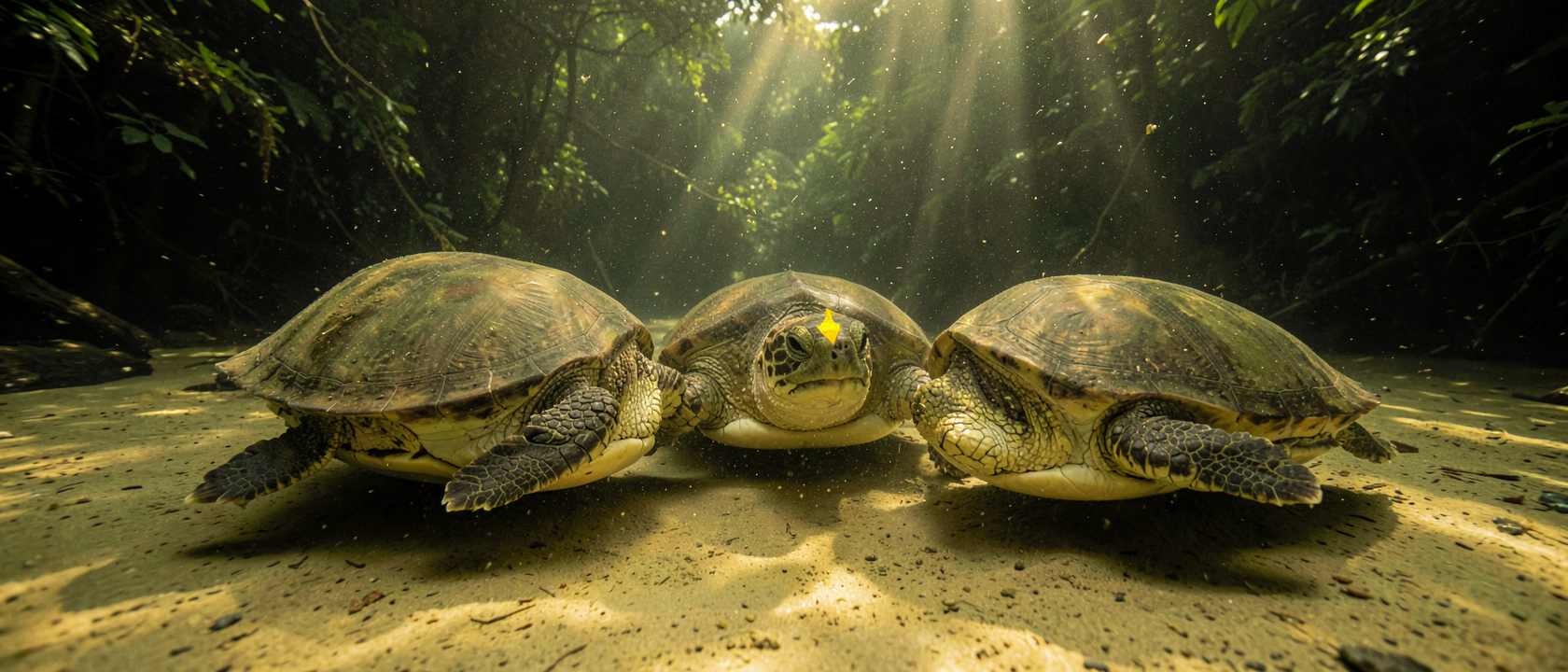
They Weren’t Just Sharing a Rock
Nineteen juvenile hicatees, the Central American river turtle, Dermatemys mawii, were fitted with sonic transmitters and tracked daily by canoe through a stretch of Belizean river. The animals moved in groups; in some cases, one turtle never strayed more than about 3 feet (1 m) from its nearest neighbor. The study site had been deliberately chosen for the absence of food patches and basking aggregations. What Don McKnight (La Trobe University / Turtle Ecology Lab, Belize), Jaren Serano (University of Florida), Denise M. Thompson, and Day Ligon (Missouri State University) published in Animal Behaviour in 2023 was a turtle herd.
The hicatee had always been classified as solitary, a classification that rested on assumption, not on any study that had asked the question directly.
The Simulation That Ended the Argument
The obvious objection is that turtles cluster because rivers cluster them: a warm eddy, submerged logs, a productive feeding patch. McKnight and colleagues designed around this. The site was verified via plant surveys, SCUBA diving surveys, and side-scan sonar to contain no logs, rocks, or significant vegetation. Environmental attractants were removed before tracking began.
The team then built a null model simulating purely random Dermatemys mawii movement through the same stretch. In every single iteration, the simulated turtles ended up farther apart than the real animals were. The real hicatees were consistently closer together than chance could explain, in a habitat where nothing was pulling them there. The grouping was deliberate.
The Crocodile in the Room
Crocodilians share the Belizean rivers where Dermatemys mawii lives. McKnight and co-authors propose the herding behavior evolved as a defense against exactly this predator: a group moving in tight formation is harder to isolate and pick off than a single animal. This is hypothesis-grade, not confirmed by controlled experiment, but the logic runs through schooling fish and flocking starlings, dilute the predator’s attention, reduce each individual’s odds of being the one caught.
The inversion is this: the same behavior that once distributed predation risk now concentrates the animals for the one predator the instinct never evolved to handle. A separate study by Serano and Ligon, also conducted in Belize, recorded that between 10.5 and 21.1 percent of tagged hicatees were poached over a five-month period, a rate the authors described as unsustainable. Poachers working the same rivers have told researchers they can catch dozens of hicatees in a single night, a number that, as McKnight put it, was really difficult to understand before the herding findings. Set a trammel net across a herd and, the implication runs, you catch the herd.
Dermatemys mawii is Critically Endangered on the IUCN Red List and the only living member of its family, Dermatemydidae. The IUCN estimated in 2016, based on a conservative 5 percent annual harvest rate and a minimum ten-year generation time, that the species could lose 81.5 percent of its population within three generations. Belize is its last stronghold; populations in Mexico and Guatemala have largely collapsed.
“They’re Just All Enjoying the Same Warm Rock”
Resource-based aggregation, turtles ending up near each other because they want the same habitat patch, not each other, has been the field’s default explanation for apparent turtle groupings. It requires no social cognition, no coordination, and no revision of the ectotherm-as-loner model that has dominated cold-blooded vertebrate research for decades. It also depends on environmental attractants being present. McKnight et al. (2023) removed them, and the grouping persisted. When the simulation tested whether random movement could reproduce the observed inter-individual distances, it could not, not in a single run.
McKnight’s Whale Moment
On one survey session, McKnight and Serano found a crocodile swimming alongside their canoe; on another, a rainstorm forced them to bail water mid-survey while continuing to log positions. Somewhere in that context, watching heavily built reptiles move through murky water in tight formation, McKnight described the experience as feeling like watching a pod of whales. That is not a scientific claim, it is what a trained zoologist said when the behavior had no turtle precedent to land on. The hicatee weighs up to about 48 pounds (22 kg), reaches a shell length of up to roughly 26 inches (65 cm), and is almost entirely aquatic. Not a whale. But moving like one, and moving together.
One Species, or the Start of Something
Three things remain unresolved. The function of group movement is hypothesized but unconfirmed: predator dilution is the leading candidate. No reliable population estimate exists for Dermatemys mawii across its range. And J. Sean Doody (University of South Florida) has reported observing similar group-movement behavior in the New Guinea snapping turtle (Elseya sp.) in tropical Australia, but those observations have not yet been scientifically published and cannot yet be treated as evidence.
If Doody’s observations hold once documented, the hicatee would shift from an isolated anomaly to the first published case in a pattern that ectotherm research has not been structured to find. McKnight notes that cold-blooded vertebrates have been substantially understudied for social behavior compared to birds and mammals, and that documented cases are likely a fraction of what actually occurs.