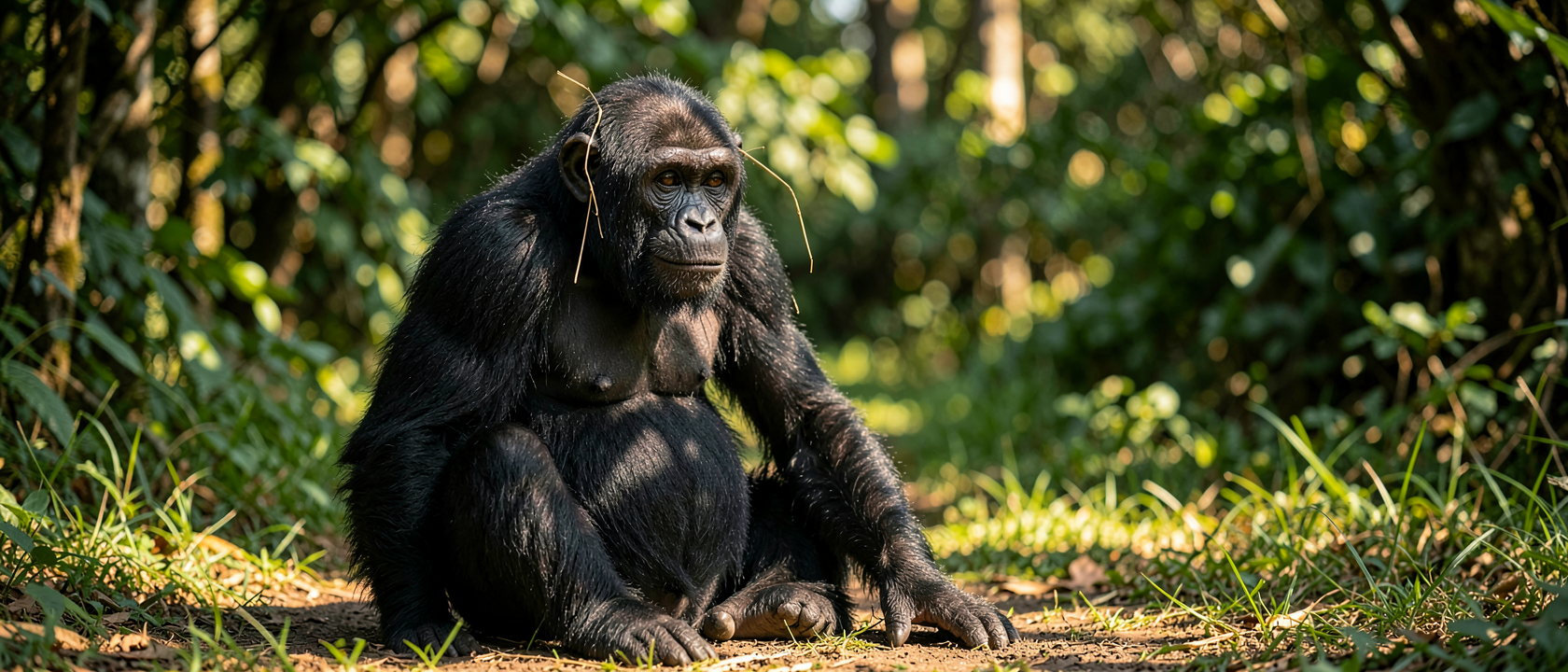
She Tucked Grass in Her Ear for No Reason. Her Friends Copied Her. She Died. They Kept Doing It.
In 2010, a female chimpanzee named Julie at Zambia’s Chimfunshi Wildlife Orphanage Trust inserted a stiff blade of grass into her ear and left it hanging there. No purpose announced itself. Seven group-mates gradually took up the same habit. Then Julie died, and her group kept going, a look without its originator, held in place by social inertia alone.
On August 16, 2023, a male chimpanzee named Juma in a completely separate group at the same sanctuary, with no contact whatsoever between groups, started doing exactly the same thing. Within a week, four more individuals had copied him. On August 27, 2023, Juma extended the look: he inserted a blade of grass into his rectum and left that hanging too. On the same day, a second individual named Commando followed suit. Three further females, Aimi, Congo, and Victoria, joined on August 31, 2023, bringing the total of grass-in-rectum adopters to five by that date. Ultimately, six of the eight chimpanzees in the group would adopt that behavior; five of the eight adopted the original grass-in-ear habit.
Edwin van Leeuwen (Utrecht University), Jake Brooker (Durham University), and colleagues published these findings in the journal Behaviour on July 4, 2025. Using Network-Based Diffusion Analysis (NBDA), a statistical method that tests whether the sequence in which individuals acquire a behavior matches their social-network ties, the researchers found 99% support for social transmission in both cases. Over 80% of adopters acquired each behavior through copying rather than independent invention. Neither behavior appeared in any of the 136 chimpanzees across seven other groups at Chimfunshi during roughly 1,100 hours of observation between May 2023 and October 2024.
The Caretakers Did It First
Both groups that developed the grass habit shared something the other seven groups did not: their human caretakers. Those caretakers reported occasionally tucking a blade of grass or a matchstick into their own ears while working, a personal cleaning habit, not a demonstration directed at any chimpanzee. The caretakers of every other group at Chimfunshi said they did not do this. Those groups showed no grass-in-ear behavior.
The mechanism van Leeuwen and Brooker propose is straightforward: the chimpanzees observed their caretakers performing an action involving a small object and an ear, then reproduced it on themselves. The second group then extended the action to a body location the caretakers never used. Once the behavior was in the group, NBDA shows, it spread through social ties rather than by independent reinvention. One immigrant, Aimée-Love, integrated into the focal group in December 2023 and had adopted grass-in-ear behavior by April 2024.
Sanctuary Life Clears the Mental Calendar
Wild common chimpanzees (Pan troglodytes) spend most of their waking hours foraging, monitoring territory, and tracking social maneuvering. Van Leeuwen and colleagues argue in the paper that this constant overhead is precisely why non-instrumental fads have never been recorded in unprovisioned wild populations. Chimfunshi residents are fed, enclosed, and socially stable. The researchers propose that reduced time pressure frees up the cognitive bandwidth required to acquire and maintain habits that do nothing functionally useful.
They push past the “bored chimps with spare time” reading, though. They propose that copying another group-member’s arbitrary habit may actively serve the group: signaling attentiveness, reinforcing affiliation, and marking belonging. Van Leeuwen and Brooker explicitly compare this to the social function of fashion in human communities, not as a loose metaphor but as a genuine parallel mechanism, where a behaviorally useless act earns its keep through social work. This remains a hypothesis, not an empirically demonstrated result, but it is the researchers’ own.
Copying Useless Details Was Supposed to Be Our Thing
A durable assumption in cultural evolution held that humans were unique in copying small, arbitrary, non-instrumental details, the exact grip, the unnecessary flourish, the purely decorative accessory. Other animals were thought to copy outcomes or broad techniques. This high-fidelity copying of pointless specifics was treated as one of the engines of human cultural complexity.
The Chimfunshi findings directly contradict that assumption. Van Leeuwen et al.’s 2025 study in Behaviour (DOI 10.1163/1568539X-bja10313) demonstrates through NBDA that sanctuary-held common chimpanzees copy non-instrumental behaviors with high fidelity and that those behaviors persist after their originators die. Jake Brooker stated in the Durham University press release that these findings challenge the claim that only humans copy arbitrary, non-functional details. The grass habit persisted not because it worked, but because others had done it. That is the logic of ritual and of fashion, apparently, as of July 2025, also the logic of at least some chimpanzees.
Two Open Questions
NBDA confirms that social transmission happened, but does not specify how. True imitation, reproducing the observed action itself, is one possibility; stimulus enhancement is another, where the caretaker’s habit simply directed attention toward ears as an interesting location. These are meaningfully different cognitive processes, and the data do not resolve the distinction.
The second question is harder: out of everything caretakers did while working, it was specifically the grass-in-ear action that caught on, in both groups, independently. Van Leeuwen has acknowledged this is unexplained by the data. What originally prompted Julie to begin in 2010 is also unresolved, and no caretaker-copying link has been formally established in the published record for that earlier case.
The Salmon Hat Precedent (A Story, Not a Data Point)
Orcas (Orcinus orca) were previously reported carrying dead salmon balanced on their heads, a behavior that spread through a group. No peer-reviewed citation and no confirmed date exist for that case. It is presented here as exactly what it is: a vivid precursor story that rhymes with the chimpanzee findings without constituting parallel evidence for them. An anecdote about orcas wearing fish hats does not make the NBDA numbers in Behaviour any stronger or weaker. It does suggest that when non-human animals start accessorizing, the story tends to travel.