
The worms that ate dinosaur-era sea monsters
A graveyard full of tiny tunnels
More than 130 fossil bones and teeth, examined one by one, turned out to be riddled with tunnels: three plesiosaurs, two mosasaurs, one ichthyosaur, plus ancient whales and turtles. That survey, led by PhD student Sarah Jamison-Todd and published in the journal PLOS One in 2025, named seven new ichnospecies, a term for categories built from the shape of a trace an animal left behind, not from the animal’s own body. Two of them are Osspecus arboreum, whose burrow branches out like a tree, and Osspecus morsus, named from the Latin for “bite” because it mostly turns up inside fossil teeth. The ichthyosaur find is itself a first: no one had documented this kind of boring in an ichthyosaur skeleton before. None of these are new animals in the usual sense. They’re new tunnels, which is a strange thing to get excited about until you realize what was digging them.
A worm with no mouth, eating bone from the inside
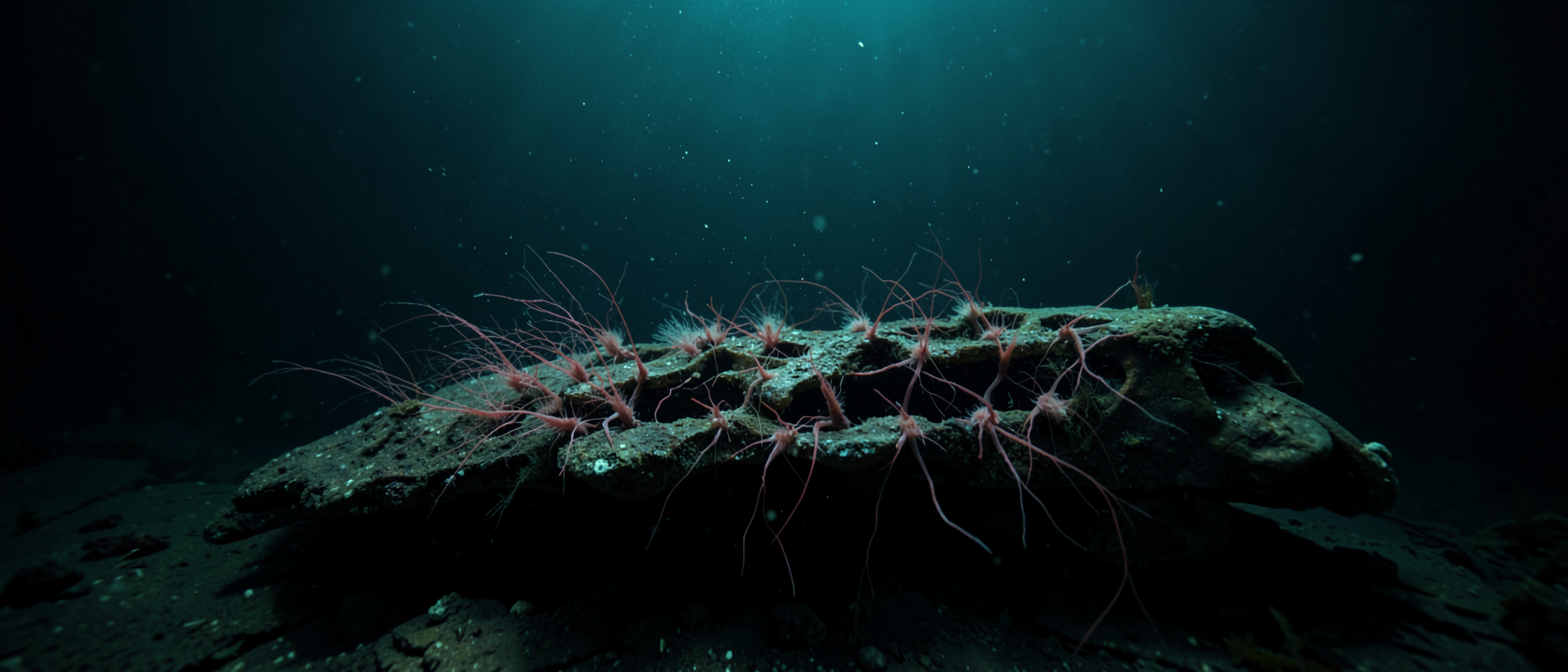
The tunnel-makers’ modern relatives are Osedax, bone-eating worms first described in 2002 and known since as “zombie worms.” They have no mouth, no stomach, no anus; there is nothing to bite with and nowhere for waste to go. A female anchors herself in bone using a branching, root-like structure, and inside that root she hosts symbiotic bacteria that dissolve the bone’s minerals chemically. The worm absorbs the released fats and proteins straight through the root tissue. To confirm the ancient tunnels were made by something digging in, rather than ordinary cracking or weathering, Jamison-Todd’s team CT-scanned the best fossils and built 3D reconstructions of the bone interiors, tracing each burrow’s shape and branching pattern from the inside out. They also used calcareous nannofossils, microscopic fossils preserved in the chalk itself, to pin some of the bones to precise windows of Cretaceous time. The result is a worm that gets by without two organs almost every other animal needs to survive: a working gut, and a mouth to feed it.
The ocean’s bone-cleanup crew has been working since the dinosaurs
When a large marine animal dies and sinks, the flesh disappears fast, handled by fish and scavengers. What’s left is bone, and bone is not nutritionally empty: fat and protein are still locked inside the marrow and the collagen. Something has to break that down too, or it just sits on the seafloor indefinitely. The burrow record shows specialized bone-eaters were already doing that job on mosasaur, ichthyosaur, and plesiosaur carcasses tens of millions of years before whales existed to supply the next course. The earliest documented burrow in a fossil whale skeleton dates to the late Eocene, long after these reptile boreholes were already an established pattern. Whales didn’t create a niche for bone-eating worms. They swam into one that had already been running since the age of marine reptiles, and became its biggest, latest customer.
No, this isn’t a “whale fall” story
The tidy version of the Osedax story treats them as a whale-fall specialist, a worm that evolved specifically to exploit the jackpot of a whale carcass hitting the seabed. The burrow record kills that timeline outright. These traces span roughly the last 100 million years, which means something was already boring into mosasaur, ichthyosaur, and plesiosaur bone long before the first whale ever swam. Whales were never the origin of this feeding strategy; they simply arrived into a system that had already been running for tens of millions of years.
Nobody has ever caught one in the act
Every trace in this study is a tunnel, never a body. Soft worm tissue doesn’t fossilize, so no one has recovered the actual animal that made any of these burrows, only the shape it left. That leaves a real gap: researchers can’t say which species, or even which genus, is responsible for a given Cretaceous borehole. And not every bone that looks bored actually was; some marks that resemble a worm’s tunnel could just as easily be weathering or the work of a different animal entirely, which is why the team leaned so heavily on CT scans rather than eyeballing the fossils. It gets more tangled, too. One of the newly defined burrow shapes turns up on fossils from both sides of the Atlantic Ocean basin, and the living species Osedax antarcticus produces borings that match that same ichnospecies. That could mean a single lineage has been doing this, largely unchanged, for 100 million years. It could just as easily mean two unrelated worms arrived at the identical bone-eating architecture independently. Jamison-Todd’s team can’t yet tell those apart, and this survey is described as a first pass. Plenty of fossil and modern burrow shapes almost certainly remain unnamed, waiting in collections that haven’t been CT-scanned yet.