
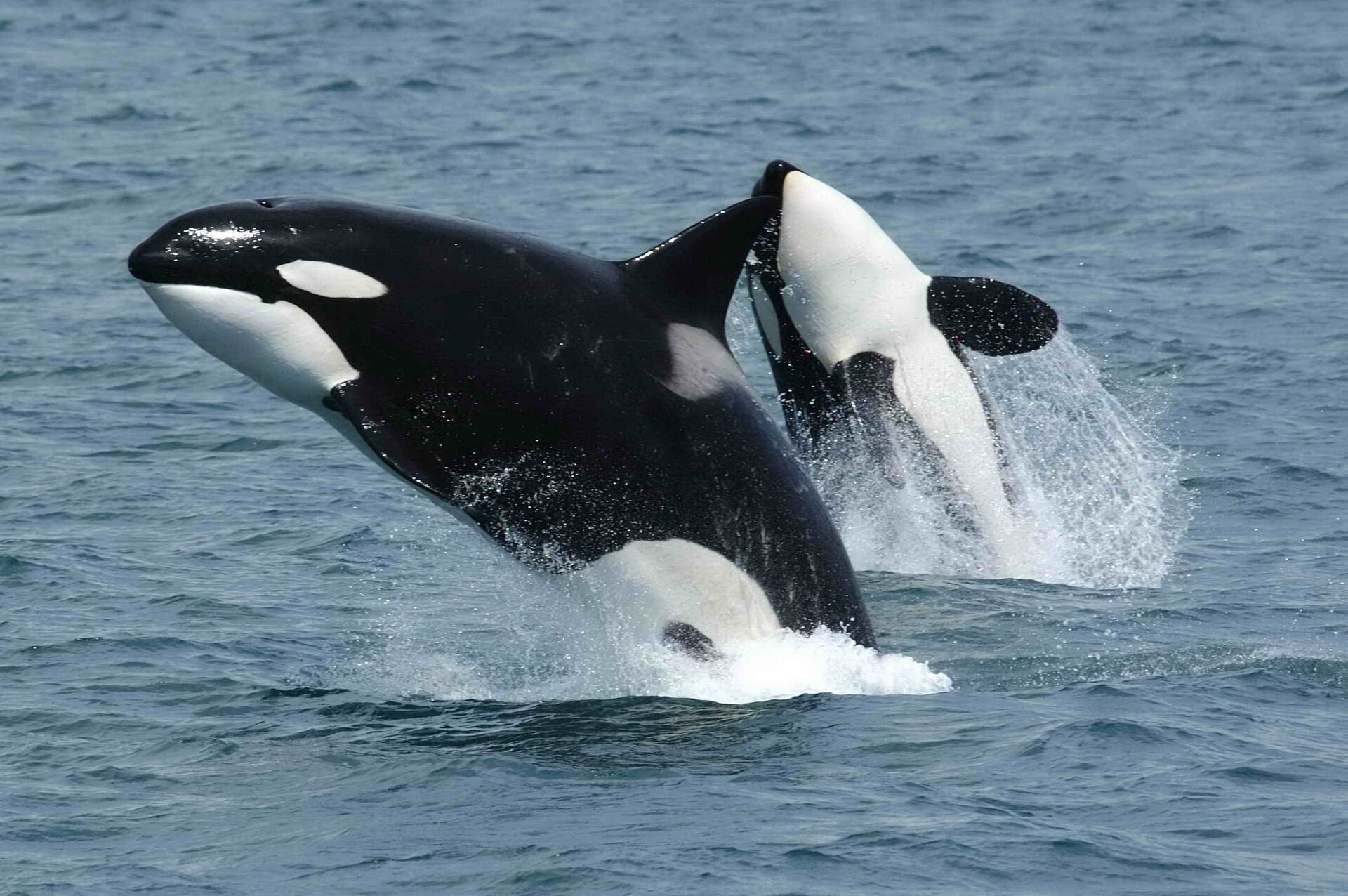
Adult males reach up to 10 m in length and 10,000 kg. The species is first known from Carl Linnaeus’s 1758 description in the 10th edition of Systema Naturae, where he named it Delphinus orca and placed its type locality in the European Ocean (Atlantic). Despite global distribution and unmistakable coloration, the IUCN’s 2017 global assessment classifies Orcinus orca as Data Deficient, meaning the overall extinction risk cannot yet be resolved — a situation driven partly by how sharply distinct populations behave like separate ecological entities.
Key facts
- Scientific name: Orcinus orca
- Kingdom: Animalia
- Phylum: Chordata
- Class: Mammalia
- Order: Cetacea
- Family: Delphinidae
- Genus: Orcinus
- Taxonomic rank: species
- Gestation period: 502.2 days
- Habitat: World Ocean
- Main food: European pilchard; Manta raya; Grey Seal; California sea lion
Physical description
Adult males and females differ substantially in size. Males reach up to 10 m and 10,000 kg; females reach up to 8 m and 7,500 kg. The dorsal fin mirrors the gap: in adult males it stands up to 2 m tall and is straight, while females and immature males carry falcate (curved) fins reaching about 1 m.
The coloration is sharply contrasted. The dorsal surface is black with a grey or white saddle patch behind the dorsal fin; the underside and lower jaw are white. Each eye is framed by an oval white eyespot. Calves are born with yellowish or orange tints on their white patches, which fade to white as they age.
Distribution and habitat
Killer whales have been recorded across all oceans of the world, from Arctic pack ice in the north to Antarctic waters in the south, and occupy both coastal and open-ocean habitats. Their preferred depth range is 20 to 60 m, but they enter shallow coastal waters and dive to 300 m when prey demands it.
The breadth of that range is illustrated by one satellite-tracked Antarctic type B individual that completed a non-stop round trip of almost 9,400 km to subtropical waters off Uruguay and Brazil in 42 days, passing through sea surface temperatures from -1.9°C to 24.2°C.
Ecotypes and diet
Three main ecotypes are recognized in the North Pacific: resident, transient (also called Bigg’s), and offshore. Residents specialize in fish; transients hunt marine mammals; the diet and habits of the offshore ecotype are less fully characterized. The three ecotypes differ in diet, vocal behavior, social structure, and genetics, and rarely interbreed even when sharing the same waters.
Diet documented across the species includes European pilchard, manta ray, grey seal, and California sea lion. Norwegian populations have been observed using a technique called carousel feeding: they surround herring into tight bait-balls by flashing their white patches, then stun individual fish with tail slaps before consuming them.
Reproduction and life history
Gestation lasts 502.2 days. Females reach sexual maturity between 7 and 16 years old; males reach maturity between 10 and 17.5 years old but typically do not reproduce until around age 21. Females give birth to one calf every five years on average. Calf mortality is high, running from 37 to 50%. Weaning begins at about one year old and is complete by two years.
Female killer whales undergo menopause around age 40. They show the longest post-reproductive lifespan recorded in any non-human animal: some females live up to 90 years after ceasing reproduction in their 30s to 40s.
Taxonomy and genomics
Linnaeus placed the species in Delphinus in 1758; it was later moved to the monotypic genus Orcinus. The genus name draws from Orcus, the ancient Roman god of the underworld — a reflection of the species’ fearsome hunting reputation.
A chromosomal-level genome assembly published in October 2022 resolved the killer whale genome at 2.65 gigabases, scaffolded into 22 chromosomal pseudomolecules. The complete mitochondrial genome measures 16.4 kilobases.
Conservation status
The IUCN’s 2017 global assessment rates Orcinus orca as Data Deficient. The 2023 European regional assessment places the species at Least Concern within that region. These two assessments reflect how differently distinct populations fare.
The Southern Resident killer whales of the North Pacific illustrate the stakes. As of the 2020 summer census, only 72 individuals remained. The U.S. Endangered Species Act listed the Southern Resident population as Endangered in 2005. The three primary threats identified for this population are decreased prey quantity and quality (particularly declining Chinook salmon stocks), persistent organic pollutants, and disturbance from vessel noise and vessel presence.
Polychlorinated biphenyls (PCBs) represent a threat that extends beyond the Southern Residents. A scientific study modeled PCB-mediated effects on reproduction and immune function and found they threaten the long-term viability of more than 50% of the world’s killer whale populations, with populations near industrialized regions at particular risk of collapse over 100 years, despite a near-global ban on PCBs introduced more than 30 years prior. Some individuals now carry PCB concentrations 25 times higher than amounts shown to alter fertility. Mothers pass these compounds to calves during birth or through milk, placing the next generation at the highest toxicological risk within each pod.
Captivity and human safety
The claim that killer whales in the wild regularly attack humans is not supported by the incident record. The documented pattern runs in the opposite direction: between 1988 and 2009, SeaWorld generated 100 incident reports recording injuries to trainers from captive killer whales. A U.S. federal court found that close-contact work with captive orcas was a recognized hazard likely to cause death or serious harm. The confinement context, not an intrinsic aggression toward humans in open water, is where the injury record accumulates.
Did you know
- The genus name Orcinus derives from Orcus, the ancient Roman god of the underworld, reflecting the species’ fearsome hunting reputation. The Romans originally applied the word “orca” to these animals, possibly borrowing the term from the Greek word for whale. (marinebio.org)
- A satellite-tracked Antarctic type B killer whale completed a non-stop round trip of almost 9,400 km (5,075 nautical miles) to subtropical waters off Uruguay and Brazil in just 42 days, traveling through sea surface temperatures ranging from -1.9°C to 24.2°C. (ncbi.nlm.nih.gov)
- Some killer whales now carry PCB concentrations 25 times higher than amounts shown to alter fertility. Mothers pass these pollutants to their calves during birth or through breast milk, placing the next generation at the highest toxicological risk within the population. (nationalgeographic.com)
- Between 1988 and 2009, SeaWorld generated 100 incident reports documenting injuries to trainers from captive killer whales. A U.S. federal court found that close-contact work with captive orcas was a recognized hazard likely to cause death or serious harm. (greywolfexpeditions.com)
Data sources
- GBIF
- Wikidata
- mmru.ubc.ca
- killerwhalemuseum.com.au
- fws.gov
- animaldiversity.org
- discoverwildlife.com
- pbs.org
- naturetoday.com
- mammaldiversity.org
- fisheries.noaa.gov
- cms.int
- research-portal.st-andrews.ac.uk
- mmc.gov
- ncbi.nlm.nih.gov
Where it appears
- Wild orcas filmed “kissing,” tongue nibbling, for nearly two minutes October 29, 2026
Data updated: 2026-10-26