
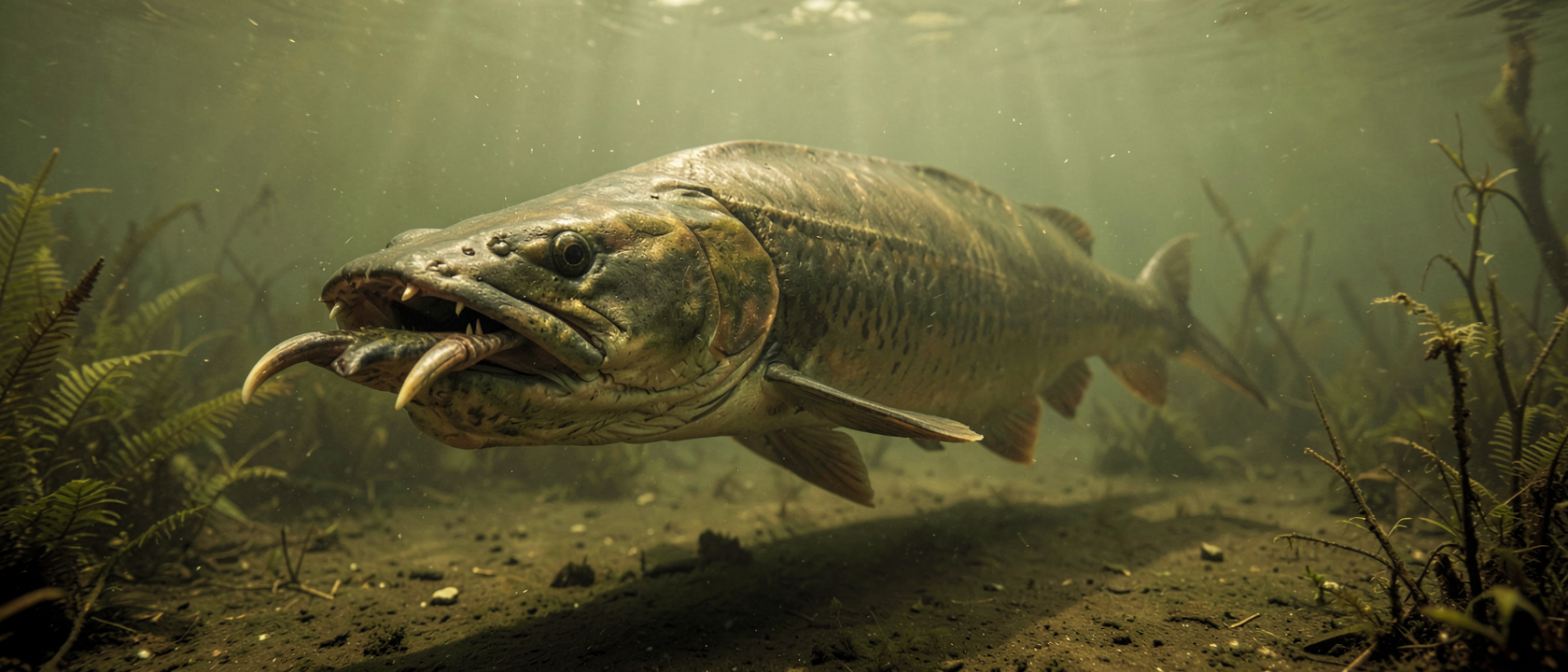
A jaw that bites twice
Picture a fossil jaw dredged out of a Nova Scotia creek bed, curved and bristling with teeth, and nothing else attached to it. That single bone is the entire known body of Sphyragnathus tyche, an extinct ray-finned fish that swam in an ancient inland lake roughly 350 million years ago. No skull, no fins, no spine ever turned up with it. Just the jaw, formally described in 2025 by Conrad D. Wilson, Chris F. Mansky and Jason S. Anderson in the Journal of Vertebrate Paleontology. From the proportions of that bone alone, the team estimates the whole animal stretched nearly 3.3 feet (1 meter), large enough to count among the bigger predators sharing that water. Lead author Conrad Wilson says the genus name translates roughly to “hammer jaw.” One piece of rock, properly read, is enough to build a scientific identity.
Where the real bite is
The front of the jaw looks almost ordinary: small, hooked teeth, the kind plenty of ancient fish used to snag something fast before it got away. The surprise is in the back. The largest teeth, fangs nearly 0.4 inches (1 centimeter) long, cluster toward the rear of the jaw rather than the front. Anderson’s team ran stress modeling on the bite, calculating how much force each tooth absorbed and how that force moved through the bone. The rear fangs handled it with low stress, the mechanical signature of a tool built to punch through flesh and move on, not to clamp down and hold prey still. Front teeth to trap, back teeth to pierce: two different jobs, one jaw.
The comparison that makes it a species
A strange-looking bone doesn’t automatically become a new species. It becomes one by failing to match anything already named, and that comparison is the real discovery here. Anderson’s team ran the same stress analysis on two known Devonian-period ray-finned fish, or actinopterygians, Austelliscus ferox and Tegeolepis clarki, both of which carried long jaws and prominent fangs of their own. In both of those fish, the back teeth turned the same bite forces into much higher stress, the signature of teeth built for gripping and holding rather than piercing. Sphyragnathus curves more sharply than either one, and its biggest fangs sit at the opposite end of the mouth, doing the opposite job. That contrast is what let the team name it as a new genus and species, and call it the earliest known actinopterygian built to pierce prey with its back teeth instead of gripping it with its front ones.
The extinction line that isn’t as clean as advertised
The end-Devonian extinction usually gets told as a hard reset: the old guard of ray-finned fish wiped out, a new cast moving in as the modern vertebrate world of cartilaginous fish, lobe-finned fish and ray-finned fish settled into dominance around 350 million years ago. The rock at Blue Beach complicates that story. Sphyragnathus and its neighbors there sit in layers laid down during the Tournaisian, an early Carboniferous interval, in the Horton Bluff Formation, after that extinction boundary. Yet the fish inside those layers still look Devonian: long jaws, heavy fangs, the build you’d expect to have already vanished. Some of these older lineages didn’t go extinct on schedule. They carried on into the Carboniferous, past the line the textbooks usually draw.
What one jaw will never answer
Paleontologists studying this period argue over what came first as ray-finned fish diversified into the modern world: new ways of feeding, or new ways of swimming. It’s an open question, and this fossil can’t settle it either way. Its jaw supports the feeding-first side of the debate, since it shows a feeding specialization already locked in at this early date. Nobody can test the swimming side, though, because nobody has the rest of the animal. There’s no body, no fins, nothing to show how fast it moved or how it was built to chase anything down. Scientifically, Sphyragnathus tyche exists only from the mouth back, and that’s the whole, honest shape of what this discovery can claim.
Found because someone had a hunch
None of this began with a grid, a grant, or a planned excavation. In 2015, Sonja Wood, who owns the Blue Beach Fossil Museum, and Chris Mansky, its curator, pulled the jaw out of a creek bed at Blue Beach on the Minas Basin, about 56 miles (90 km) north of Halifax, Nova Scotia, because Wood had a hunch about where to look. A decade later, researchers attached a species name to that single piece of rock: Sphyragnathus tyche, described by Wilson, Mansky and Anderson. Wilson told CBC, in an interview published June 20, 2025, that it would have been a fairly fearsome-looking fish, and that an open mouth would have shown off those back fangs right away. Nobody has ever seen the fish whole. They just know, now, exactly what its bite was built to do.