
A kitten, a case report, and twenty-four hours
In May 2024, two indoor-only house cats in separate Michigan households died of highly pathogenic avian influenza A(H5N1). The Centers for Disease Control and Prevention documented both cases in a Morbidity and Mortality Weekly Report published on February 20, 2025, in the middle of an outbreak that had already reached dairy cattle herds in Michigan and 16 other states.
The first cat, a 5-year-old indoor female, began showing symptoms on day two of her illness. She stopped eating, stopped grooming herself, and grew disoriented and lethargic. By day four she was seizing, losing her sight, and losing her balance. She was referred to the Michigan State University Veterinary Medical Center and euthanized. Samples sequenced at MSU’s Veterinary Diagnostic Laboratory, confirmed by the USDA’s National Veterinary Services Laboratories, came back as HPAI A(H5N1), clade 2.3.4.4b, genotype B3.13, the genetic lineage behind that spring’s dairy cattle outbreak.
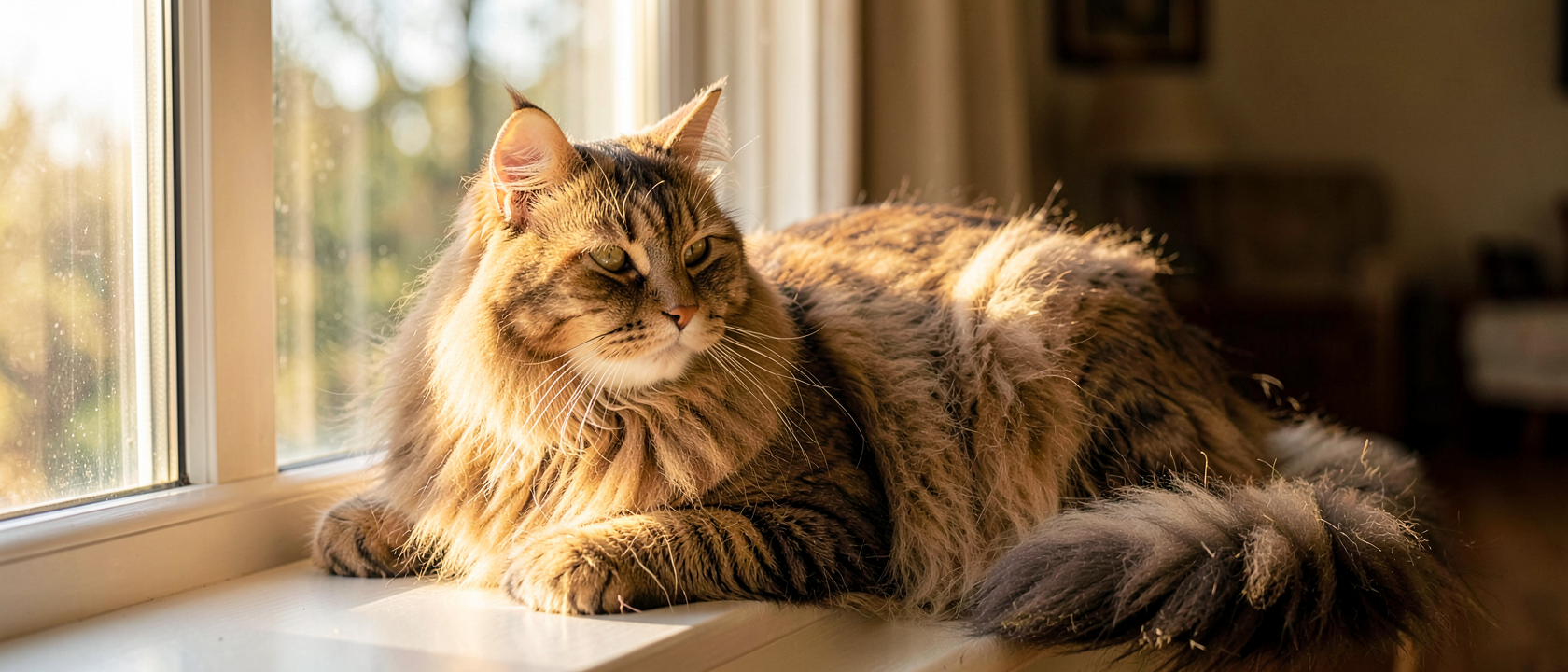
The second cat was a 6-month-old male Maine Coon: large-bodied, tufted-eared, the kind of cat people mistake for a Norwegian Forest Cat or a Siberian. He went from healthy to dead within about a day of his first symptoms, one of the fastest-documented courses of this disease in a cat. Anorexia, lethargy, facial swelling, a body too weak to move. Then nothing.
How a kitten might catch a cattle virus without ever meeting a cow
Neither cat went near a bird, dead or alive. Both households had something else in common: an adult who worked around infected dairy cattle.
The Maine Coon’s owner transported unpasteurized milk between multiple Michigan dairy farms, including farms with cattle already confirmed positive for H5N1. He wore no protective gear and reported being splashed with raw milk in the face and eyes. Two days before his cat got sick, he reported eye irritation of his own, though he declined testing. The kitten, by the household’s own account, regularly rolled in that worker’s clothing.
A second cat in the same house had no such habit and never got sick. Rolled in the clothes, didn’t roll in the clothes. It’s the closest thing this case has to a controlled experiment: same house, same virus somewhere in it, two cats, two different outcomes.
Unpasteurized milk is not an incidental detail here. H5N1 replicates to very high concentrations in the udder tissue and milk of infected dairy cattle, so raw milk can carry live virus much the way a bird carcass does. It simply does it without the feathers to warn anyone.
Why a cat’s whole personality is a liability here
Cats roll in things. They rub their faces along furniture, lick fabric, groom themselves for long stretches, and investigate anything new nose and mouth first. None of that is a quirk. It is most of what being a cat consists of.
In a household where H5N1 is present, that same behavior becomes a delivery system straight to the mucous membranes: the mouth, the nose, the eyes, exactly where a respiratory virus needs to land. Grooming evolved for hygiene and temperature regulation, nothing more exotic than that. In an outbreak, the same instinct becomes the exposure route instead, because a cat cannot tell the difference between its owner’s ordinary shirt and its owner’s shirt that happens to be carrying a live virus. That is the whole mechanism: a sense of smell with no concept of contamination behind it.
The poultry story was never the whole story
The standard assumption about cats and bird flu is that a cat gets it from a bird: a sick pigeon, a dead gull, raw poultry in a bowl. Neither Michigan cat ever touched one. One caught the virus, it seems, from something in its own household. The other’s household had unpasteurized milk moving through it.
That second detail kills a related myth. Whether raw milk looks or smells normal has nothing to do with whether it carries live virus. In this outbreak, unpasteurized milk from infected herds is treated by investigators as a documented exposure route, not a theoretical one.
The investigation that kept closing doors on itself
Here is what the report cannot settle, because nobody tested for it. The dairy worker connected to the first cat declined influenza testing; the three other people in his household tested negative. The milk-transport worker connected to the Maine Coon also declined testing, despite reporting eye irritation two days before his cat fell sick, a known mild symptom of human H5N1 infection, though unconfirmed in his case. Neither man’s illness, if it was one, was ever confirmed as bird flu or ruled out as something else.
Dr. Diego Diel of Cornell University’s College of Veterinary Medicine has said the report does not actually prove the virus passed from person to cat. The data describe a plausible chain, not a confirmed one, and nobody tested enough people to close that gap in either direction. How these two exclusively indoor cats got infected at all, by fomites on clothing, by direct contact, or by some other route, is a question the case report simply cannot answer.
The family that stopped answering the phone
In the first household, a second cat also got mildly sick around the same time: a little sneezy, watery-eyed, slightly off. The family had a simple explanation: allergies. They told investigators that and then stopped responding to follow-up contact.
Nobody accused them of hiding anything. It reads like an ordinary call made by people with an odd-acting cat and a reasonable guess about why. It is also the reason this thread of the case closes with a shrug instead of a lab result: one household, one cat, one plausible non-answer, and no way now to know which one it was.
Which is the real lesson here, more than any single transmission route. People who assume a sick cat with a cough just has allergies are making the same guess investigators couldn’t rule out. The owners who actually catch what’s happening are the ones who know a cat’s whole life is built around rubbing its face on everything it meets.